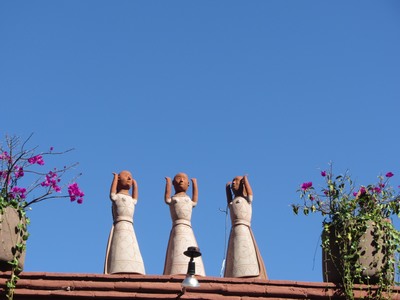
 Or is it Three Amigas or Pretty Maids all in a Row?
Hear no evil
2

Or is it Three Amigas or Pretty Maids all in a Row?
Currently I live on the top floor of a house, on a hill in Taxco. When I open my eyes in the morning I look over the top of the city and beyond to the mountains, where every morning the sun comes up to greet me.
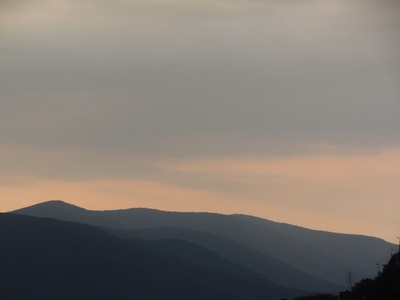
Since winter is the dry season in Mexico, that usually means the sky turns from deep indigo, to violet to shades of magenta, coral, pink and peach, in layers sort of like a sand sculpture or those gelatin cups they sell everywhere here (Mexicans love their gelatin).
Days are clear and bright with azure blue skies occasionally dotted with a few white puffy clouds.
Imagine my surprise and wonder when I opened my eyes and saw this.
He certainly knows how to paint a beautiful sky. I just love how the beauty changes minute by minute.
Took a little trip out to Irma’s ranchero (now belonging to her son, Fabian.) The house is situated on the side of the mountain about 20 minutes or so outside of Taxco. To quote The Who, “I can see for miles and miles and miles and miles.”
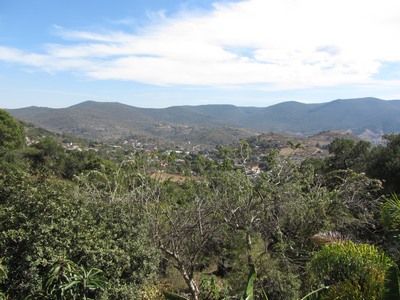
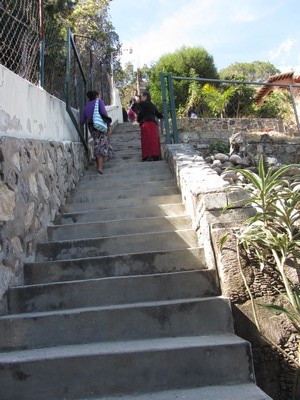 Below the house, by about 50 or so steps, is the Acamixla KH, which has a balcony that wraps around the side and back.
I was snapping some photos and admiring the view when I came around a corner and and there on the deck sat a big bunch of bananas ripening in the sun. 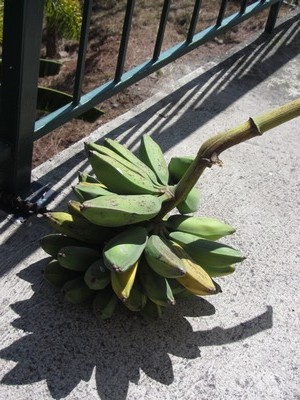
Looking around, I discovered the bananas must have come from one of several trees growing on the property..
Having only seen banana trees at botanical gardens, and then usually with a bunch of bananas high over head, I was amazed to see this “double-decker” banana flower up close.


You can clearly see the bunch of bananas at the top but look closer at what appears to be a relative of Audrey II, the man eating plant in “Little Shop of Horrors”, and you will see a banana flower just starting to open.
Look closer still and you will see the individual banana flowers under the larger open petal. As the larger flower bud opens, petal by petal, it exposes a ring of long, tubular yellow flowers with red tips. I am told that when these have had a chance to be pollinated, the covering leaves drop to the ground and a new set opens revealing another ring of sweet smelling golden blossoms. When the flower has opened completely, all that remains is a bunch of green bananas to grow and ripen – upside down of course. But you knew that didn’t you?
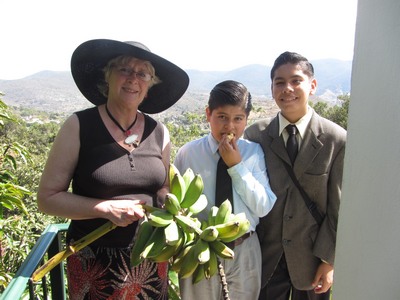 Banana anyone?
This gallery contains 124 photos.
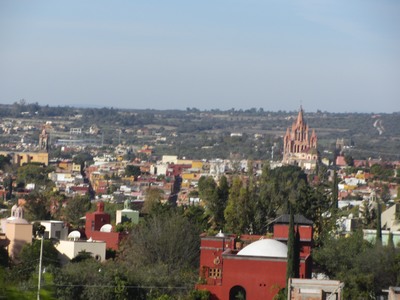
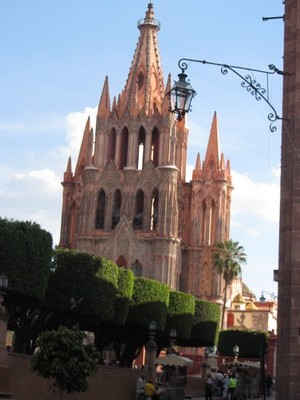 Voted “The Most Beautiful City in the World” by Conde Nast Traveler in 2013, San Miguel de Allende is a Spanish colonial town established in the mid-1500s. In the center is the typical town plaza, although here it is called “the Jardin” rather than a zocolo. Grand hacienda style casas ring the Jardin, now filled with restaurants, shops, and a museum dedicated to Ignacio Allende (considered the father of the Mexican revolution) and the history of the city, the founding families, and the revolution itself all facing (more or less) the Parroquia de San Miguel Arcangel, built in the 17th century. The facade was reconstructed in the 1800s by an indigenous brick layer and self-taught architect who drew his inspiration from lithographs of Gothic style churches from Europe. It is really a fanciful creation in multicolored stone that has become the symbol of San Miguel and one of the most photographed churches in Mexico.
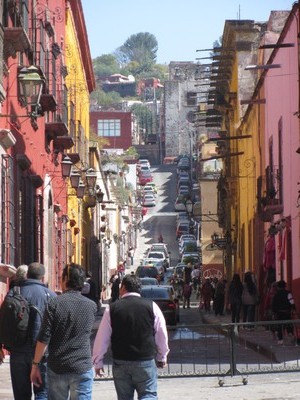 Being a Spanish colonial town, the cobblestone streets are laid out in a grid, allowing for some adjustment due to terrain. The houses are hacienda style which means they are walled all around, with large doors that open onto a courtyard. Though originally these walls would have been plain stucco, today they are painted golden yellow, brick, clay and other warm rustic colors. It is one of Mexico’s “Puebla Magicos” (magic cities) and as such rises to a higher level of beauty, cleanliness, and enjoyment that attracts tourists from all over Mexico and around the world.
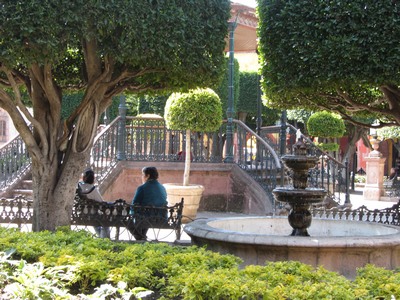 Many Americans and Canadians either live or winter here so English is widespread. It helps to have some knowledge of Spanish but you can get by without. There is always someone nearby to help you if need be.
There are many hotels here that would rival any hotel room in the States or you can choose, like I did, to go Mexican.
Thanks to some friends of a friend, I ended up in an old hacienda, complete with courtyard and very Mexican accommodations. This was good in that my rooms (it was a 2-story place) were quaint, tiled, and painted in the Mexican style (similar to rosemaling), centrally located, and an easy walk to almost everything. On the other hand, being that Mexican houses are all cement and tile, designed to keep you cool, and the night I arrived it was 36 degrees (yes that’s right – just above freezing) it was freezing inside. I had a fireplace to take the chill off the lower room, however the wood was more like kindling and there were no matches. There was a kitchen but the gas was not on, and again no matches. They did see fit to pile a few more blankets outside my door, so with those and moving upstairs to sleep I was fairly comfortable once I figured out how to capture the heat during the day.


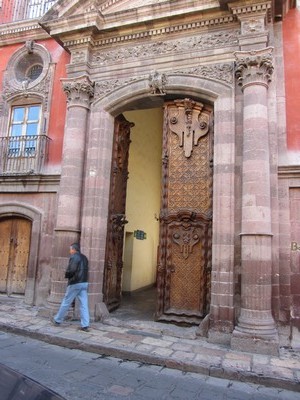 When you walk the streets of San Miguel, the walls are broken by huge doors, many centuries old, many newer and designed to look that way (it’s the law). Shops selling everything from handmade leather bags from Leon, to pottery from Puebla, to traditional embroidered clothing and more from Oaxaca, fill the individual spaces originally designed for this purpose or spill out into a courtyard lined with shops of many kinds.
The world famous San Miguel shoes designed by a little old lady and her cobbler husband to provide a stable, cushy, yet elegant way for women to navigate the cobblestone streets is here as well. Martha still holds court in the shop everyday dressed like something out of Anna Karenina — long coat, old fashioned hat, and these crazy shoes.
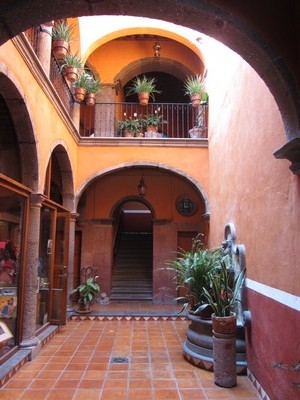 If you are fortunate, you might come across an open door to a courtyard of a private residence. Then you get a glimpse of a sunny garden around a central fountain, offset by old-world tile, ancient wooden doors, wrought iron railings and beautiful architectural details. You might also come across the Inquisitor’s House across the street from the torture chamber (in use for this purpose until the late 1800s), a restaurant where you can eat in the kitchen and many rooftop bars and restaurants with fabulous views of the city.
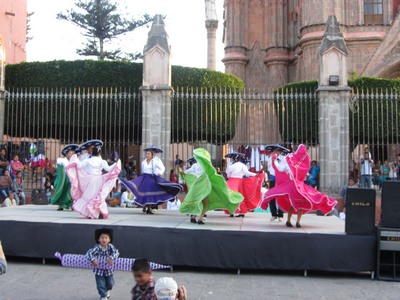
On weekends there is a party atmosphere between the Jardin and Parroquia with giant street puppets, singers, dancers and more. Every corner sports its own unique atmosphere from a mariachi band providing accompaniment for the shoe shine man’s wife’s singing, to the amateur opera singer serenading a table of friends, to the guy with the guitar and pan flute playing for change.
The atmosphere is very artsy, with two schools teaching painting, drawing, ceramics, fabric weaving, music, and more, and many artesaninas (artisans). The specialty of this town appears to be pewter — a good, non-breakable gift to take home.
San Miguel de Allende is truly a “magic city.”
Well both Jimmy and Phil are in agreement. Looks like 6 more weeks of cold and snow back home. I picked a good winter to be here rather than there.
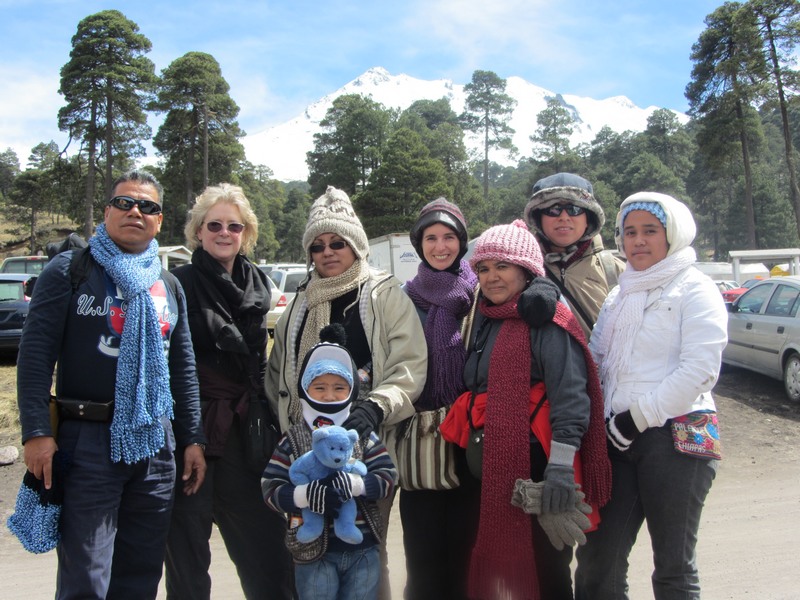 Unseasonably cold here too, (Yes, that is snow on the volcano, near Toluca) but that just means lows in the 40s or 50s (except San Miguel that got down to just above freezing). Being a Northerner, I just grab a sweater or wrap to ward off the late evening chill; if you are Mexican though, it is “Muy FRIO!!!! and you bundle up like an Eskimo.
And to think all this unseasonable cold is due to global warming! True! Believe it or not. According to the scientist who study these things, it is too warm to keep the polar vortex intact and so it split and is flying around the globe bringing the deep cold with it.
Thing is, no matter how you look at it, winter is half over, so instead of grumbling about the groundhogs’ predictions, do what the Mexicans do and CELEBRATE!
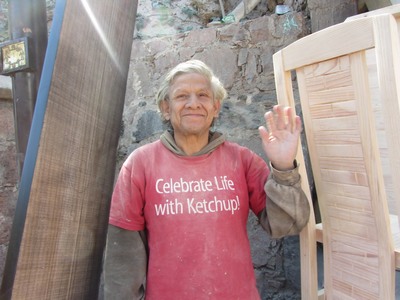 Mexicans love “American” clothing, whether they know what it says or not.
Men are more guilty of wearing the unknown than women. I spotted one man wearing a shirt declaring himself the “World’s Greatest Grandma” and another as as a member of the “Women’s Naked 5K Team.”
Instead of donating old clothes to Goodwill, perhaps I should bring a bunch down here. I could just layer them on, walk around town, and sell them to people on the street. “Hey buddy, want to buy a shirt?”
What do you think? Might just pay for my ticket that way.
The brass bands are playing again and the airworks (those fireworks with only the boom) are going off again, and the combis are filled with people carrying around a doll wrapped up and cradled like it’s a real baby. What’s going on?
All this is in preparation for the last hurrah of the holiday season — Día de la Candelaria.
Officially known as the Feast of Our Lady of Candelaria or Candlemas, February 2nd marks 40 days after Christmas and thus Catholics celebrate in memory of the presentation of Jesus at the temple in Jerusalem (Luke 2; 22-39 ) and purification of his mother, Mary, after childbirth (a requirement of the Law of the Old Testament – Lev 12; 1-8).
Like many Mexican celebrations though, this feast day represents a fusion of pre-Hispanic traditions and Catholic beliefs. It appears to have originated in Tenerife (Canary Islands), southwest of Spain, in the early 15th century and spread from there.
The celebration may actually be a vestige of an old Pagan tradition, since this date coincides with the eleventh day of the first month of the ancient Aztec calendar and the beginning of the agricultural cycle when offerings to the gods of rain and clouds (tlaloques) would have been made to assure a plentiful harvest. In many rural villages the inhabitants wear corn cobs to church to be blessed.
 In Mexico, Dia de la Candelaria is an extension of the Christmas holiday season. (And you wondered why the Christmas decorations were still up in all their bedraggled splendor…) On Christmas Eve a statue of the niño Dios (baby Jesus) is placed in the nativity scene; on January 6th, Three King’s Day, the child is brought presents from the magi or kings; and on February 2nd, the statue is dressed in fine clothes and presented and blessed in the church (be sure to check out the link above to see what these dolls look like) after which it is placed in a niche where it remains the rest of the year.

Rosca de Reyes
Similarly, Mexican children receive gifts on Christmas Eve (the babe’s birth day) and on January 6th (when it is thought that the kings or wise men would have visited the Christ child.) Then on February 2, the doll is taken to church and whomever found a toy baby in their Rosca de Reyes (wreath of the kings) bread on January 6th, hosts a Candlemas feast consisting of tamales and atole (a thick gruel drink).
 Both are predominantly made with corn; another link to Aztec ceremonies.
I find it interesting that February 2 also marks the mid-way point between the winter solstice and spring equinox which has long been thought to be a marker or predictor of the weather to come. In the US we call it Groundhog Day and according to tradition, if the ground hog sees his shadow, he goes back in his hole, representing 6 more weeks of winter; if not, spring is supposedly on its way. Often Punxsutawney Phil (Pennsylvania) and our own Wisconsin groundhog, Jimmy, will compare predictions and hopefully agree that the long, very cold winter will soon end.
Here are a couple of poems that show the connection between Candlemas and Groundhog Day.
From Scotland:
If Candle-mas Day is bright and clear,
There’ll be two winters in the year.
From England::
If Candle mas be fair and bright,
Winter has another flight.
If Candlemas brings clouds and rain,
Winter will not come again.

For a few laughs, watch your local channel (library or Netflix) for the Bill Murray movie Groundhog Day. What is your favorite scene?
 Picture perfect view. Sure beats dirty snow.
A different kind of eye candy. Abundant in Mexico, these beautiful flowers decorate many things, nothing more beautiful that this lighted cabinet though.
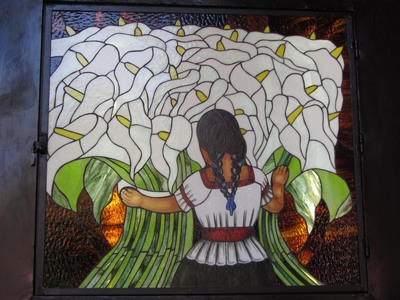 This artist is fantastic!!! If I had the funds and the location for it, I would take this home with me.
 The Adventures of Blue Bear