Agua Verde

If you want a refreshing, and cleansing, good for you drink, try this traditional Mexican “agua de fruta” (fruit water.)

Green Water (juice drink)

A big bunch of parsley, washed and chopped, discarding any long thick stems (about 2 cups)*
A large cucumber, peeled and cut into bite size chunks (about 2 cups)*
1\3 of a pineapple, peeled and cut into bite size chunks (about 2 cups)*
2 Tbsp lime juice (1 large or several small)
1 1\2 quarts cold water In a 1/2 gallon pitcher

In a blender blend the parsley with 1\2 quart water and add it to the rest of the water in a 1/2 gallon pitcher. Blend the cucumber with some of the parsley water in the pitcher, strain through a colander into the pitcher. Do the same with the pineapple. Squeeze the lime(s) and add to green water. Stir well and serve. If you prefer a little sweeter, add a little sugar or mix with lemonade instead of water.

Best fresh, but drink within 24 hours.

Actually you can follow this procedure for most any juice drink. Just blend the fruit down to pulp, strain, and add to water. Sweeten to taste. Good combinations are papaya, orange and lime, guava and lime, watermelon, cantaloupe and lime or your favorite combination. The idea is to add to water to make the juice go farther and make it more refreshing by reducing the sugar content (and calories.)

* Ingredients are not exact, start with approximately equal parts of parsley, cucumber and pineapple, then adjust to your taste.

Cheese, please

The word of the day is “queso.” Cheese in English.

In Mexico they only have a few kinds of cheese and except for queso Oaxaca (Mexican string cheese) they are all pretty much the same, only varying in ripeness (aging) and, thus, firmness and stronger flavor. The way I, a gringo, see it is that they have the kind that crumbles, the hard kind either grated or whole, and Oaxaca. Little do I know!

Once a week, a friend of mine who lives in Buena Vista, a small town near Taxco, comes to town bearing handmade cheese that everyone says is “the best.” I decided to get some for the house and was asked what kind I wanted. I knew I wanted Oaxaca (for quesadillas or just eating) and I wanted the kind that crumbles to put on tacos, tostadas, etc. so that is what I asked for.

My friend was apparently confused by my using the word crumbles (and I found out later, that he asked another American what I meant by that) and by text he replied, “Sorry I’m not sure which is the second one. What do you want to do with it? I know you want to eat it but how??”

I, thinking this is a simple request (after all, they only have 4 kinds of cheese), answered, “For tacos and such.”

Still confused about “what kind” of cheese I wanted, he told me he would send a message in Spanish and would I please show it to Irma and have her respond. But Irma, not having her “lentes” (glasses), could not read the message, so I handed my phone to her grandson to read and reply in Spanish.

Cheese stall at the mercado, Chilpancingo, MexicoA very lively conversation discussing cheese names ensued between them. I imagine, she just buys it, like I do, hard, soft or crumbly, from the cheese stalls in the “mercado” (market.) Finally, they settled on a couple kinds by name (manchego or criollo), then changed their minds and asked for cotija or criollo.

Thinking we had settled on the quantity and kind of cheese, I headed up to my room on the fourth floor. About the time I was taking off my shoes, I received another message. My friend wanted to know if they wanted “suave” (soft) or “seko” (hard) and told me that one kind came both ways and the other only came “seko.” So down the stairs I went to ask an “otro pregunta” (another question.)

Criollo seko being decided upon, my friend acknowledged the choice with a “Sorry now.”

This sent me into peals of laughter. He was not the one to take 20 minutes to figure out what kind of cheese we wanted, nor was it his confusion to be sorry for. After saying so, I replied facetiously, “You only have a few kinds of cheese, how hard can it be?”

To which he replied, “Just a little hard. Don’t worry,” which had me laughing even harder.

I explained that, “In Wisconsin, we have hundreds of kinds of cheese to choose from. This is too funny!”

“jaja” (ha ha),he replied.

To be fair, the Mexican food guru at Epicurious says there are seven kinds of Mexican cheese. The kinds I know are:

Queso Fresco (Fresh cheese): Aged only a few days, it is soft and crumbly and can be used like feta. (I think this may be the kind I was thinking of.) I have since learned that cheese here is made from raw milk and because this cheese is not aged very long, it can possibly carry a bacteria that can make you sick. You should definitely cook it.

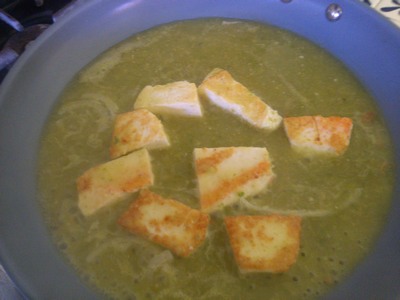
Chili con QuesoQueso Cotija: A hard cheese that is sold in rounds or grated from large blocks. The unique thing about this cheese is that it does not melt, it only softens, making it perfect for Chile con Queso – where you brown the cheese on a griddle, then serve it in chile verde sauce like soup. Yummy. The browned cheese is delicious all by itself too.
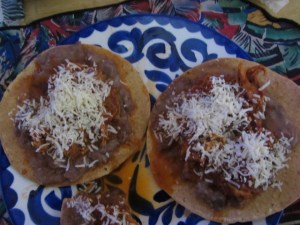
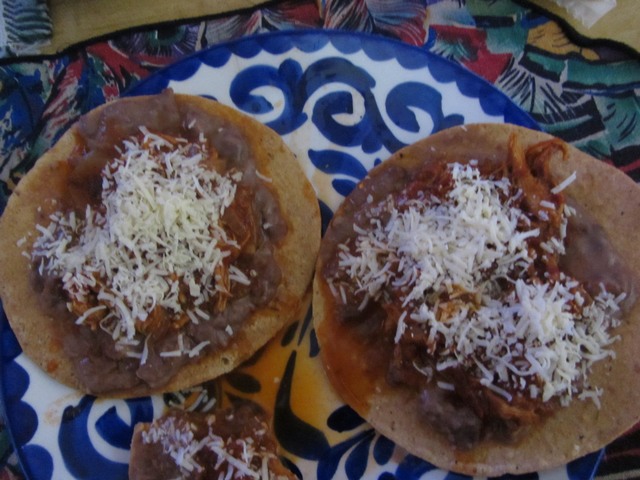
Tinga tosadas, Taxco, Mexico


Queso Criollo: Is a local cheese made only here in the state of Guerrero. It appears, by its use, to be similar in nature to Cotija. Better to crumble this kind than Fresco.
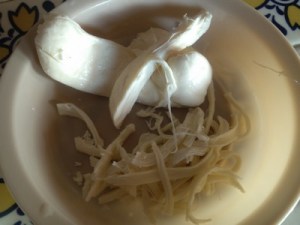
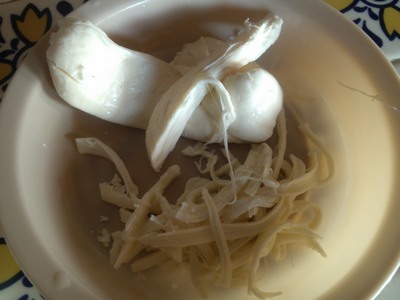
Queso Oaxaca, Mexico


Queso de Oaxaca:
My favorite, because we have nothing like it in the States, comes in broad strands that resemble string cheese, only softer. It’s unique texture comes from stretching the cheese as it is made. Pull it apart and put it on beans, tostadas, or soups, or because it melts wonderfully, in quesadillas. I will often buy a few pesos worth for an easy snack on the go.

Tostadas with crema, Taxco, MexicoAnd then of course there is that other dairy product — crema, a thick fresh or slightly sour cream (like the French creme fraiche) that is dolloped on tacos, tostadas, and in soups.


For a description of other Mexican cheeses and some delicious sounding recipes, see the Mexican cheese article in Epicurious.

Securidad

If you have been watching the news, you know that Guerrero state has been in a state of chaos recently. Some students, protesting the inequalities of the government’s placement of teachers (urban students favored over rural) were rounded up by police and disappeared. It is assumed that the then mayor of Iguala and his wife, who has connections to a drug cartel, ordered the police to transfer the students to the cartel inferring that some of the students had rival gang connections.
Well you can just imagine what happened.

The students are missing and presumed dead.

All over Mexico, and the world, people have protested these barbaric actions. Unrest is high and tempers are short.

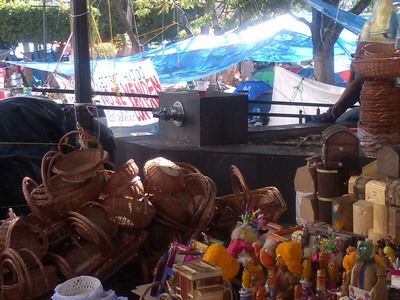
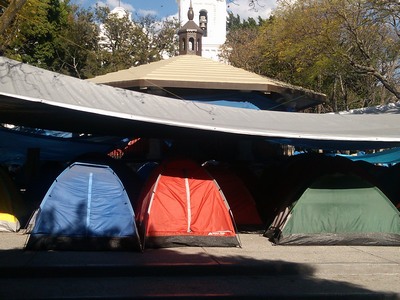
Protesters, tent city, Chilpancingo, MexicoProtesters have built a tent city, on the zocolo, in the middle of the market in Chilpancingo, the state capital. The government is on full military alert, which means there is a heavy Federal Police presence in Chilpancingo, Iguala, and other cities with universities (including Taxco), especially so during holiday periods when the students do not have classes.

Tent City, Chilpancingo, MexicoAlthough all is quiet here, the heavy military presence feels a little like Madison during the height of the Vietnam War protests.

With this unrest comes insecurity and people are more aware than usual of their vulnerabilities. It is not uncommon for people known to be successful or have wealth to build a “fortress” of protection around themselves. Now even the average Juan is doing the same.

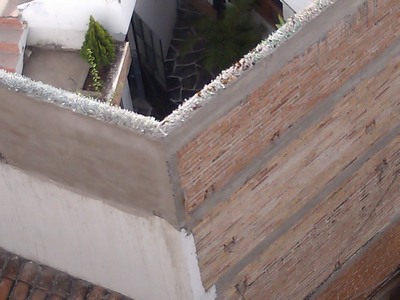
Wall with broken glass on top, Taxco, Mexico

Houses already secured by solid metal doors, walled courtyards, and decorative ironwork over windows, are raising walls higher to make access to their homes impossible.


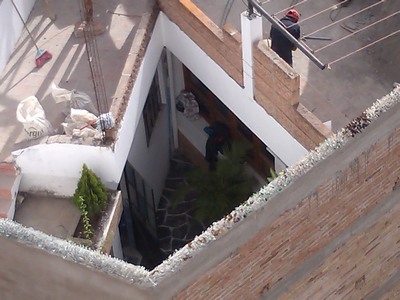
Wall with broken glass on top, Taxco, Mexico


Broken bottles are set into the cement on top not so much to deter birds landing and dropping gifts into the patio below as to keep possible intruders out.

(This used to be one of my favorite houses too. A lovely courtyard behind a one story wall, provided privacy yet was bright and airy. Now with its three story wall, it is more like a dungeon.)

Houses, Taxco, MexicoEven the little guy, between these two much larger, taller buildings has added onto his house, though his found materials construction and corrugated metal roof pale in comparison.

Yet, if anyone were to consider his humble abode worthy of breaking into, the resident turkey would give a gobble.

Teloloapan

A little over an hour, and two buses, north and west of Taxco is the town of Teloloapan,  where mi amiga ,Vanessa, lived when she first came to Mexico.

We went for a special event and stayed with Pedro and Bonfilla (hope that’s spelled correctly) and their family, whom Vanessa had gotten to know in the States.

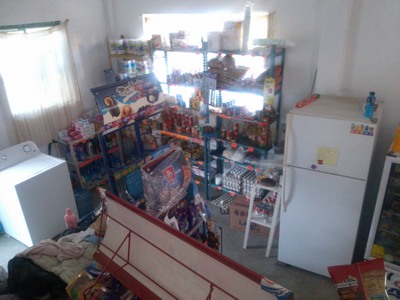
The family runs a tienda, a little neighborhood store, high on a hillside overlooking town, though not quite as high as his parents’ house which has a fabulous view of the city.

They literally live “above the store,” which is only a few steps from the open door to their living room. Rather than having to sit and “man the store”, this arrangement allows them to be doing something in the living or kitchen area and still hear and greet customers as they come in.

Tienda, Teloloapan, MexicoLike a PDQ, they sell a little of everything — things one might need immediately, avoiding a time consuming trip to the big market downtown. Children come in for candy or snacks and are often sent to get milk, cheese, or Coke  for the meal while mama is cooking.


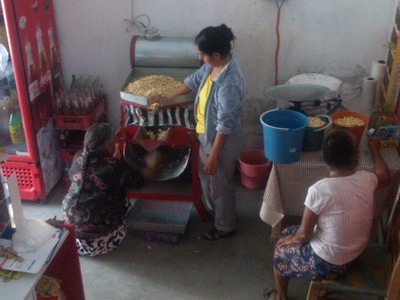
Grinding corn into masa, Teloloapan, MexicoThe day starts early as, each morning, neighborhood women bring their corn to be ground into masa so they can make fresh tortillas for the day’s meals.

The family, their parents, and even neighbors up the street, hosted a house full of company from other towns, far and wide. Everyone congregated at their house for a simple dinner of beans and hot homemade tortillas with fresh salsa roja (red) and, of course, Coca (Cola.)   We laughed, we talked, we shared photos of family — a good time was had by all. Every bed in the house, and even makeshift pallets on the floor provided a good night’s rest.

Making breakfast the following morning proved to be a bit of a challenge as we discovered that we had run out of gas for cooking and heating water. Being Sunday and not being able to get more until Monday, cooking was done the old fashioned way — over an open fire.

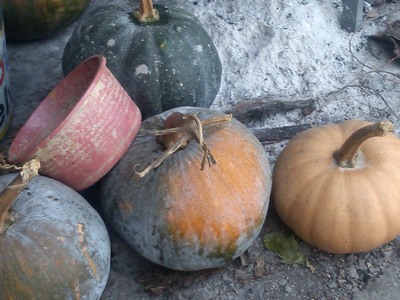
Calabasa (squash), Teloloapan, MexicoAn overhang in the yard protects the cooking area from rain and the relentless sun. A big pot of corn boiled away in the corner (to be ground into masa later), water was heated for baths (aka bucket showers) in the other, and in between tortillas were made (even we gingos got in on the act) and a pan of hot coals cooked other breakfast items — huevos (eggs), frijoles (beans), salsa, and a huge pot of calabasa (squash).

Cooked slowly with piloncillo, cones of natural brown sugar, the squash  turns into a delectable, mouth watering treat, to be served, sometimes with milk, for breakfast or as a snack or desert. MMMMMMM!

After breakfast, we all piled into the car and drove to the assembly grounds, where an old quarry site was transformed for the day with the aid of a makeshift tent, made out of corn and flour sacks, which provided much needed shade from the hot sun. I loved watching the wind ripple through the floating panels to the end where, with a poof, it escaped once more to the open air. Almost as interesting as cloud watching.

I am always amazed at the resourcefulness of the people here; nothing useful ever goes to waste.

Mexican Traditions – Three Kings Day

Band in the street, Festival of OUr Lady Guadalupe, Taxco, Mexico


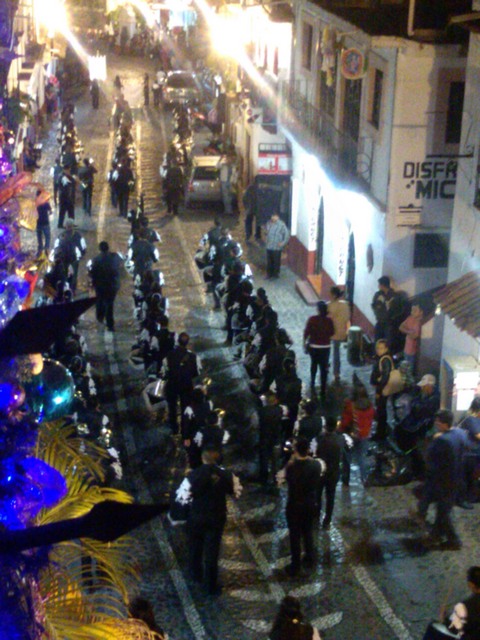
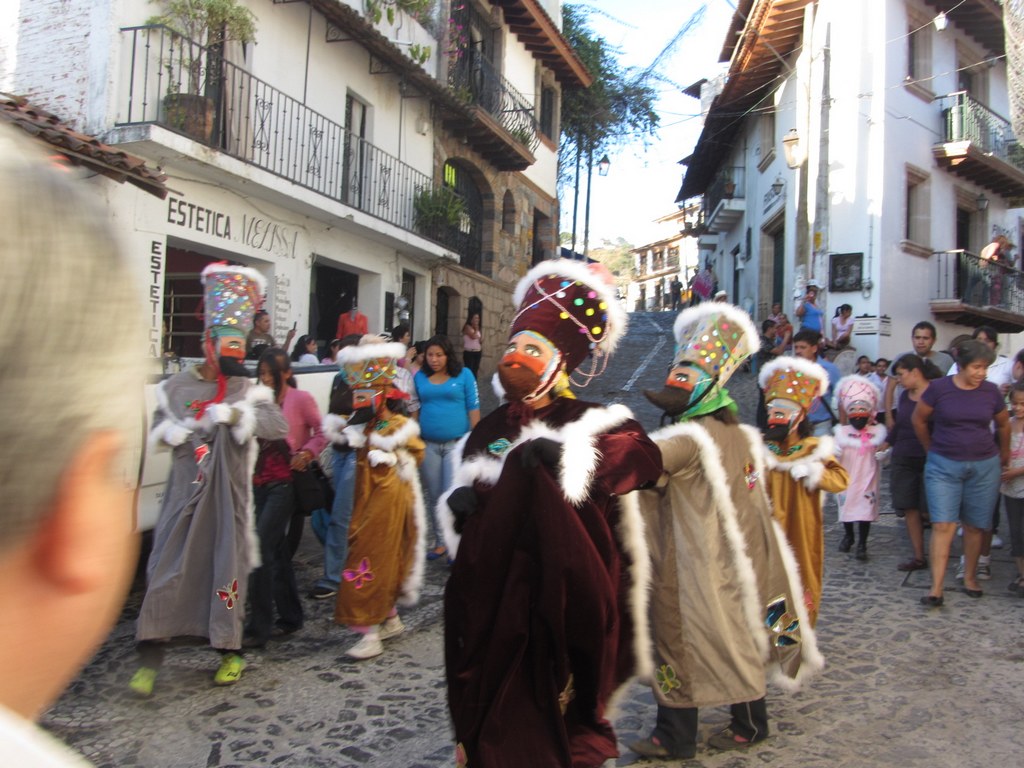
The holiday season in Mexico just goes on and on. First there is the The Feast of Our Lady Guadalupe which begins on December 1st and culminates on December 12th with marching bands playing repetitive music, feverish dancing, and of course fireworks.

Las Posadas procession, Taxco, Mexico


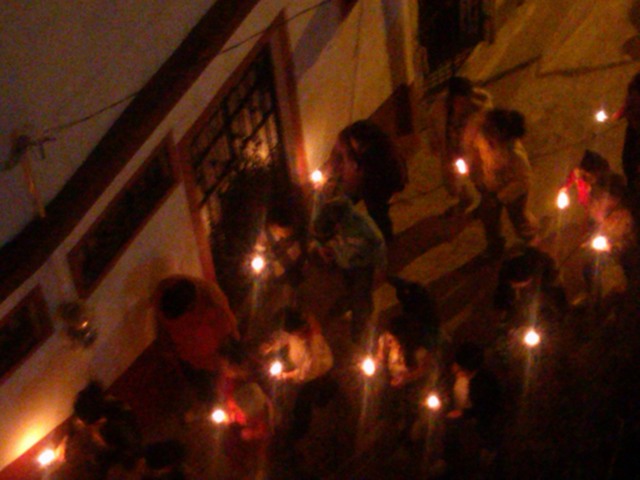
Then on the 16th, Las Posadas start and the calles (streets) and barrios (neighborhoods) are filled with the sound of children singing and pinatas breaking, along with candlelit processions, and more fireworks.


Families gather for Christmas Eve and Christmas but unlike back home, these are only days for family to be together; no gifts under the tree to open — well maybe a small gift or two.

Tonight is the night that Mexican children most look forward to. They set out their shoes in eager anticipation of finding them filled with gifts in the morning. Three Kings Day, January 6th, marks twelve days after Christmas Day, when supposedly the three kings appeared before the baby Jesus and presented him with the gifts of gold, frankincense, and myrrh.

At midnight, the sky will be punctuated with the sight and sound of fireworks and airworks (fireworks with only the boom), church bells will peal, and if they do not sleep though all that noise, children will open their gifts. The day will be marked with yet another family gathering where Rosca de Reyes (Wreath of Kings) bread will be eaten and whomever finds the baby Jesus in their piece gets to host the final holiday celebration, Dia de Candelaria, on February 2.

(To learn more about these Mexican traditions, follow the links above.)

Three Kings Day, Taxco, MexicoNo doubt there will also be another parade down my street. Can’t wait!


Translation Please

There is no doubt about it, learning another language is hard (unless, maybe,  you learn as a kid.)

Spanish, being a romance language, shares many Latin root words with English that are the same or very similar in both languages (university is universidad). From there on, though, Spanish is pretty much opposite in structure (aka grammar) from English.

To give you a few examples, adjectives follow nouns rather than precede them (the boy small or the house beautiful) and when you say you do not want… or something is not…, the negative is added to the front of words and phrases (No want… or I no go…) and there are two words for to be (is, are, etc.) that have two distinctly different meanings, though both meanings translate to the same word in English.

So like my great grandmother who might have said, “Throw me down the stairs a hankie,” I have to learn to think and speak backwards. Like I said, it is not easy.

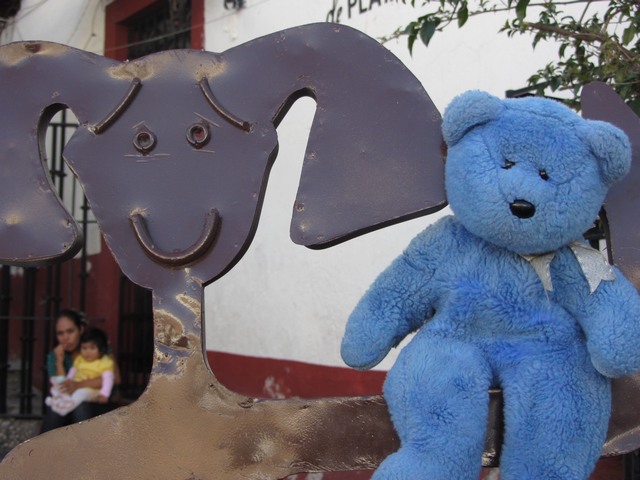
Blue Bear & Friend, Taxco, MexicoI have found though, that if I am having trouble making myself understood, I should speak with a woman — preferably one who has raised children.

I was relating a story in Spanish and was pretty sure that I was using the correct words and even phrases. Though the women were smiling and nodding, one hombre in particular kept shouting, “Speak Spanish,” to which I replied, “I thought I was.” He turned to his wife, and said, “Do you understand her?” And she replied, “Yes.” He said, “Only a few words here and there, right?” to which she replied, “No, every word.” He, of course, was dumbfounded.

As my hostess Irma, likes to say, “Many words fly into the air,” however due to their experience in raising little ones learning to talk, mothers will most likely catch most of those words, fill in the blanks, and understand what you are saying no matter how badly you mangle the language.

Here are just a few of the women who understand me.

Good Morning Sunshine

I heard from home, and the sun finally came out. Many thanks to me for sending some sunshine their way.

Here in Taxco and the surrounding area though, we paid the price, but after several days of this —

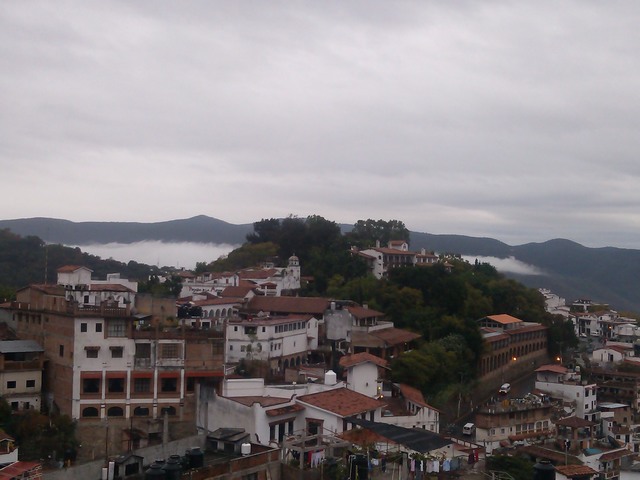
Clouds over Taxco, MexicoHeavy clouds and the cold rain that comes with it, the sun came back.

Living in cement block and tile houses, without central heat and often without hot water, a “cold snap” can be quite trying. Those walls just suck the heat out of your body. Even I was “freezing” at night.

But, given a few days, as usual, the sun has returned and warmed our homes and hearts.

Good morning sunshine!

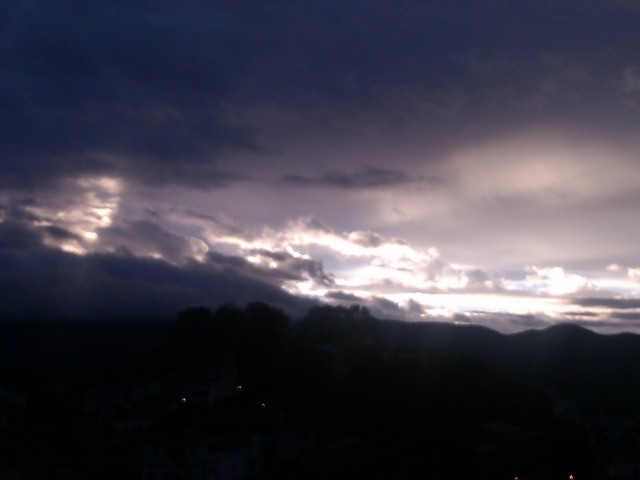
Sunrise, Taxco, Mexico Sunrise, Taxco, Mexico Sunrise over the mountains, Taxcp, Mexico

Nubes

So yesterday, I sent some of our ever present sunshine to the folks back home who haven’t seen the sun for three weeks. Perhaps that was a mistake, for this is what I woke up to this morning–

Magnificent Clouds, Taxco de Alarcon, MexicoThose clouds in the valley are pretty magnificent aren’t they?

The accompanying all day drenching was highly unusual. Even with our “paraguas” (umbrellas, though literally “for water”) eventually my feet were wet and I was “mas frio” (very cold.)

But as Annie liked to sing, “The sun will come out, tomorrow.” And if not, probably the next day.

Good Morning Sunshine

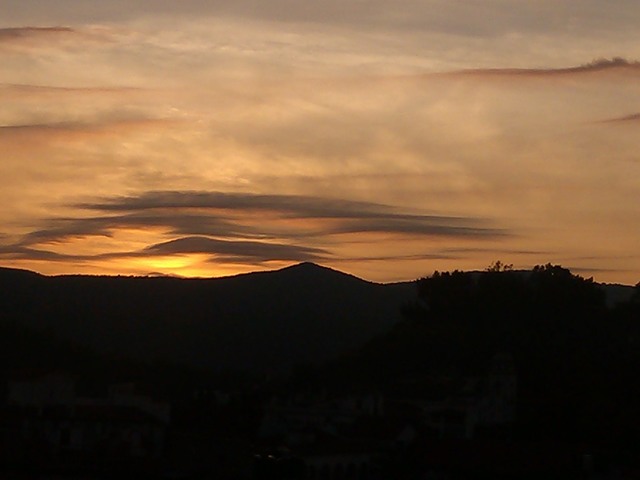
Without getting out of bed, I can watch the sunrise over the mountains. Usually the sky is clear and sunrise is just a matter of the sky fading from black, to indigo, to violet, fuchsia, coral, golden, and then the blaze of the sun over the blackness of the landscape. Lately though, we have had a lot of clouds, making for some spectacular sunrises.

For my friends back home who are discouraged because they  have not seen the sun for three weeks now, this one is for you!

This slideshow requires JavaScript.

Palabra del Dia – Word of the Day

I live with a Mexican family, that other than the usual pleasantries (Good morning, good night, etc.) do not speak English, and though my vocabulary is growing my ability to truly communicate is vastly limited. I try though.

I am told that I am learning quickly, although I do not feel so confident in my abilities. My head literally hurts some days as I try to understand. And, there are times my brain absolutely refuses to speak Spanish no matter how hard I might try.

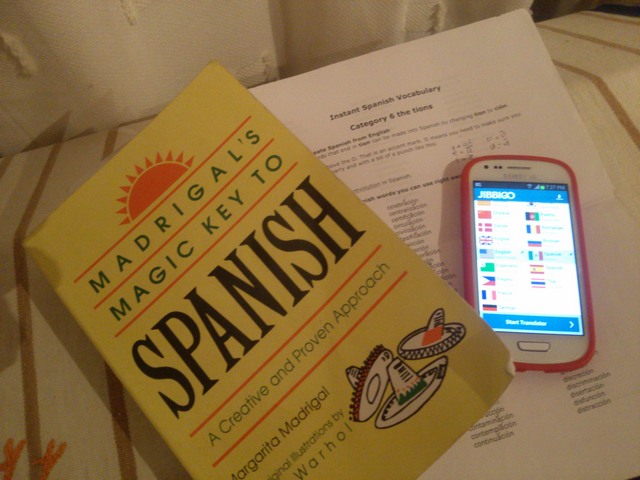
Tools for learning SpanishTo over come my inadequacies, I have downloaded two language apps that unlike Google translation, work offline. One is an English-Spanish dictionary, just like the book form only handily kept on your Smartphone where it is easy to reference and less likely to be left behind somewhere. The other is a translation program, Jibbigo, that translates phrases or sentences in a number of  languages, so if you and the person you are trying to communicate with can both read and type, you can actually have a simple two-way conversation. The phone will even do the talking for you, in case your pronunciation is horrible.

As we were sitting around the dinner table recently, Irma’s granddaughters were curious about my translation app so we played around – translating and pronouncing different words. It all started because I wanted to say something was funny, so I looked it up – co’mico  (pronounced CO mee co). When I was trying to help them pronounce funny, which proved to be difficult for them (Spanish does not have a short u sound). I said it was similar to the name of Irma’s daughter, and the girls’ mother, Fanny (pronounced Fahn ee). We made ” funny” the word of the day and went on comparing other words in Spanish and English.

Later when I asked Carlita (Fanny’s youngest daughter) what the word of the day was. She thought for a moment and said, “Mama?” So much for word association! Yet, we all got a big kick out of her answer.

The following morning Irma questioned me about “good morning,” “good afternoon,” “good night,” and tested out all the other English words she thought she knew. (Quite a few actually!) Despite her initial objection that she was too old to learn English, she just might learn after all.

In fact, we (the whole family) will all learn together. Much more fun than studying a book for hours on end; more practical too because you learn the words you will actually use.

Our word for today is amiga/amigo – friend.

My Mexican family

Irma (R) and some of her family.