Flashback — Folk Art Center – Blue Ridge Parkway

At milepost 382 of the Blue Ridge Parkway, just outside of Asheville, NC, is the Folk Art Center, a wonderful place to stretch your legs and feast your eyes on some handmade beauty. Run by the Southern Highland Craft Guild, a century old artist’s organization, in cooperation with the National Park Service and the Appalachian Regional Commission, this gallery and gift shop offers seasonal exhibits and fine arts and crafts from around the region.

Here is a sampling of the quilts and folk art on display during my spring visit.

To learn more visit the Craft Guild website.

FYI – You will find other Craft Guild shops in Asheville, Gatlinburg, TN, Middlesboro, KY and at milepost 294 of the Parkway near Blowing Rock, NC.

Flashback — Mountain High

And now for the rest of the story —

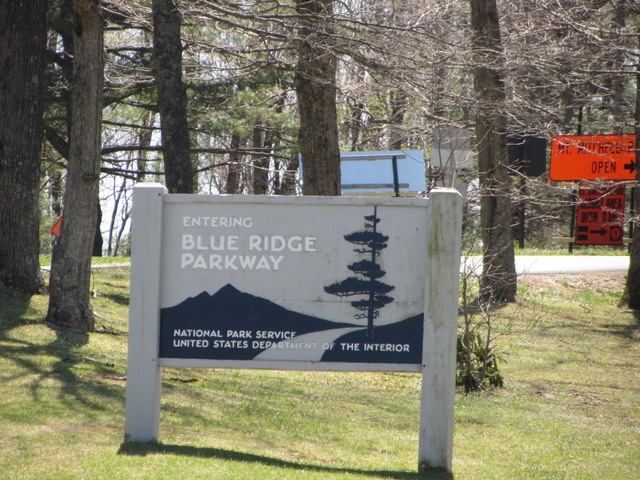
As traBlue Ridge Parkway signvels, even meanders, always do, it came time to turn toward home. Leaving the coast behind, I headed West toward Asheville, North Carolina, the Blue Ridge Parkway and Great Smoky Mountains National Park a place I had lived for a few months just out of high school and other than to drive by occasionally on trips south had not visited again since my early 20s. I spent a couple of glorious days (not nearly enough) driving the parkway which traverses 469 miles through Virginia and North Carolina along the Blue Ridge, a part of the Appalachian Mountains, through tunnels and across streams and deep ravines, all with the glorious backdrop of the blue ridges for miles and miles.

Rising from Asheville at approximately 3000 feet above sea level to 6000+ several times, the climate changed from warm sunshine and blooming dogwoods to still naked trees and brisk wintery winds, then back to the warmth of spring in bloom again. Many scenic overlooks mark your way, along with great hiking opportunities, some easy and some more difficult, to waterfalls and places like Devil’s Courthouse (a cave where the wind makes it sound like someone is talking) and Looking Glass Rock (with a wet face that glows in the sun and shines like a mirror). (L-R below)

My favorite memory is the trip down from Mitchell Mountain, the highest point in the Eastern US. A section of the parkway was closed ahead and I would have had to backtrack at least 30 miles to reach a paved road going down the mountain. Having driven 50-60 miles out of my way, following the tourism office directions to reach the parkway the “easy” way (which I guess means less curves), I was not interested in backtracking that far. Discovering that I did not mind curves (what is with this curvaceous avoidance?), the ranger told me about a forest road shortcut down the side of the mountain that had just been graded, so of course I took it.

What a ride!

The road winds straight down the side of the mountain, switching back and forth and sometimes wrapping around itself, as it follows the terrain and a rushing stream. At the top there is nothing but late winter brown and dull conifers, but as you descend, tiny green leaves soften the stark branches of deciduous trees. Over and over you cross a stream which tumbles over dead fall and boulders — music to your ears. Before long, dogwoods in full bloom delight your eyes as you wind your way into spring warmth. At the bottom, an old mill attests to strength of the water’s flow.

Here are a few scenes from my drive.

This slideshow requires JavaScript.

Asheville is lovely. Like my hometown, Madison, WI (though only 1/4 the size), it is a small city that is big in beauty and culture. Throw in the Blue Ridge Parkway, the Great Smokys around the bend, and Southern charm plus music, artisans, and lots of organic food and you have a city I would love to call home.

In fact, when I came down the mountain to find a camp host in a very off-the-beaten-path federal campground just outside of town, I was very tempted to just stay right there and never leave.


Hola mi amigos!


Greetings from Mexico!

It is early December and I am sitting on my balcony overlooking Taxco, Mexico. The sun is shining, the birds chirping, a light breeze stirs the 75 degree day — just about perfect I’d say, except you all cannot be with me.Typical Street - Taxco, Mexico

Since I have not posted to my blog in almost 6 months, I feel I owe you a brief explanation. My last posts were describing my trip home to Wisconsin from a rather mad-dash trip to Florida to escape the heating season in my apartment which was seriously affecting my chemical sensitivities . I got as far as Charleston, SC and was ready to head West into the mountains (Asheville and the Great Smokies) promising you more. (I’ve provided links my blogs on Charleston, Asheville, and the Smokies, to read posts on Florida, search in the box above.)

Sorry I let you down. Because of a need to speed home (rather than meander) the last couple of days I got behind. Then when I arrived home, the usual sensitivities reaction, “stopped me in my tracks.”

In the end, the decision was made that I had to find a different place to live, which with my sensitivities was not so easy. I spent the summer searching the possibilities, traveling hundreds of miles in the process, while at the same time making contacts, taking classes, and getting certification for a new occupational direction I hope to launch in the summer of 2015. To say I have been busy — coming and going, barely touching base at home before I was gone again — would be an understatement.

But that was then, and this is now.

By mid-November I finished selling, donating, or recycling most of my worldly goods, put a few things in storage, vacated my apartment, and traveled off to Portland, Maine to visit my daughter and family. Now, in Mexico, I finally have the pleasure of stopping long enough to catch my breath and tell about it.

First, though, I want to tell you “the rest of the story” of my trip through the mountains. Hang on to your sombrero, it will be a fast ride!

BlueBear-MexicanHat-qpr

Beach Personalities

As I turn west and trade coastal communities for mountains, I reflect on the beaches I leave behind.

One thing I learned on this trip is that not all beaches are created equal. Each is unique in its own way —

some are smooth,                                             some are littered with shells,

some are wild, untamed,                                 and others are urban retreats.

Some slope gently into the water while others drop steeply behind large (protected by law) dunes. Each has its own personality.

Though I have been on many beaches in my days, exhibiting all of the qualities listed above, I was totally unprepared for what I found at New Smyrna Beach.

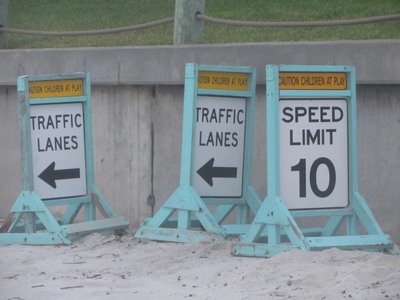
A speed limit!

img_8086-qprI was told by many that New Smyrna Beach  was the “prettiest beach” on the East Coast of Florida, because of its relatively shell-free white sand and tidal pools for the little ones to splash in. Now maybe I did not visit the best part of the beach; it does stretch for miles, but when I got there, I found condos built on seawalls almost at the water’s edge, and in their shadow, a very shallow beach area with a “speedway” taking up two-thirds of the available space.

OK, so the speed is only 10 mph, but when it is between  the beach goer and the water, that is about 10 mph too fast in my opinion.

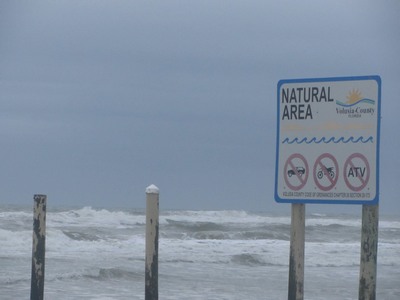
No traffic beach area, New Smyrna Beach , FloridaThankfully, every mile or two a section of the beach is declared “traffic free.” Be sure to look for the “traffic free” signs.

Or do as I did — drive to the far end of the barrier island into the northern section of Canaveral National Seashore and find miles and miles and miles and miles of beach with only foot traffic allowed.

Misty walk, Canaveral National SeashoreWhat’s your beach personality?


Charleston Chew

I am not a big city bear. I enjoy a day trip to the city, walking amidst the tall buildings, window shopping, people watching, visiting museums and grand big city parks — even riding the subway can be fun. But I hate the chaos of traffic and trying to find a parking spot, especially in a big city that I am unfamiliar with, and even more so when I am the driver, navigator, and sole crash avoider.

Charleston, South Carolina signBeing on the Atlantic coast and reluctant to leave the water behind, I thought I’d take a chance on the city life and make like a Southern belle for a few hours in Charleston, South Carolina. After all, Charleston represents the founding of our nation, Southern charm, and more history than you can imagine.

The plan was to head downtown, take in some history, photograph antebellum homes for the folks back home, have a little dinner in a quaint local establishment in a 200+ year old neighborhood and then head to Asheville and the mountains.

Having avoided Savannah and taken a more direct secondary highway into the state, I missed the official welcome center so I had no state map. Just outside the city I came upon a tourist information center so I stopped to get a map. Being a private tourism office, they make their money from referrals to hotels and restaurants in Charleston; the agent had no state maps and she was not too pleased with my plan to just visit the city for a few hours and hit the road again. (Let’s just say she did not offer a stellar example of Southern hospitality.)
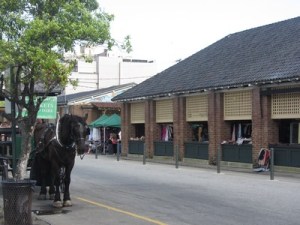
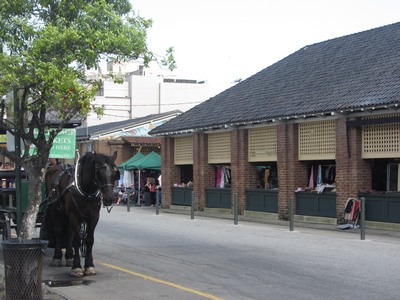
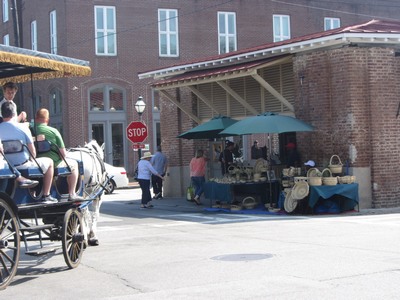
Olde Market, Charleston, South CarolinaThough I asked for directions to the historic area where I could see the antebellum homes and such, she directed me to the Olde Market area — “200 years old and lots of arts and crafts.” OK I am up for that.
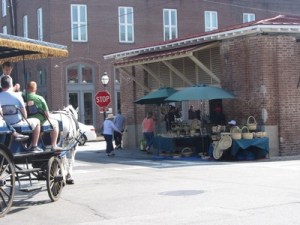
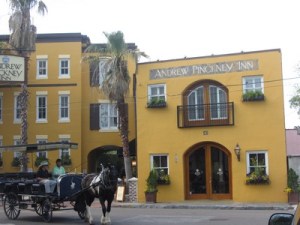
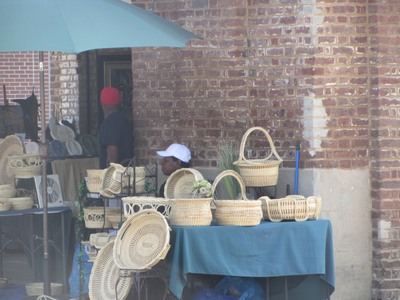
Basket vendor, Olde Market, Charleston, South Carolina Niche hotel and horse drawn carriage, Charleston, South CarolinaAfter navigating into the heart of the old city port area, where streets are twisted and narrow, one way and dead ended, driving around for 1/2 hour, dodging people, cars, and horse drawn carriages to find a parking spot, I found the olde market — a succession of 8 – 10 or more brick buildings with open ends and half walls filled with vendors. They have indeed stood here as a place to vend goods (originally from the ships in port and the plantations outside town) for 200 years.

The area was originally a warehouse district, though now the warehouses sport major chain and niche hotels, pubs, and restaurants for the tourists.

Baskets, Charleston, South CarolinaSince I was expecting “arts and crafts,” I was not prepared for the flea market atmosphere — a few handmade basket vendors (a Charleston specialty) and hand sewn bonnets, aprons, and household items, but stalls were mostly filled with 21st century junk “as seen on TV” or you’d find at K-mart. After walking through 3 buildings and literally finding nothing worth even pausing to look at (except the baskets – tourist priced), I bought a handmade lemonade and bolted back to my car. Following my own intuition and with the help of the lemonade vendor, I managed to make my way to White Point Gardens at the water’s edge.

This delightful couple blocks of green space, though under reconstruction in spots, offered a respite from the traffic and chaos. Walking around the area, I discovered the kind of historical homes, large and small, that I was looking for, towering live oaks dripping in Spanish moss, old brick and cobblestone streets, sections of the old city wall, gates offering glimpses of 200 year old courtyards and formal gardens, pavilions, statues, and more historical markers than you could count. Horse drawn carriages were everywhere, telling of the history of certain houses and residents (I guess taking the tour was the “seeing the antebellum houses” the tourism maven had in mind.)

Enjoy this photo tour of the area south of Broad.

This slideshow requires JavaScript.
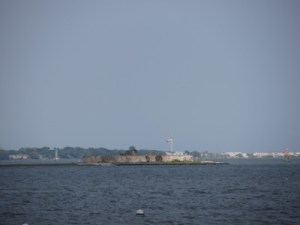
Fort Sumter, Charleston, South CarolinaBeing a coastal city, a seawall and promenade, 6-feet high and wide enough for 4 people to walk abreast protects the homes from the sea (and served dual duty as a battery in times past (the canons now sit in the park.) From the top, you get a view of Fort Sumter where the Star Spangled Banner was penned. (Never realized this historic fort was so small.)

For some reason, my foot hurt, making it really painful to walk (I learned later I had cracked a metatarsal bone; don’t ask me how) so I departed without finding a local historic establishment for dinner and set my sites on the drive home — via Asheville, North Carolina, and through the Blue Ridge and Great Smoky Mountains.

I have decided that a solo meander is not conducive to big city exploration. Charleston is a charming Southern city, worthy of a couple days or a long weekend of exploration where one can ferret out the historical gems and quaint restaurants. Visit with a friend, spend the money and stay in the heart of the city, and act like a tourist — take the horse drawn tours, visit the market, go to the fort, walk the old streets and live the history of America.

One last ocean sunrise

Edisto Beach, South Carolina

Well, the day had to come, one last day to walk the beach at sunrise before turning west and heading toward the heartland. I shall miss arriving in the darkness, a faint glow on the horizon, and watching it grow to a rosy glow that gets brighter and brighter until that golden orb peaks over the horizon and quickly explodes into a streak of color and a million diamonds sparkling on the waves.

Here I share with you the best of the last great sunrise over the ocean, at least for this trip.

This slideshow requires JavaScript.

Only at the beach do you have this kind of unobstructed view of the magic moment the day begins. Ah what a glorious sight!

Lighthouses

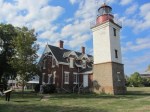
Take a good look at these lighthouse photos. What do you notice?

Having visited many lighthouses in many locations, I have noticed that each is unique — each a different height, made of different materials, with different paint patterns — but not being a navigator, the real purpose of each light’s unique style and paint job never really crossed my mind.

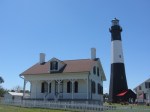
Tybee Island Lighthouse station signWhen I visited the Tybee Island Light Station and Museum, near Savannah, Georgia, I learned the real and really quite obvious reason for those unique patterns — called a day mark, they are a way to identify which lighthouse is which when you see them by day.

Tybee Island offers a rare opportunity to view a working lighthouse and see how the keeper, his assistants, and their families lived from the late 1700s until the light was automated well into the 20th century.

Climb the 178 steps to the top and think about doing that several times a day to keep the oil lamp burning. Look into the 1st order Fresnel lens (large enough for 4 people to stand inside) which magnifies the light of a single 1000 watt bulb and focuses it into a beam that can be seen 18 miles out to sea.
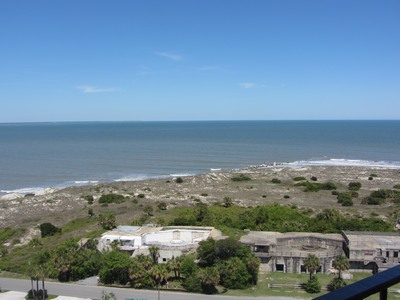
From the outdoor observation deck at the top, you get a good view of the Fort Screven battery, below, built as a protection for nearby Savannah,as well as the beach, ocean, and nearby coastal cities.
Fort Screven battery from top of Tybee Island lighthouseDon’t leave without lunch at the North Beach Bar and Grill between the lighthouse and the beach. The smells emanating from the kitchen make your mouth water and the coastal Americana decor is a delightful beach break.

Memorial Day – an American Holiday

Today is Memorial Day in the US. A day set aside to honor those who have sacrificed their lives protecting the “land of the free” in battles around the globe. There will be speeches, cemetery visits, and memorial observances throughout the land.

Memorial Day is also the official start of the summer season —  tourist towns dust off the winter cobwebs, theme parks reopen their doors, children will soon be out of school, and a host of family activities are being planned. This long weekend affords families the opportunity to travel, get together for that first picnic of the season, and celebrate the summer to come.

Blue Bear hanging from a lantern

Let the camping and paddling season begin!

Jekyll but no Hyde

A few miles up the road from St. Augustine, the landscape changes from endless miles of sandy beaches to wilder salt marshes, estuaries, and individual barrier islands. No longer do beach cities and development extend to the waves lapping at the shore.

The Atlantic coast of Georgia (USA) is filled with inlets, outlets, and barrier islands. It is a magical place of winding estuaries and tall marsh grasses that glow in the sun lending the nickname, the Golden Isles. Due to bad weather and limited time to meander and explore, I had to make like a dragonfly and zip through this area, lightly touching down from time to time. Here are a few of the highlights.

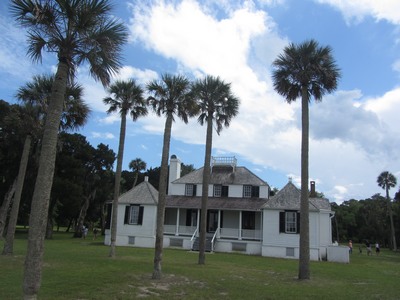
img_8314-qprSt. George Island (can you see the English connection in that name?) is the site of the Kinglsey Plantation, a national historic site depicting life on a Southern plantation. Since the idea of Southern plantations has a negative connotation, due to the Civil War, I recommend visiting and learning more about this era of American history.

The part the history books don’t tell is that under Spanish rule, slavery was outlawed. (In fact, Ft. Mose, just north of St. Augustine, was a settlement of Africans – freemen and former slaves.) But, when the British and later the Americans took over, land owners were actively recruited but were not granted tracts of  land to work agriculturally unless they had a certain number of slaves for every acre. Yeah, I know, shocking isn’t it?

Jekyll Island, once the winter playground of the rich and famous, this island is home to “cottages” built by people with names like JP Morgan, Vanderbilt, Goodyear, and Pulitzer that are bigger than the houses, even McMansions, of most people today. A group of these millionaires, bought the island from the family of the original plantation owner and created an exclusive club for the rich and famous. Many historic moments occurred here such as the first meeting of the Federal Reserve and the first transcontinental telephone call.

This slideshow requires JavaScript.

Today, anyone, for a small fee, can drive to the island, tour the historic district and get a sense of the opulence of the Victorian era. You can rent a cottage or a room in the turn of the 20th century inn, or if just a day tripper, wander through the public rooms viewing vintage photographs, grab a bite in the Bistro, or dine in luxury in the historic dining room. Rent a bicycle and pedal through the historic area; head to the beach and on your way you will discover ruins of the original plantation house, the old cemetery and enjoy scenic vistas and byways.

img_8345-qprBe sure to stop at the Georgia Sea Turtle Center where nestlings are monitored and injured sea turtles are rescued, rehabilitated, and if possible, released back into the wild. There is a nice interactive exhibit hall with live animals. Your admission fees support the work they do to preserve these magnificent creatures, some of whom are threatened and endangered.

Skidaway Island is the home of a large state park that provides access to the salt marshes and estuaries. The campground is located on a large hammock on the intercoastal waterway, a brackish water river system that extends most of the way down the eastern seaboard, separating the mainland from the barrier islands, offshore, which serve to protect the land mass from storm surges.

These barrier islands afford opportunities to enjoy unspoiled beaches, paddle quiet backwaters and estuaries, hike, bird watch, and get away from it all in many ways. I could spend months or years exploring them all, but alas I do not have the time. I look forward to another opportunity to travel this way, stay longer and explore deeper.