Since I have such a fabulous vantage point at sunrise, by popular demand, I am sharing my view with you. Enjoy!




Since I have such a fabulous vantage point at sunrise, by popular demand, I am sharing my view with you. Enjoy!
A little over an hour, and two buses, north and west of Taxco is the town of Teloloapan, where mi amiga ,Vanessa, lived when she first came to Mexico.
We went for a special event and stayed with Pedro and Bonfilla (hope that’s spelled correctly) and their family, whom Vanessa had gotten to know in the States.
The family runs a tienda, a little neighborhood store, high on a hillside overlooking town, though not quite as high as his parents’ house which has a fabulous view of the city.
They literally live “above the store,” which is only a few steps from the open door to their living room. Rather than having to sit and “man the store”, this arrangement allows them to be doing something in the living or kitchen area and still hear and greet customers as they come in.
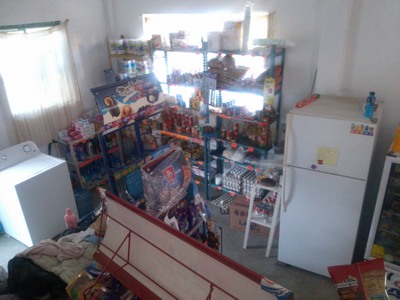 Like a PDQ, they sell a little of everything — things one might need immediately, avoiding a time consuming trip to the big market downtown. Children come in for candy or snacks and are often sent to get milk, cheese, or Coke for the meal while mama is cooking.
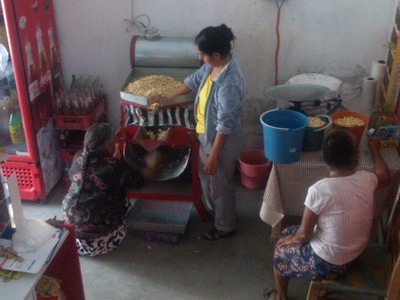 The day starts early as, each morning, neighborhood women bring their corn to be ground into masa so they can make fresh tortillas for the day’s meals.
The family, their parents, and even neighbors up the street, hosted a house full of company from other towns, far and wide. Everyone congregated at their house for a simple dinner of beans and hot homemade tortillas with fresh salsa roja (red) and, of course, Coca (Cola.) We laughed, we talked, we shared photos of family — a good time was had by all. Every bed in the house, and even makeshift pallets on the floor provided a good night’s rest.
Making breakfast the following morning proved to be a bit of a challenge as we discovered that we had run out of gas for cooking and heating water. Being Sunday and not being able to get more until Monday, cooking was done the old fashioned way — over an open fire.
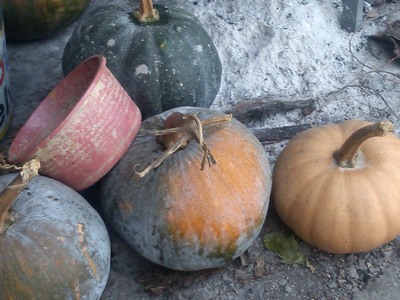 An overhang in the yard protects the cooking area from rain and the relentless sun. A big pot of corn boiled away in the corner (to be ground into masa later), water was heated for baths (aka bucket showers) in the other, and in between tortillas were made (even we gingos got in on the act) and a pan of hot coals cooked other breakfast items — huevos (eggs), frijoles (beans), salsa, and a huge pot of calabasa (squash).
Cooked slowly with piloncillo, cones of natural brown sugar, the squash turns into a delectable, mouth watering treat, to be served, sometimes with milk, for breakfast or as a snack or desert. MMMMMMM!


After breakfast, we all piled into the car and drove to the assembly grounds, where an old quarry site was transformed for the day with the aid of a makeshift tent, made out of corn and flour sacks, which provided much needed shade from the hot sun. I loved watching the wind ripple through the floating panels to the end where, with a poof, it escaped once more to the open air. Almost as interesting as cloud watching.


I am always amazed at the resourcefulness of the people here; nothing useful ever goes to waste.
These are the words of the day in honor of my friend, Vanessa, who left this morning to visit her family in Wisconsin. It will be an adventure for sure.
When I awoke I checked the temperature and she is in for a shock when she lands.
Taxco 59 with sunshine and a high expected of 78
Madison -5 with a high expected of only 14
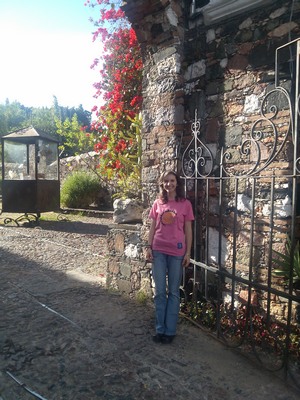 Vanessa has not been to Wisconsin in the winter for many years and I am afraid her “blood has been thinned,” as it is said, by many years in a warm climate. A couple weeks ago, we had a cold spell here, everyone was “freezing.” She admitted one morning that she was so cold the night before that she had a hard time sleeping. Finally she got up to check the temperature and was shocked to see that it was only 61 degrees. Oh my!!!!
Yet, despite her “thin blood,” she is looking forward to seeing and playing in the snow.A I am sure she will be warmed from the inside out by her family’s love.
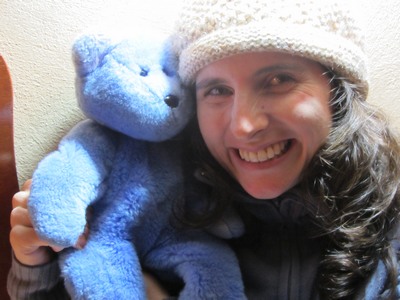 A heated house, plenty of warm clothing, and a hot tub will help too. (I want a picture of that!) She may even find Taxco muy caliente when she returns in a few weeks.
Bien Viaje! Nos vemos pronto!
Safe travels! See you soon!
This morning’s sunrise was so spectacular, I just had to share it.
The bold…


and the softer side…


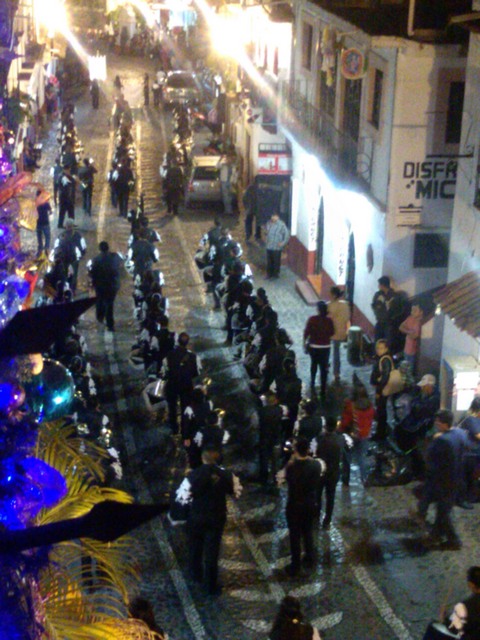
The holiday season in Mexico just goes on and on. First there is the The Feast of Our Lady Guadalupe which begins on December 1st and culminates on December 12th with marching bands playing repetitive music, feverish dancing, and of course fireworks.
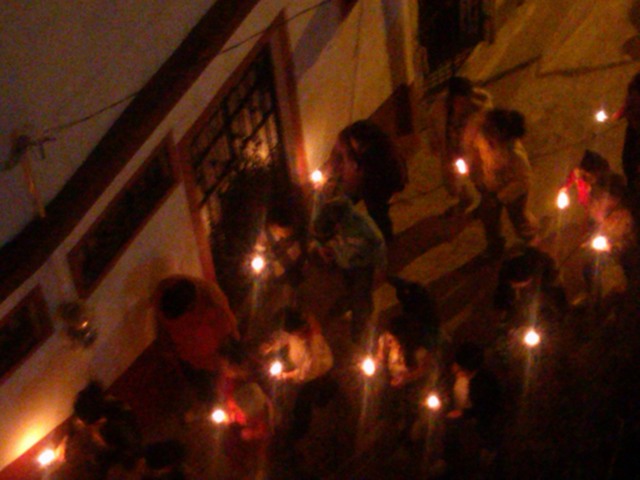
Then on the 16th, Las Posadas start and the calles (streets) and barrios (neighborhoods) are filled with the sound of children singing and pinatas breaking, along with candlelit processions, and more fireworks.
Families gather for Christmas Eve and Christmas but unlike back home, these are only days for family to be together; no gifts under the tree to open — well maybe a small gift or two.
Tonight is the night that Mexican children most look forward to. They set out their shoes in eager anticipation of finding them filled with gifts in the morning. Three Kings Day, January 6th, marks twelve days after Christmas Day, when supposedly the three kings appeared before the baby Jesus and presented him with the gifts of gold, frankincense, and myrrh.


At midnight, the sky will be punctuated with the sight and sound of fireworks and airworks (fireworks with only the boom), church bells will peal, and if they do not sleep though all that noise, children will open their gifts. The day will be marked with yet another family gathering where Rosca de Reyes (Wreath of Kings) bread will be eaten and whomever finds the baby Jesus in their piece gets to host the final holiday celebration, Dia de Candelaria, on February 2.
(To learn more about these Mexican traditions, follow the links above.)
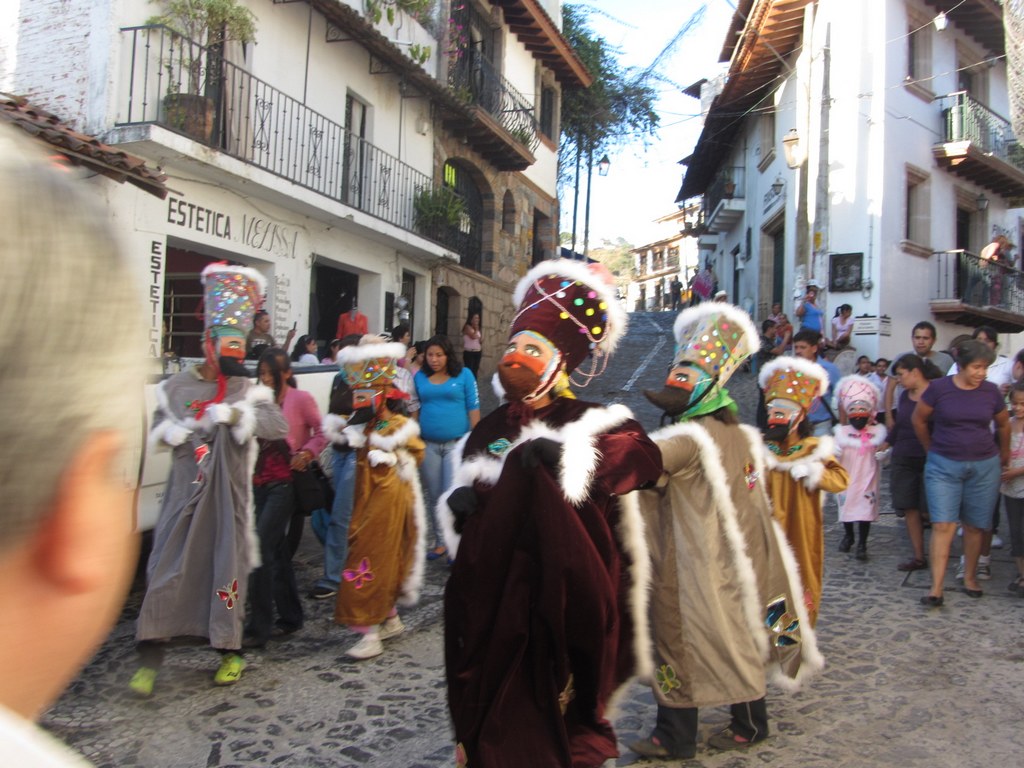 No doubt there will also be another parade down my street. Can’t wait!
There is no doubt about it, learning another language is hard (unless, maybe, you learn as a kid.)
Spanish, being a romance language, shares many Latin root words with English that are the same or very similar in both languages (university is universidad). From there on, though, Spanish is pretty much opposite in structure (aka grammar) from English.
To give you a few examples, adjectives follow nouns rather than precede them (the boy small or the house beautiful) and when you say you do not want… or something is not…, the negative is added to the front of words and phrases (No want… or I no go…) and there are two words for to be (is, are, etc.) that have two distinctly different meanings, though both meanings translate to the same word in English.
So like my great grandmother who might have said, “Throw me down the stairs a hankie,” I have to learn to think and speak backwards. Like I said, it is not easy.
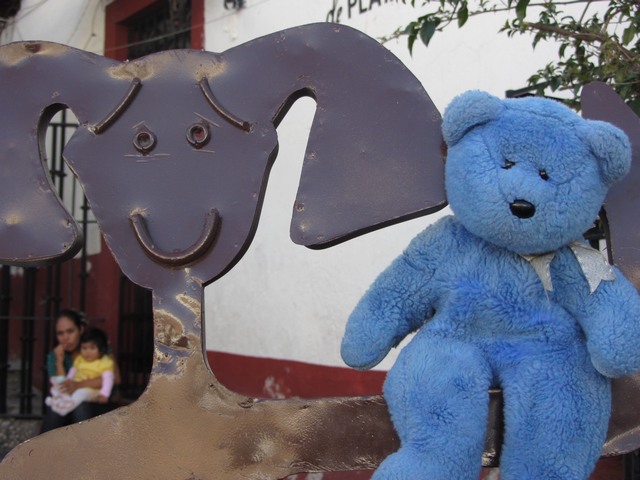 I have found though, that if I am having trouble making myself understood, I should speak with a woman — preferably one who has raised children.
I was relating a story in Spanish and was pretty sure that I was using the correct words and even phrases. Though the women were smiling and nodding, one hombre in particular kept shouting, “Speak Spanish,” to which I replied, “I thought I was.” He turned to his wife, and said, “Do you understand her?” And she replied, “Yes.” He said, “Only a few words here and there, right?” to which she replied, “No, every word.” He, of course, was dumbfounded.
As my hostess Irma, likes to say, “Many words fly into the air,” however due to their experience in raising little ones learning to talk, mothers will most likely catch most of those words, fill in the blanks, and understand what you are saying no matter how badly you mangle the language.
Here are just a few of the women who understand me.


I heard from home, and the sun finally came out. Many thanks to me for sending some sunshine their way.
Here in Taxco and the surrounding area though, we paid the price, but after several days of this —
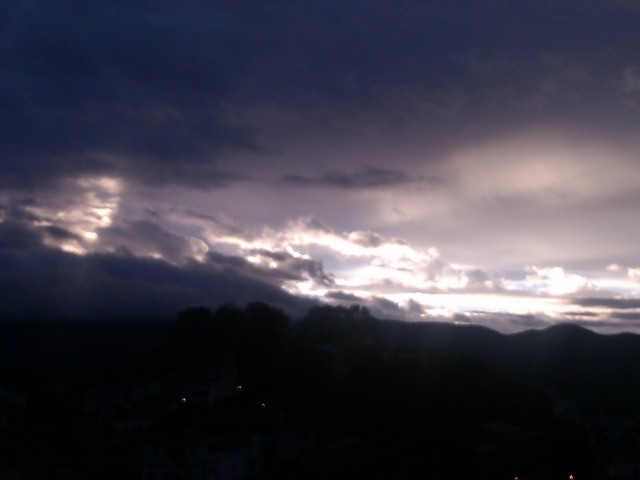 Heavy clouds and the cold rain that comes with it, the sun came back.
Living in cement block and tile houses, without central heat and often without hot water, a “cold snap” can be quite trying. Those walls just suck the heat out of your body. Even I was “freezing” at night.
But, given a few days, as usual, the sun has returned and warmed our homes and hearts.
Good morning sunshine!

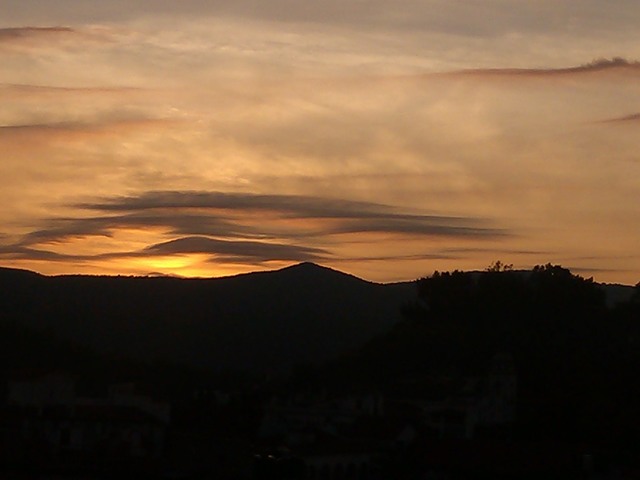

So yesterday, I sent some of our ever present sunshine to the folks back home who haven’t seen the sun for three weeks. Perhaps that was a mistake, for this is what I woke up to this morning–
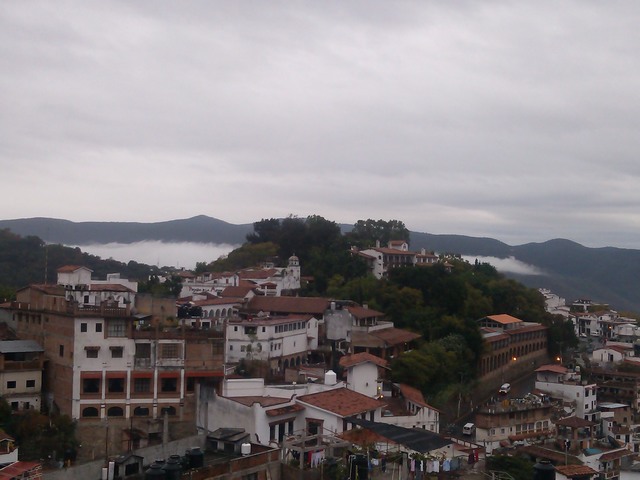 Those clouds in the valley are pretty magnificent aren’t they?
The accompanying all day drenching was highly unusual. Even with our “paraguas” (umbrellas, though literally “for water”) eventually my feet were wet and I was “mas frio” (very cold.)
But as Annie liked to sing, “The sun will come out, tomorrow.” And if not, probably the next day.
Without getting out of bed, I can watch the sunrise over the mountains. Usually the sky is clear and sunrise is just a matter of the sky fading from black, to indigo, to violet, fuchsia, coral, golden, and then the blaze of the sun over the blackness of the landscape. Lately though, we have had a lot of clouds, making for some spectacular sunrises.
For my friends back home who are discouraged because they have not seen the sun for three weeks now, this one is for you!
I live with a Mexican family, that other than the usual pleasantries (Good morning, good night, etc.) do not speak English, and though my vocabulary is growing my ability to truly communicate is vastly limited. I try though.
I am told that I am learning quickly, although I do not feel so confident in my abilities. My head literally hurts some days as I try to understand. And, there are times my brain absolutely refuses to speak Spanish no matter how hard I might try.
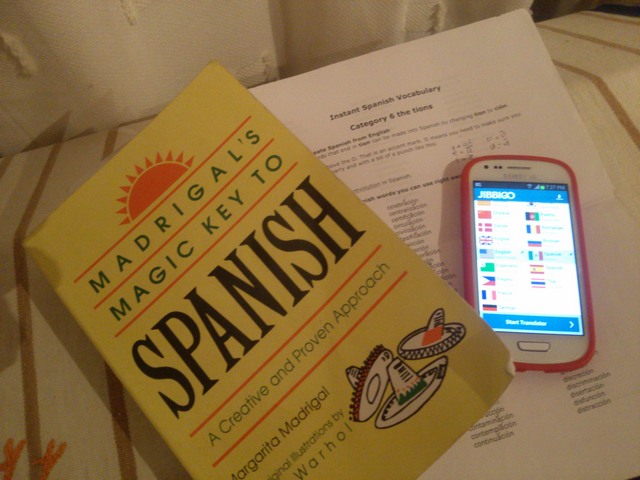 To over come my inadequacies, I have downloaded two language apps that unlike Google translation, work offline. One is an English-Spanish dictionary, just like the book form only handily kept on your Smartphone where it is easy to reference and less likely to be left behind somewhere. The other is a translation program, Jibbigo, that translates phrases or sentences in a number of languages, so if you and the person you are trying to communicate with can both read and type, you can actually have a simple two-way conversation. The phone will even do the talking for you, in case your pronunciation is horrible.
As we were sitting around the dinner table recently, Irma’s granddaughters were curious about my translation app so we played around – translating and pronouncing different words. It all started because I wanted to say something was funny, so I looked it up – co’mico (pronounced CO mee co). When I was trying to help them pronounce funny, which proved to be difficult for them (Spanish does not have a short u sound). I said it was similar to the name of Irma’s daughter, and the girls’ mother, Fanny (pronounced Fahn ee). We made ” funny” the word of the day and went on comparing other words in Spanish and English.
Later when I asked Carlita (Fanny’s youngest daughter) what the word of the day was. She thought for a moment and said, “Mama?” So much for word association! Yet, we all got a big kick out of her answer.
The following morning Irma questioned me about “good morning,” “good afternoon,” “good night,” and tested out all the other English words she thought she knew. (Quite a few actually!) Despite her initial objection that she was too old to learn English, she just might learn after all.
In fact, we (the whole family) will all learn together. Much more fun than studying a book for hours on end; more practical too because you learn the words you will actually use.
Our word for today is amiga/amigo – friend.

Irma (R) and some of her family.
 The Adventures of Blue Bear