Cometas

Hermoso del amanecer!

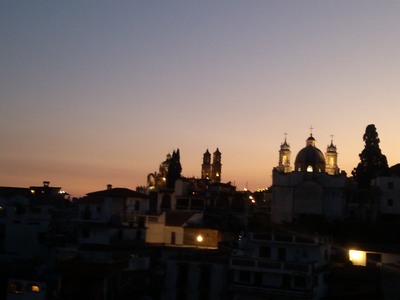
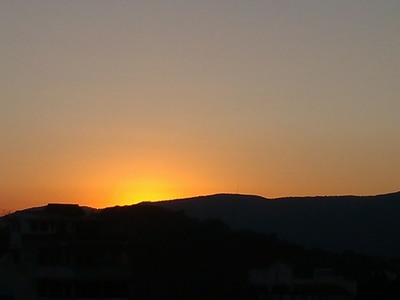
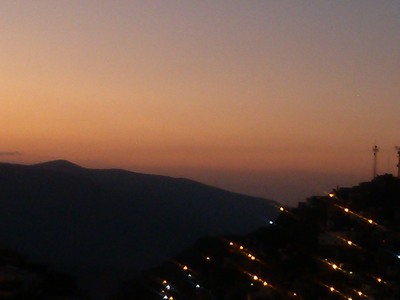
A friend sent me that text to say what a lovely dusk it was. That is what they say here since the sun sets long after it drops behind the mountains. Only rarely does Taxco get a glimpse of color like this at the end of the day.

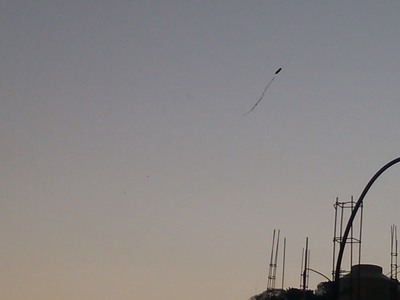
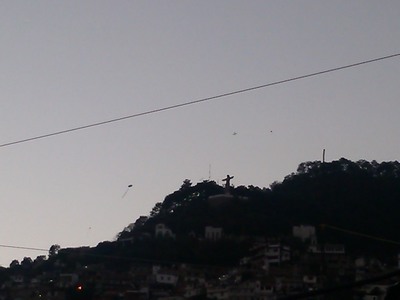
Dusk in Taxco de Alarcon, MexicoSo I went out on my balcony to see and not only did the sky have a nice blush behind Santa Prisca and the Ex-convento, but it was filled with cometas (kites) high and low;  dozens of them from the Zocolo to the Cristo statue.

KIte over Taxco de Alarcon, Mexico

KItes over Taxco de Alarcon, MexicoLook closely and you will see at least 4 in this photo; many more are in the shadows below.

What do you think Mexicans would make of the expression, “Go fly a kite!”

Sunrise Rainbow

Good morning!

Sunrise, cloudless sky, Taxco de Alarcon, MexicoAnother cloudless sky  — the norm for this time of year.

Though the rainbow of color the sky generates when there are no clouds to add accent is pretty, seeing it day after day in a photo without the whisper of the breeze or song of the birds to enhance the experience might get rather boring for you.

With this post, I think I have shown you just about all the variations of a cloudless sunrise that are possible, and I will revert to just posting the spectacular images or maybe the week in review. What would you like?

Besides there is much more to write about than sunrises. Stay tuned.

Going Bananas Again

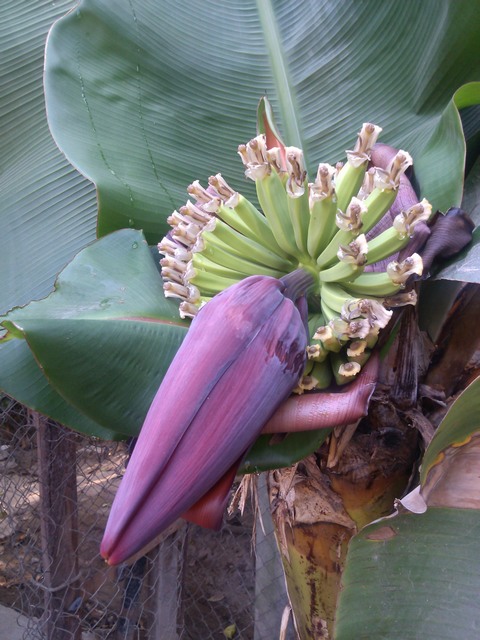
This is a banana flower. (A platano, in Mexico.)

Banana flower, Ocotito, MexicoLooks a little like Audrey II, the man-eating plant in Little Shop of Horrors, don’t you think?

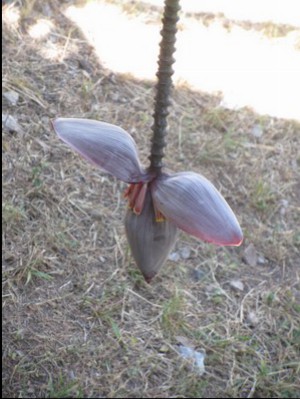
Banana flower, Acamixtla, Mexico

This flower bud, which is probably 8 or more inches long, opens, petal by petal, exposing a ring of long, tubular yellow flowers with red tips.

When these have had a chance to be pollinated, the covering leaves drop to the ground and a new set opens revealing another ring of sweet smelling golden blossoms.


Banana flower, Acamixtla, MexicoWhen the flower has opened completely, all that remains is a bunch of green bananas to grow and ripen – upside down of course.

Then the plant sends out another flower and the process begins all over again.


Here area a few more photos.

This slideshow requires JavaScript.

Tasty beauty don’t you think?

Some days are diamonds, some days are stones

John Denver sang those words. He was not talking about sunrises but it is a good adage anyway.

Each day awakens differently, some to sparkling brightness that illicit “oooohs” and “ahhs” as if watching fireworks. Others are more sedate in nature — cloudless days that offer a simple glow that grows from dark to light. This was one of those days.

Sunrise, Taxco de Alarcon, Mexico Sunrise, Taxco de Alarcon, MexicoSunrise, Taxco de Alarcon, MexicoSunrise, Taxco de Alarcon, Mexico


Whether spectacularly colorful or a simple glow, each day’s beginning is still beautiful.

Sunrise: Taxco Style

I have been asked for sunrise pictures EVERY DAY! I am not sure I can grant that request but will give it my best shot! (OK you language junkies, noodle on that one — shoot who?)

Sunrise, Taxo de Alarcon, Mexico

I just love how the sky changes with each passing minute, growing in intensity before brightening. I am so thankful to have such a glorious way to start each day.

Watch this to see the whole show.

This slideshow requires JavaScript.

Just call me chicken

I stand corrected.

Recently I wrote about chicken feet in my soup.

I have heard from my readers and confirmed with my hostess that chicken feet are a delicacy to be savored not just here in Mexico but in other parts of the world as well. Chicken foot sculpture, market, Chilpancingo, Mexico

Now, I have eaten some strange things out of politeness but if offered chicken feet, I’m not sure I could eat one.

Reminds me of a scene in an Indiana Jones movie, where he was served monkey brain soup with eyeballs floating in it. Ewww!!!

Of course that is what they said when I told them that I had eaten alligator, raccoon, and rattlesnake.

And, no, they do NOT taste like chicken.

Sunrise — Sunset

I saw my first sunset in Taxco today. Since the sun drops behind the mountains long before it sets, seeing any color at night is most unusual.

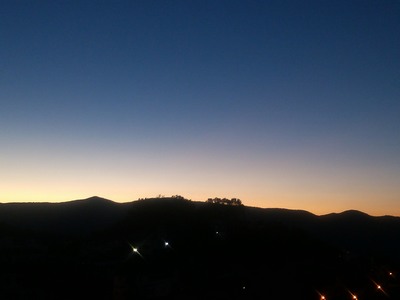
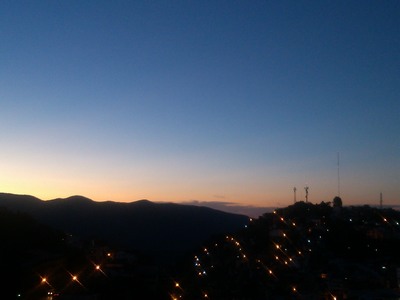
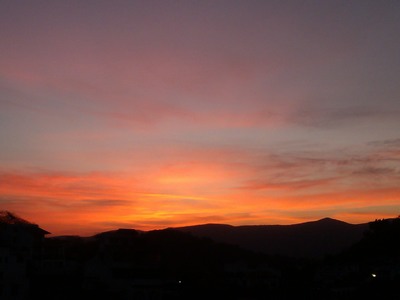
But wait, the sunset (r) was in the exact same place as the sunrise (l) this morning!

“How is that?” I asked my friend. And she responded with “January is crazy; February more” which may explain the ups and downs of the weather but not why the sun is setting in the east.

Having no logical explanation of this phenomenon, I will merely share the photos of this morning’s sunrise with you. Enjoy!

This slideshow requires JavaScript.


Candles for Groundhog Day

It is the middle of winter and we humans have to have a reason to mark that fact. Though back home, Super Bowl commercials and the predictions of Puxatawney Phil or Jimmy (the Wisconsin ground hog) for a long cold winter or an early spring  are the topic of the day (though if you figure it out, both seem to be about 6 weeks away).

Here in Mexico, the holiday season is finally coming to an end with Dia de la Candelaria (Day of the Candles.) I cannot really add anything new so I am reposting this article from last year. If you have not seen it, the information is all new to you; if you have, I hope you enjoy the review. Or, just rent the movie and have a good laugh or two.

Dia de la Candelaria

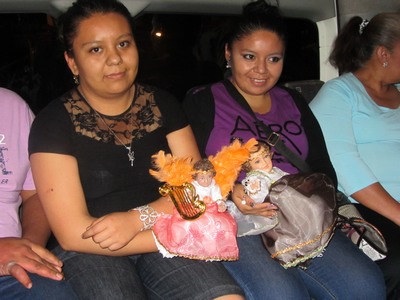
The brass bands are playing again and the airworks (those fireworks with only the boom) are going off again, and the combis are filled with people carrying around a doll wrapped up and cradled like it’s a real baby. What’s going on?

All this is in preparation for the last hurrah of the holiday season — Día de la Candelaria.

Officially known as the Feast of Our Lady of Candelaria or Candlemas, February 2nd marks 40 days after Christmas and thus Catholics celebrate in memory of the presentation of Jesus at the temple in Jerusalem (Luke 2; 22-39 ) and purification of his mother, Mary, after childbirth (a requirement of the Law of the Old Testament – Lev 12; 1-8).

Like many Mexican celebrations though, this feast day represents a fusion of pre-Hispanic traditions and Catholic beliefs. It appears to have originated in Tenerife (Canary Islands), southwest of Spain, in the early 15th century and spread from there.

The celebration may actually be a vestige of an old Pagan tradition, since this date coincides with the eleventh day of the first month of the ancient Aztec calendar and the beginning of the agricultural cycle when offerings to the gods of rain and clouds (tlaloques) would have been made to assure a plentiful harvest. In many rural villages the inhabitants wear corn cobs to church to be blessed.

Nino Dios, Taxco, MexicoIn Mexico, Dia de la Candelaria is an extension of the Christmas holiday season. (And I wondered why the Christmas decorations were still up in all their bedraggled splendor…)  On Christmas Eve a statue of the niño Dios (baby Jesus) is placed in the nativity scene; on January 6th, Three King’s Day, the child is brought presents from the magi or kings; and on February 2nd, the statue is dressed in fine clothes and presented and blessed in the church after which it is placed in a niche where it remains the rest of the year.
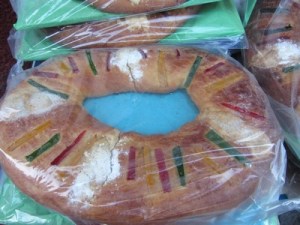
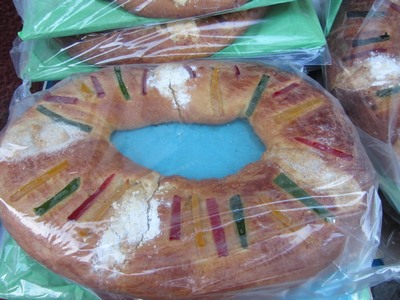
Rosca de Reyes

Rosca de Reyes

Mexican children receive gifts on Christmas Eve (the babe’s birth day) and on January 6th (the big day), when it is thought that the kings or wise men would have visited the Christ child. Then on February 2, the doll is taken to church and whomever found a toy baby in their Rosca de Reyes (wreath of the kings) bread on January 6th, hosts a Candlemas feast consisting of tamales and atole (a thick gruel drink).
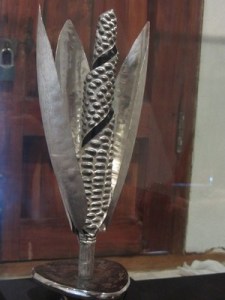
Silver corn statue, Mexico Both are predominantly made with corn; another link to Aztec ceremonies.

I find it interesting that February 2 also marks the mid-way point between the winter solstice and spring equinox which has long been thought to be a marker or predictor of the weather to come. In the US we call it Groundhog Day and according to tradition, if the ground hog sees his shadow, he goes back in his hole, representing 6 more weeks of winter; if not, spring is supposedly on its way.  Often Punxsutawney Phil (Pennsylvania) and our own Wisconsin groundhog, Jimmy, will compare predictions and hopefully agree that the long, cold winter will soon end.

Here are a couple of poems that show the connection between Candlemas and Groundhog Day.

From Scotland:

If Candle-mas Day is bright and clear,
There’ll be two winters in the year.

From England::

If Candle mas be fair and bright,
Winter has another flight.
If Candlemas brings clouds and rain,
Winter will not come again.

Groundhog Day Video cvrFor a few laughs, watch your local channel (library or Netflix) for the Bill Murray movie Groundhog Day.

What is your favorite scene?

Mexican Chicken Soup

The word of the day is “la gripa,” cold or flu.

Even though it is sunny and warm, it is cold season in Mexico, just as it is in the States. And just like everywhere, when one person brings home a cold or the flu, they generously share it with other family members.

When Irma was under the weather recently (now there is one of those “what does that mean?” expressions), I thought I would make chicken soup to help her feel better faster.

I was busily chopping onion and garlic while the chicken was starting to simmer in the pot when she appeared to fulfill her duty to make lunch. When she insisted on handing me the alphabet macaroni (something I was never fond of except for spelling practice), I had to explain that I was making “sopa Americana por la enferma” (American soup for the sick) or she would have nothing of it. Later when the hot, fragrant broth was set before her, she gingerly tasted it and declared it “muy bueno” very good.

Here, the treatment for what ails you — whether la gripa, a broken bone, anxiety, depression, or anything in between — is sopa made with alphabets in a tomato broth. Apparently, they believe in the healing capacity of alphabet soup as we do in chicken broth.  Science just might disagree though, as this article from Web MD points out.

It is not like Mexicans do not make chicken soup, as this photo of a recent lunch will attest to.

Mexican chicken soup

“Look mom, there’s a foot in my soup!”

I always wondered what they did with these.

Chicken foot sculpture, market, Chilpancingo, MexicoAs an amusing anecdote. An American friend of mine once told me about when he and his wife first moved to a small town in Mexico. Chicken feet were highly valued, and chicken breasts were almost given away. They said they never ate better.

To each his own.

My grandmother always preferred what she called the “Shteets,” those two tiny specks of meat “that jump over the fence last” (the tail bone). I was never really sure if she liked that part best or she was making sure that everyone else ate high off the bird while she was satisfied with a bite or two.

By the way, they do not eat the chicken feet, they just flavor the broth with them. (I stand corrected, many do eat them. Eeeeew!)

What is your favorite remedy for a cold?