Tepoztlan

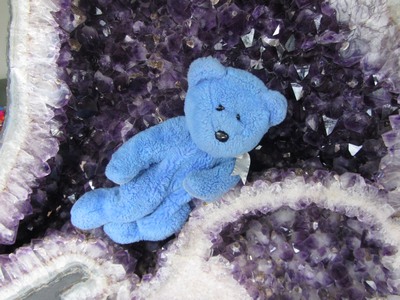
Blue Beal and amethyst

Blue Bear rests in a giant amethyst

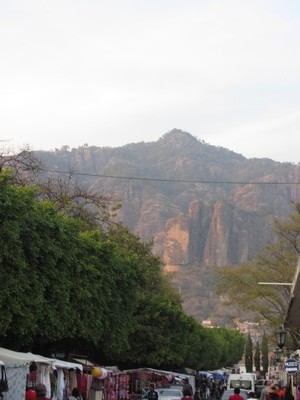
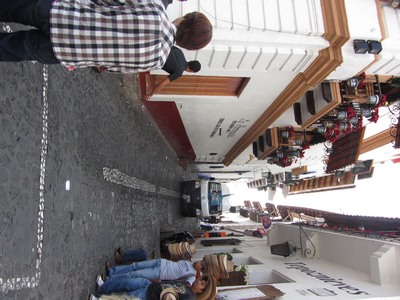
While visiting Cuernavaca, a group of us decided to visit what was described as a “cute little town” up the mountain from the city. Not knowing exactly what we  were getting into, we drove halfway across town for lunch suitable for a vegan and stopped at a rock shop so our driver could show off his knowledge of geology, and arrived late in the afternoon at the “cute little town” (ancient  – all narrow cobblestone streets with the usual picturesque zocolo in the middle) at the base of a spectacular mountain glowing in the setting sun.

Tepoztlan, Mexico

Tepoztlan, turns out to be the location of a pre-Spanish pyramid on the mountain and a center for the largest Rastafarian/Hippie village I have seen since the 1960s. Something to do with that pyramid, I suppose.

Since the sun was already setting, we were not allowed to climb the mountain and view the ruins so we did  the next best thing. We browsed the junk (most imported from India) in the market stalls that lined the zocolo, snacked on jicama, vegan bread, toasted grasshoppers (ICK!) etc., and bought postcards.  The ex-convent/museum (there seem to be a lot of those in Mexico) was filled with artifacts from the indigenous cultures who lived here centuries ago. Though many similarities to other archeological sites, each has its own uniqueness as well. Always interesting.

We all agreed that we would like to come again, on a weekday, when we can climb the mountain, examine the ruins, get a great overview of this cute little town, and avoid most of the modern, hippie culture on the main street.

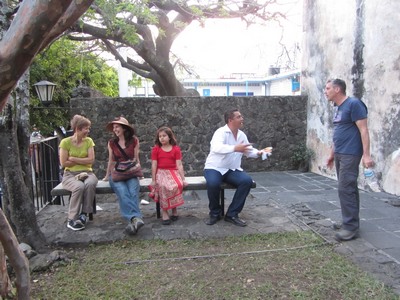
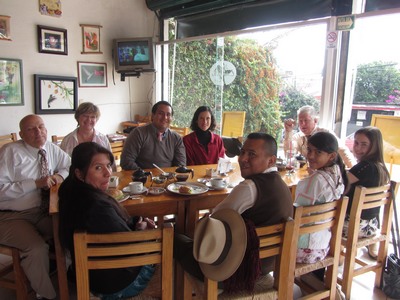
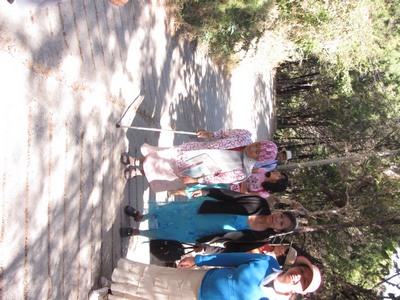
Friends at Tepoztlan, Mexico

Jill, Vanessa, Amarani, Emanuel, & Dan

Care to join us?

I just want to be understood

Please pardon my silence the last couple weeks. I have been traveling and exploring and either had an unreliable Internet connection or no energy to write. Let me catch  you up on the highlights.

Having been in Mexico, pretty much “en todo espanol” (total Spanish) for a month, it was time to give my brain a break. Though I can speak a little Spanish — more all the time, I just wanted to truly be understood for a change.

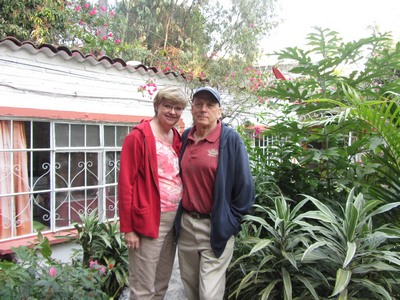
Friends in  Cuernavaca, Mexico

Bob and Kathy

So I boarded a bus to Cuernavaca (the city of eternal spring) somewhat South and West of Mexico City where I stayed with Bob and Kathy, a lovely Witness couple from Colorado, who shared their home, the challenges and joys of retiring in Mexico and their fabulous, gluten free brownies (and recipe) with me.

Cuernavaca, about 45 minutes from Mexico City has become almost a bedroom community, definitely a weekend retreat from the noise, pollution, and crime of the BIG city up the road. Mexico City residents also come for the cooler temperatures and after the big earthquake a few years ago, a sense of safety. What was once a naturally air-conditioned weekend get-away or a mecca for Americans wanting to learn Spanish, is now a sprawling megalopolis of its own filled with all the trappings of both Mexican and American life (Walmart or Costco anyone?).

Like most Mexican towns, the city fans out from the zocolo, this time instead of being dominated by the church though, it is bordered by the Palace of Cortez, itself a sprawling 1500s structure that now houses a museum, and a municipal building almost as large.

The zocolo itself is simply a stone plaza with a few benches and trees around it. As typical, artisaninas (crafts people) and food vendors of every description hawk their wares and try to get a few pesos out of you. On weekends you might be treated to a clown performing loudly in this open space, or the opposite, a mute floating angel.

There is a lovely artisans market next to the palace with some nice Mexican souvenir options, but to me the most interesting and lovely sight can be found in the “little zocolo” to the side of the main one, where a kiosk (gazebo) designed by Gustave Eiffel (of Eiffel Tower fame) and carried to this location in pieces by mule, adds a bit of early 19th century whimsy and grandeur.

The city is built on a succession of barrancas , steep ravines which help to channel water (abundant here) and cool the climate. A highlight is Salto de San Anton, a waterfall, near the center of town, that cascades about 150 feet into a pool exposing some pretty cool rock formations in the process. I am not sure if it was that we were there on a weekday or some other  reason but we were not allowed to walk either the path that goes under the falls or over the top. As we walked along the street looking for a view from the top, a nursery owner who uses the cool moisture of the falls to benefit his plants, allowed us to come into his garden for a peek. Not the best view of the falls but to be allowed to walk around his garden area was muy magnifico, like a small botanical garden.  Actually their are many plant growers and sellers here and the street was filled with green and flowering plants of all kinds. And imagine it is only mid-January!!! Back home the seed catalogs have not even arrived yet.

Bob and Kathy live at the end of one of the barrancas (or I think it was a small one). They rent a cute little Mexican cottage, likely built in the 40s or early 50s as income property (housing Spanish language students), in a garden setting that is sunny, yet cool and quiet  (a nice escape from the big city out the gate and down the street a few blocks. The cottage has been added onto a few times as every room and even the middle of some rooms go up or down a step or two. Very quaint and cozy though.

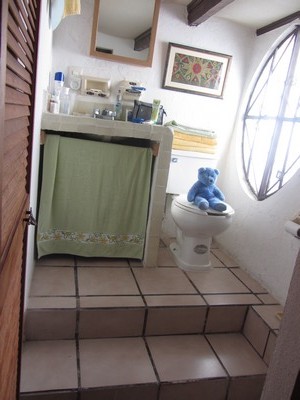
Throne room

I especially liked the guest 1/2 bath — a true “throne room” — just watch your head when you rise your majesty, the ceiling rafters are only about 4 1/2 feet above the throne!

I am afraid I asked a million questions and probably talked their ear off but it was so nice to be truly understood.

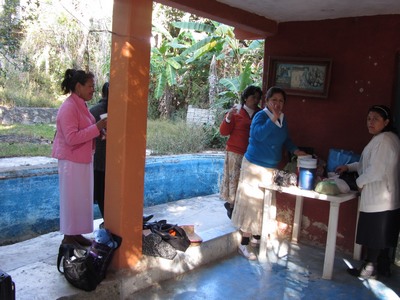
Break time, Cuernavaca service group

Break time, Cuernavaca service group

Street Signs

Taxco is not a small town, yet it is small enough that the residents (the permanent ones anyway) seem to know everyone. There are no traffic lights in Taxco, though there are traffic police that stop traffic on busy roads so pedestrians can cross. Other than that, it is pretty much a first come, first go philosophy, or the typical Mexican attitude of if you can squeeze your car into the space, do so. Add that to the general steepness of the terrain and as you can imagine this philosophy comes with a lot of horn honking and occasionally (amazing really how rarely), scraped paint,  broken lights, and shouting.

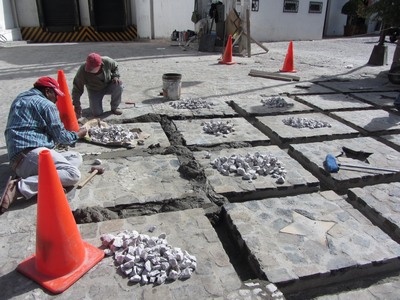
img_5684-qprBut having no traffic lights does not mean that there are no street signs. This being a colonial town, with the exception of the main highways into and through town, the streets are as they have been for centuries made of cobblestone.The road builders, set each stone by hand, and sometimes, using the three colors available (black, white, and red) take the opportunity to add some creative variety to their jobs by placing a pattern into the pavers.

img_5606-qprThere are the typical white lines down the middle, supposedly the line demarks two lanes but usually they serve more as a guide for one car, as if it could not get around the bend without straddling the line.

Other times, the lines form patterns — leaves, geometrics, even intricate pictures  in stone outside businesses or in the plazuelas.

Here are a few of my favorite street signs. enjoy the show.

This slideshow requires JavaScript.

Experiences — Cerro Gordo and beyond

Blue Bear and SarahLast Week I was mountain climbing in Tetipak. This week I went with Sarah on a short combi ride from Taxco to Cerro Gordo, where you can see for miles and miles. My friends and I visited a pretty pair of towns separated by a surprisingly clean, babbling river that cascades over rocks and 3-4 foot  falls (at least this time of year) here and there.

img_5950-qpr

My companion and guide, Jorge’ (call me George), pointed to the mountain in the distance where the spring-fed source of the river could be clearly seen cascading in an arch, hundreds of feet high.(Look closely and you will see the white streak on the top right side of the closest mountain.)  No wonder the water was so clean!Mountains outside Ijide, Mexico

As with other twin cities, one seems to be filled with grande casas (houses) and rancheros, while the other seems to provide the workers and services.

I thought a herd of cattle in the middle of town was  interesting.

(They were apathetic though.)

And then there was the stream that ran across the main road and tumbled down a pretty little waterfall. Careful, don’t get your feet wet.

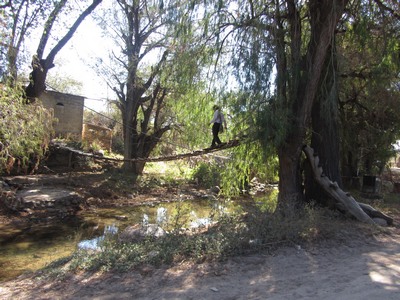
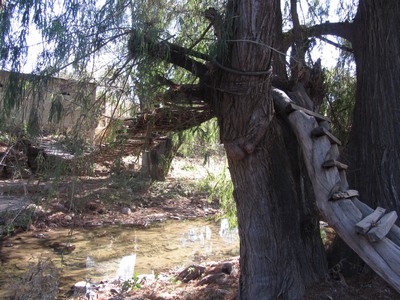
There was even a bridge over the river reminiscent of an Indiana Jones movie, complete with missing slats but minus the deep chasm below.

Rope & slat bridge, Ijide, MexicoOf all the little off-the-beaten-path places I have been this trip, this was by far my favorite. The streets and callejons were broad, the ups and downs not so steep, the abundance of flowers and greenery refreshing, and the cascading water provided musica naturale — ahhhhhh, a little taste of paradise.

This slideshow requires JavaScript.

Whole lot of shakin’ goin’ on

Monday night I was just dozing off, when the bed felt like it was shaking. At first, in my half daze, I thought is must be a particularly big truck on the street in front of the house, shaking the ground. The shaking stopped for a few seconds and then the house shook again, more mildly and without a sign of traffic anywhere. What I was feeling was temblors.

Popocatepetl must be trying to awaken his sleeping woman again.

Popapetepec1-qpr

Tetipac, Mexico

I was with Vanessa at the hairdresser’s last week, when the girl’s sister, Ana, invited me to go along on Saturday to a little town up the mountain, then have lunch at a sister’s home. Now I made up my mind a long time ago, that unless something is obviously dangerous, say “Yes” to any invitation, otherwise, you never know what great experiences you might miss.

So I needed to get up early on Saturday, “dress for cold and hot” (whatever that means), and  get to the opposite side of town, find a house I had been to once (which looks like every other house), to catch a ride to the town Tetipac (pronounced Te tee PAHK). We had to get going early because it was a good 45 minute drive to the top of the mountain and beyond — beyond all the towns I am familiar with, beyond the state park, Cerro del Huixteco  (more on this in a future post), through the trees and the chilly air, and down the other side.
San Juan & Tetipac, Mexico

San Juan & Tetipac, Mexico

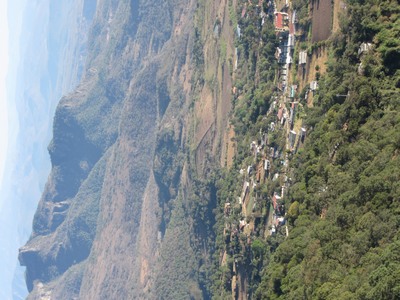
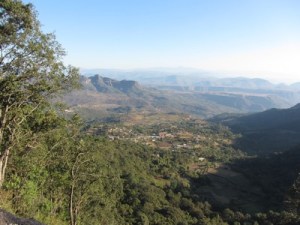
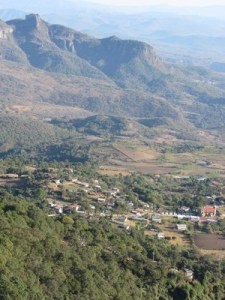
Now if Taxco is at 5600 feet or so, Huixteco has to be near an ear popping 7500 and the top of the peak around  8000 or so. We were high, that fact made very obvious when as we were heading down the other side, parts of the road had washed away and we had  a commanding view of the town waaaaaaaaaaay down below as well as the tableland and mountains in the distance.   San Juan and Tetipac, Mexico
As we had gone up, up, up, we then started down, down, down, curving around and around — whether  due to the curvature of the mountain or to switchbacks because of the steepness of the terrain, I was not sure (probably both.) At last, we reached the town and snaked our way steeply through the upper regions and down into a main business area hugging the side of the mountain. We turned left at an intersection, and immediately ground gears to crawl up the steeply pitched street and parked. The parking spot was at such an angle that someone had to hold the door as I tried to heave myself out of the back seat without falling back in.
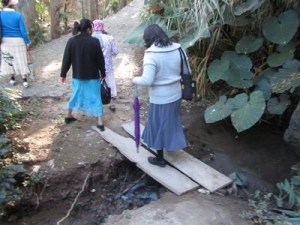
"Wooden bridge" Tetipac, MexicoSafely out of the car, we then, walked still further up another steep grade to the top of a driveway, and you guessed it — what goes up has to go down, down, down, and down some more where at the bottom we crossed a stream on a couple of warped 2×12’s to come to the entrance of the house where the service meeting would be held.

We and  three people from the house next door climbed a set of stairs into the lower patio area of what used to be a very grand casa with a nice landscaped yard and a pool (it is still a nice house upstairs, but the pool would make a better sunken garden at this point.) At this hour and altitude, I became very aware of what cold meant  as I shifted uncomfortably on the cold cement, trying to find a sunny spot to warm my toes.

Breakfast at Tetipac, MexicoSoon,  some others  came, then more, and when there were about 20 or 30 of us all milling around, a brother got up on the steps above the group and said a prayer. Not speaking Spanish very well, I thought it was time to go in the field, but when I grabbed my bag and stood up again, lo and behold, breakfast was being served! I was offered coffee (the weak Mexican kind), tea, tortas (sandwiches), and rolls. I had eaten before I left so I accepted a cup of hot tea (to warm my toes) and found it sweeter than any sweet tea served in the deep South.
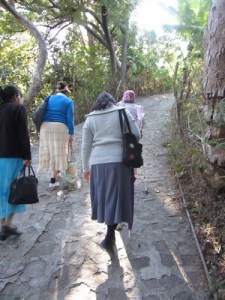
Steep road, Tetipac, Mexico

Up, up, up

After everyone had eaten, the food was packed up, the brother said another prayer and we were off, two by two — down the steps of the house, down to the stream, across the wooden “bridge” and up, up, and up the steep driveway to the top. I was breathing heavy (not used to this altitude nor the “can barely stand up” steepness,) but if  the 87-year-old pioneer sister with a cane could make the grade, I was determined to do the same!
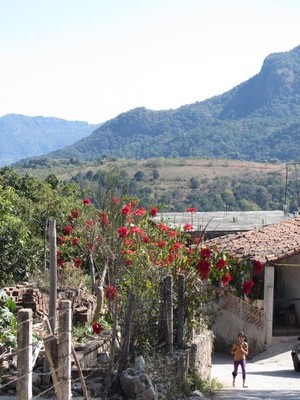
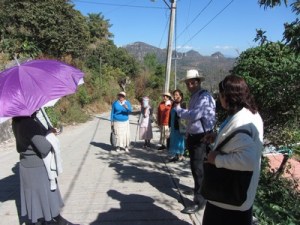
img_5741-qprNow Mexican service is a little different than that of the US. Since there are few real blocks and lots of little callejons (alleys) to get lost in, everyone works house over house as a herd (or is that a flock?). Most of the group went down the steep incline to the main residential street and started working up the mountain; nine of us sisters were sent down a dead end road and then were to connect with the main group when we were done.

“So how does this work?” you say, since most Americans have trouble working house over house when there are just three people!

Well, the whole group walks along the street, and when a door to a house is found, two people peel off, knock and holler “Buenas dias!” and wait to see if someone comes to the door or sticks their head out a window above.

Padlocked door

Not-at-home

img_5721-qpr

(I still sometimes do not know how they know a house door from a garage door from a closed business  since in these places most of the doors are solid corrugated iron gates that look more like garage doors. One thing I do know is if it has a padlock on the outside,  no one is home.)

The rest of the group walks on, repeating this procedure (sometimes at doors within a few feet of each other) until they come to an alley or a fork in the road, then a 10-15 minute discussion ensues to determine if the alley is a real callejon with houses on it that should be worked or if it is even part of the territory to be worked, and if so who is going to go that way. The brother in charge, who is trailing the last members of his flock to be sure none get lost or left behind, usually arrives and reassigns groups of people to go each way.
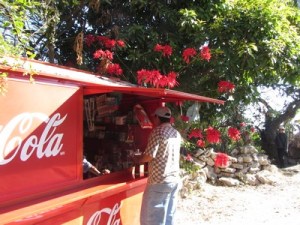
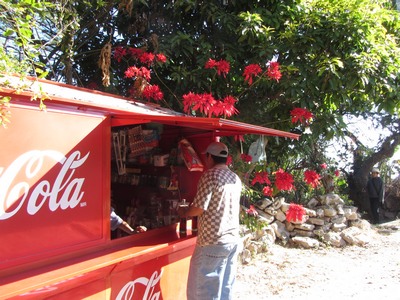
TiendaOn this particular day,  the sister I was with had a good call at the first house (also the location of a tienda, a shop – but in this case a metal box, with sides that open to vend novelties, snacks, and necessities; think of the food carts on State Street or at a carnival only without wheels) which meant that everyone else worked the dead end and then went to the main street and started following the other  group up the mountain street. That left us dead last in the flock, walking and walking up the steep incline in the hot sun until we caught up with the rest of the group, deep in discussion over which way to go. Getting that straightened out, we walked and walked and walked  up some more either finding no one home (found out later most of the town was at a funeral) or being behind the rest of the group, attempting to make it to the front where we might actually be able to call on a house (a flock of geese come to mind.) Then we came to another fork in the road.
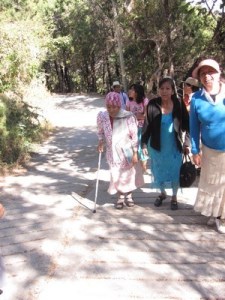
87 year-old pioneer (with cane)

87 year-old pioneer (with cane)

As we waited and discussed whether we should take the side street (callejon) even steeper up the mountainside, where there may or may not be a house, or the calle (street) that seemed to continue on a gentle slope heading down, a man and his wife came down the callejon (so there were houses up there). I seized the opportunity to try out my presentation in very  limited Spanish and when I had no more words to use, the sister helped out. The man took the magazines and answered the question about whether anyone else lived up there by pointing to an old man, with one leg, one crutch, and a pile of firewood on his shoulders as he started down a “callejon” (more of a dirt path short cut down the mountain) into town. I dare you to try that on two good legs without any firewood!
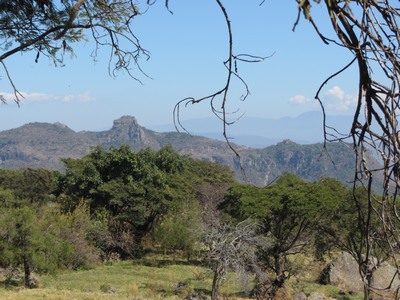
Sombrero Mountain, near Tetipac, Mexico

Sombrero Mountain

Nobody home today, so, on we went down the relatively gentle road, past the cow pasture and an amazing view of  Sombero Mountain – so named because it looks like a giant sombero, until we came to the main road into town, far above where we started. So on we walked,down, down, down, past the city monument and the fountain welcoming you into town, past the washed out road with white rocks indicating not to drive there, past the first few houses and businesses, all visited by other members of the flock, well ahead of us, past the house on the rock (No, not that one!) until we came to what appeared to be the main (and only) intersection in town where everyone was gathering for break time (which means, find a place in the shade and if you can sit on something do so.)

It was not long before the car and the combi that had given everyone a ride over the mountain, appeared, loaded us all up, then took us down, down, down some more where the real center of town was located (you know because the church is located there along with a small square of businesses), past the weekly market stalls to a house in the lower section where we were invited to lunch by a sister and her daughter. They served everyone the most delicious mole (both red and green), friole tamales, and rice.  Mmm mmm good!
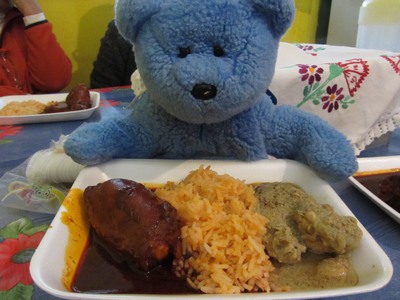
red and green mole

Blue bear with red and green mole.

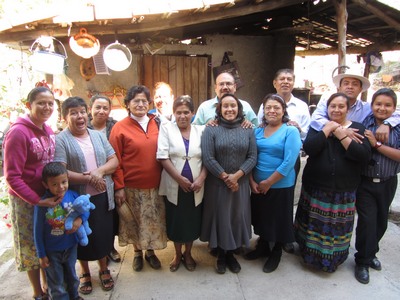
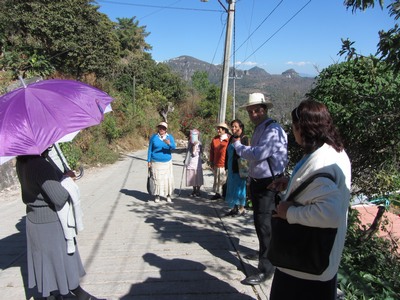
Service group, Tetipac, Mexico

Service group, Tetipac, Mexico

Now, if you are wondering how you keep track of placements and not-at-homes in such a far flung, rustic place that may or may not have house numbers, well, you don’t. The territory is worked every week or two, so if you miss them this week, there is always next week and somehow all the sheep are found.

Three Kings Day — Mexican Traditions

In Mexico, Christmas Eve and Day are a time for family. Since the whole country has at least two weeks if not a month off school and work this time of year, the whole family comes from far and wide to gather around the dinner table on Christmas Eve and share Christmas Day together, for the most part quietly. The children may receive a small gift or two, mostly from visiting relatives, but Three Kings Day (January 6) is the big gift day for them.

Called Epiphany elsewhere, this is the close of the Feliz Navidad season that began on December 12 with the Festival of Guadalupe. The tradition holds that this is the day (12 days after Christmas) that the three kings (wise men or magi) arrived to present gifts to the infant Jesus.

So,imitating the gift giving of the three kings, Mexican parents present gifts to their children (and each other) on this day. The night before, children set out their shoes and in the morning they are filled with small gifts, (The children of Latin America, as well as Spain, receive their gifts from the three kings rather than from Santa Claus) though now days the gifts may appear under a Christmas tree.

It is interesting that in other parts of Europe (Russia and other Orthodox lands for example) that Father Christmas comes on January 6; that date having something to do with the change to the Julian calendar.

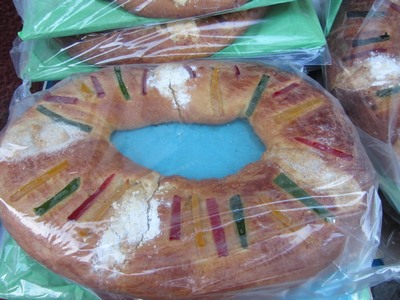
Three Kings Day is celebrated with the eating of a special bread, Rosca de Reyes (wreath of the kings). Baked as an oval, the loaf represents a crown and is decorated with colorful dried fruits and candies to symbolize jewels.

Rosca de Reyes

Rosca de Reyes

A doll figure is hidden inside, representing hiding Jesus from King Herod’s troops. (You might recognize this tradition as part of Mardi Gras celebrations when kings cake is served.)The person who gets the slice with the doll inside must host a party on the dia de candelaria (day of the candles or candle mass) on February 2. (More on that in February.)

Another Mexican tradition was also upheld, as I was awakened at midnight by firecrakers and cherry bombs going off in the callejon (alley) behind my house.

Gatos y Perros (Cats and Dogs)

I have been told “It never rains in December,” or January or February, for that matter. And yet there I was with a family way up on the mountain and the tin roof started to ping, ping ping. The daughter rushed outside and brought clothes in from the line just as the ping, ping, pinging turned into a steady roar, so loud and furious that we could not hear each other speak. So after a few minutes of arranging a few buckets, they opened the window so I could see the rain coming down in sheets, shrouding the next mountain in a hazy aqua mist. It really was quite beautiful to watch even if we could not talk over the roar.  (Imagine what it might be like living under a waterfall.) I had been considering buying an umbrella for the sun, but after this downpour, I think there is no doubt that an umbrella is on my list of must-haves right up there with a sturdier pair of sandals for navigating the cobblestones.

I am in Mexico a full 6 weeks earlier than last year and I’ve noticed that it is cooler and cloudier; the latter greatly affecting the former, you see. In my previous visit, I marveled at how nearly every day was the same. The sun rose from behind the mountains with only a rosy glow, no clouds to reflect its glory. It traveled across a deep azure blue yet cloudless sky, until it set without much fanfare; only rarely a few clouds provided a canvass for the setting rays to wash with color. This year however, I have seen clouds over the mountains in the morning glowing in hues of pale pink to fuchsia to purple and at night deep tangy reds accenting steely blue cumulus puffs. Of course those clouds are where that sudden downpour came from. Ah the glory of creation!

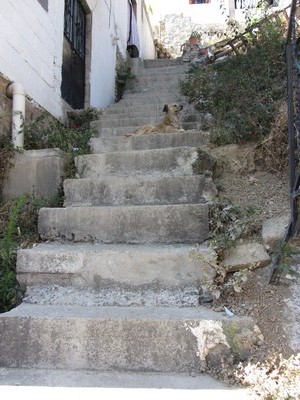
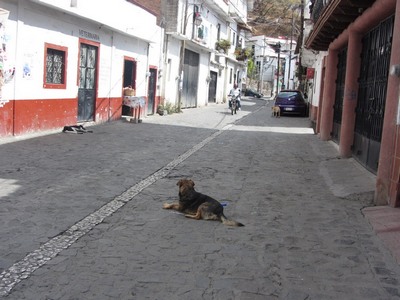
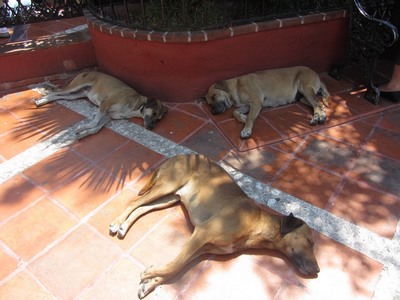
Dog on stairsThen there are the other kinds of cats and dogs. I am not sure why most Mexican’s buy dogs. Oh there are house dogs (usually Chihuahua or small poodle mix) as pampered as any US pet but most are just mutts that pace the rooftops barking at every noise, person, or vehicle that goes by (and there are many). There is one on a roof not far away that seems to bark incessantly — you’d think it’d grow hoarse, but no, “Bark, bark, bark, bark, breathe; bark, bark, bark, bark,” all day and late into the night.  Dog in street, Taxco, MexicoI am sure dogs deter would be thieves, and perhaps, along with the cats, keep any non-human creatures at bay, but they are not pets here, they are just dogs, not to be paid any mind. Many run wild and wander the streets, stealing garbage, and leaving messy reminders that they have traveled that way. When you walk the streets you definitely have to look up for low hanging building extensions (lights, plant shelves, window guards, even roof tops), ahead and to the sides for traffic (here it is pedestrians beware), and down to watch where you step. It can be exciting some days.

Dogs @ zocolo

Mariachi

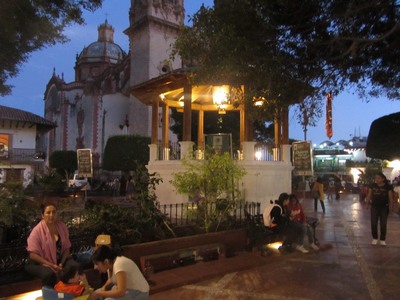
Zocolo at night, Taxco, MexicoThe Zocolo is the center of activity in most Mexican towns and Taxco is no different. There is usually a landscaped, park in the center, with flowers, trees, shrubbery, benches to sit upon, and a “kiosk” (bandstand) for musical and other presentations on special occasions. There is a casual, relaxed fiesta atmosphere about the place — vendors sell popcorn and candy, blow up toys and Mylar balloons; there are artisans selling watercolors, indigenous peoples selling sombreros (hats), colorful baskets, painted leather or pottery, embroidered clothing, and  the ever present street urchins with their packs of Chicklets. Of course, a Zocolo would not be complete without a shoeshine chair on every corner. They do a brisk business, too. Mexicans love shiny shoes.

You might find many of these things or their equivalent in almost any larger American city. Madison, Chicago, Austin, Boston, Manhatten, Brooklyn, all seem to have their version, whether in the city center or a central park of some sort. However, only in Mexico will  you find a true Mariachi band.

You can tell the Mariachi (the most distinguished of street musicians) from the rest of the bands by their black suits, red ties, and shiny silver buttons and chains adorning their jackets and pant legs. There are usually about 7 in the group — several violins, a viola, a couple guitars (one a bass), and a trumpet or two. They tend to gather at the Zocolo on weekends and in the early evening when people are strolling about, warming up, practicing riffs of new songs, and generally waiting for some lucky woman to come along whose escort treats her to a performance. After the negotiations over price, the band gets off their park bench, and with great aplomb seats the couple and gathers around to serenade her. One song turns into another and then another — like true musicians everywhere, they love to practice their craft.

I recorded video of one song, however I cannot seem to upload it to Youtube in a timely manner so you will have to be satisfied with pictures for now. If I do not figure it out and post it later, when you see me, ask to see the video. It is truly a treat.