
April showers do indeed bring May flowers.

April showers do indeed bring May flowers.
Returning to the US after 5 months in Mexico, means adjusting to some significant changes.
First, the weather. It is c-c-c-c-cold – going from 85 degrees to a high in the 40s or 50s is a shock to the system. As my grandmother used to say, “You’ll get used to it.” That is true, but “hurry spring!!!!”
Second, though it is only temporary, the pitter patter of tiny feet and all that goes with them — the tumbles, the tears, the tantrums, the snotty noses, the sweet smiles, the sticky hugs, and, of course, the constant clatter. Shocking and sometimes a test of endurance. Being with my grandchildren (and their parents) however, is something I would not miss for the world.
Most of all though, I have to get used to the sticker shock. Twice now I have gone out to buy ingredients to make a single meal for four, only to reach the check out and be flabberghasted at the cost. In Mexico, I could buy a whole week’s worth of groceries for what doesn’t even fill a single bag here!!! I don’t think I will ever get used to that.
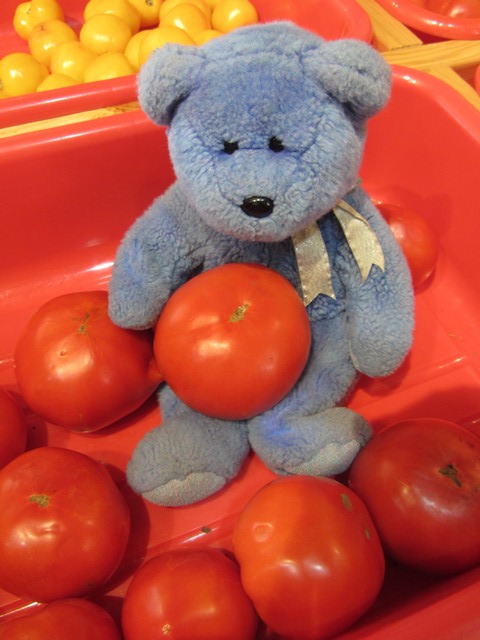
Traveling to and from Mexico, I take advantage of having my bags already packed and visit my daughter and family. This year that meant a trip to Portland — Maine, not Oregon.
Portland is a beautiful, historic, sea faring city, “Down East” as the natives call it, which means it is in the southern part of the state on the East Coast of the US, yet still just about as far north as one can get without being in Canada.
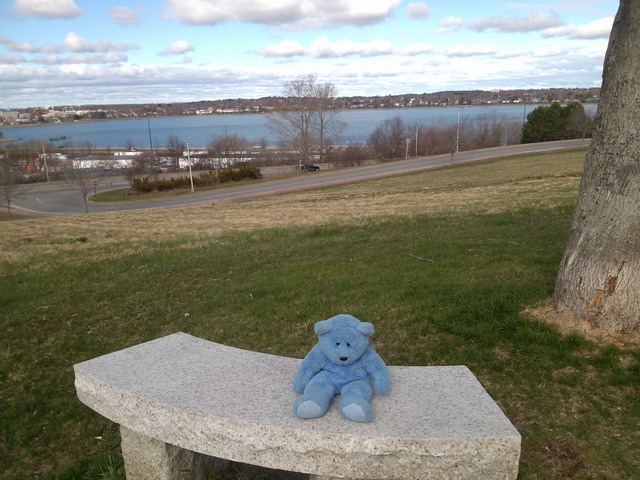 If you have never visited the East Coast of the US, especially in these northern climes, it is a rugged landscape, and the people are a rugged lot. They have an independent streak and are passionate about the environment. Many of the original “organic” or “all natural” companies had their origins in Maine.
It is a land of outdoor beauty and adventures — rocky shorelines with views of sailboats and fishing trawlers; rolling hills covered in maple trees that give up their sweet nectar in the spring and go out in a blaze of color in the fall; snowy winters for skiing, skating, sledding, ice fishing, or sitting around a warm fire.
Portland itself is quaint as only towns with 200+ years of history can be. Everything is historic from the wharf along the Fore River that leads to the sea, to the fishing boats, the brick streets, and the grand Customs House. Stroll along the waterfront or wander around downtown and you will find quaint shops, filled with souvenirs, antiques, handmade pottery, clothing, but also the necessities. It’s a small town, boutique atmosphere. If you want a shopping mall though, you will not find one; you will have to drive 20 minutes to the next town.
 There is plenty to do in Portland. Visit the Children’s Museum with your favorite little ones; they never run out of things to experience. Head to the Railroad Museum and ride the train along Casco Bay. Go whale watching. Walk the historic wharf area and purchase the catch of the day right from the boat. Or indulge in killer dark chocolate sorbet from Gorgeous Gelato, one of many ice cream and gelato shops competing for your taste buds.
Speaking of taste buds, Portland is a foodie’s heaven. Though chain restaurants can be found, local restaurants offering delicacies from cultures around the world, creatively transform the tiny spaces of the historic buildings into a feast for the eyes and palate.
The arts are alive and well in Portland, with dance, theater, puppet shows, and groups centered around activities like swing dancing. The library is not just a quiet repository for books but a center of community activities with concerts and visiting performers.


I wish I had more time to spend in Portland, and I especially wish I could have been there during the summer when the whale boats are running, the water is warm, and the town is humming. Perhaps I will visit again and have a chance to explore more.
Stay tuned.
 Some days are hot. Some days are cold. But one thing is for sure, spring has sprung.
I have left Taxco de Alarcon, Mexico behind. As I settle into my new home in the US, I remember often the sites and sounds that make this lovely city so unique.
I thought I’d share them with you here. Sit back and enjoy the tour.
Sit back and enjoy the show.
 This is Matylda. She is a cute, little spitfire of a young woman from Poland, who is currently living in Central America. The son of a family of friends, who is living in Guatemala, met her there, and when he came back to Mexico to visit family, she invited herself along. Thus began a whirlwind tour of central Mexico to accommodate her insatiable desire to see and do everything possible. In a brief 48 hours in Taxco, she shopped the tianguis (super silver market) from one end to the other, hung out at the zocolo, tasted foods she had never tasted before, went to the top of one mountain to get the best view of Taxco from the base of the Cristo statue, then down to the bottom and up another mountain to the upscale resort, Montetaxco, where she climbed on the back of a horse for a photo op, then down to town again.
And that was just Taxco. I think she put more mileage on their car and more photos on their camera in 10 days than they do all year.
It was a blast getting to know you Matylda. No one can accuse you of waltzing through life.
Near El Ocotito is the town of Buena Vista San Juan or something like that. There are a lot of Buena Vistas in Mexico so most have a saint’s name attached but since that part is never used locally, if you are a visitor and especially a gringo like me, you are never quite sure.
Just outside of town is a spring that bubbles up out of the ground. As usual this “miracle” has been marked with a cross so that the blessing of water never dries up. A small catch basin holds enough for locals to come and collect the cold, clear water for drinking immediately or to carry home for later.


The rest of the water, flows under the rock wall of the basin and along a natural channel until it is corralled in a large catch basin or pool before it cascades over the edge and follows a natural channel again.


This larger pool is both the water supply for the town AND the local swimming hole. For a small fee, which goes to support the town, you can enter the grounds and picnic, swim, hunt crayfish, play in the water, or simply enjoy the surroundings and the sun setting behind the mountains.


A local family who live adjacent to this unique natural water source, take the admission fees and run a concession selling roasted corn, snacks, drinks, and bathroom visits in exchange for free water and all the swimming they might like. Like the natives in Florida, they probably think the people who come here to swim in the winter are crazy, but they are happy to take their money.
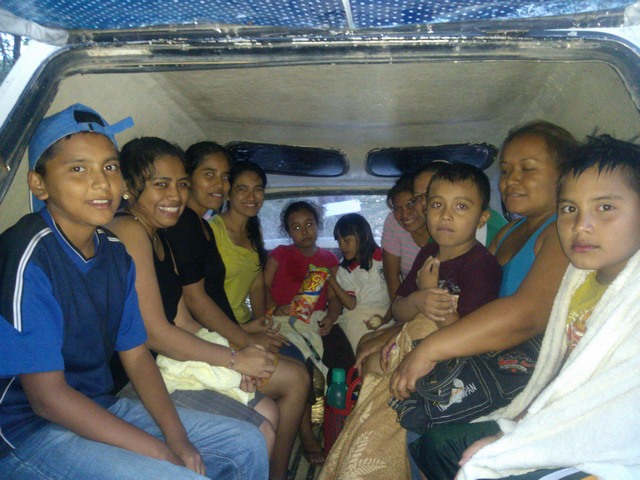 Shivering but still smiling, just a few of the crazy ones.
One of the reasons that Tehuacalco was built on top of the mountain is because of the river that flows around the bottom. Afterall, what self-respecting god of water would bless a place without water?!!!
The river, with its tumbling rocks, quiet pools, and water slides, is a sort of natural water park. The tumbled rocks in the stream bed, above and below a relatively quiet pool at the base of a large rock mass, attest to the power of the water during the rainy season.


This being the dry season however, the water runs quickly but not dangerously over the rocks and fills the pool to a depth of about 4 feet. Large flat rocks offer a place for sitting, sunning, or sliding into the pool. The tumbled rocks offer a place to sit and listen to the music of the water as it tumbles, babbles and gurgles along its journey to the sea.


This is the tame side. On the other side of the road, the river drops over the large boulders forming small pools to splash in and many opportunities for the more adventurous folks to slip and slide your way down river.
People with property on both sides of the road are capitalizing on their prime location by offering a place to park, food, and refreshments, tables and chairs for picnics, and easy access, even stairs, to the water. Chickens, ducks, and dogs come to clean up any food that is spilled or left behind by visitors. This day, you could even buy a puppy.
 Though the water here did not elicit any active diving or water ball activities, the youngsters especially had a great time. As the sun began to set and the air became cool though, it was time to return to nearby Ocotito.
Not too far west of Ocotito is an archeological site, the ruins of an ancient indigenous people, known locally as “The Ruins.” Tehuacalco, or sacred place of water, was discovered only recently and opened in 2008.The site interprets a center of government and worship, which ruled over a vast area roughly covering all of Guerrero state, and cities to the north, to the Pacific coast, and all the way to Jalapa in the southeast on the Atlantic.
It has a modern interpretive museum and bi-lingual (Spanish and English) signage, though as part of a group of 38 Spanish speaking friends, ranging in age from 3 on up, I had little chance to read the signs.
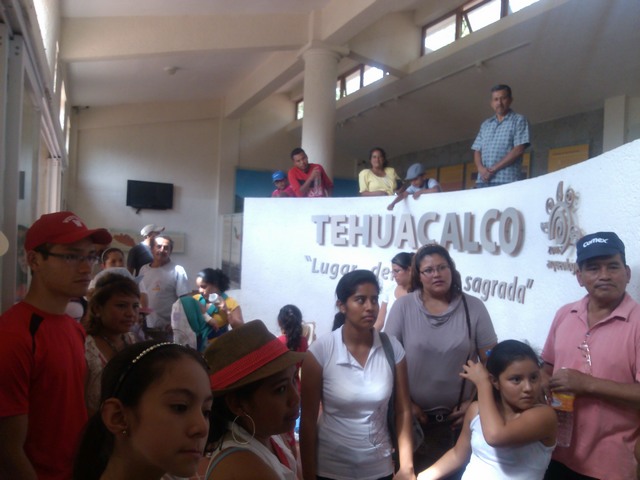 Since the ruins were discovered buried pretty much intact, rather than torn apart and the stones scattered, it appears that this site was abandoned by the people (for some unknown reason) rather than discovered by the Spaniards. Its location, high on a remote mountain, and a lack of silver or gold, may have played a role in that outcome.
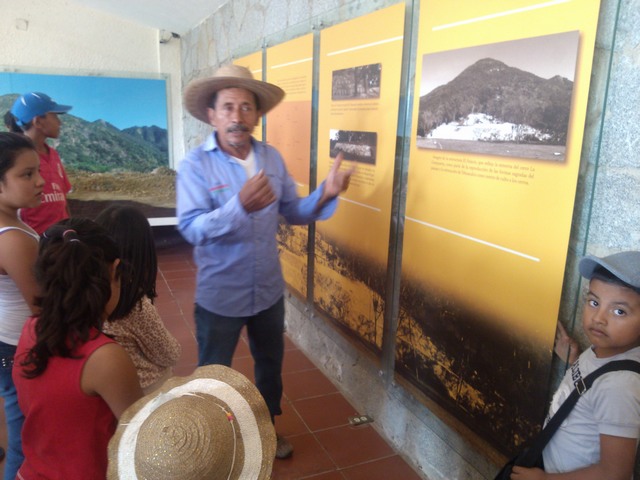 The people who lived here, worshiped the god of rain and water (essencial to life) and chose this location because of the abundance of water. They built a high temple, which faced the four points (or directions), where on each season’s solstice, the sun came up directly over one of four neighboring mountains. (This indicates to me that they may have worshipped the sun as well, though they could have just been marking the seasons.)
The building that housed their gods is gone now; all that remains is the temple mount. Below the temple is the government mount with some remaining ruins, several stellas (stone markers) which marked the passing of time (days, hours, and seasons), and the ball court.


Similar to other ball courts in Mexico and the Americas, this game, which was played by just two people, consisted of the players batting around a 5 kilo (about 11 pound) ball, made from a local tree trunk, using only their legs or shoulders (sort of like soccer or football if you come from these parts.) The object was to get the ball into a small opening in the wall at center court.
 Though the game was likely played every day, once a year, the two best players were selected to play to the death, literally. All the citizens would come to watch the match, standing above the court in the grassy area, one side rooting for each player.
The winner of the match was sacrificed to the gods (yes, I said winner), while the loser was ejected from the society to fend for himself amidst wild animals and poisonous snakes — live or die, never to return.
On the day of sacrifice, a procession moved along the sacred pathway and up the stairs and steep incline to the temple mount. Each level of elevation marking one step (level) closer to the gods. Only the priests, kings, and sacrificial victims were allowed to climb the stairway to the gods. The average person stood in a field below the temple and watched the spectacle as braziers lit up the night sky and shadowy human forms performed rituals and dances culminating in the sacrifice of the victim and his beating heart being offered to the gods.


I learned a couple of interesting things visiting this ancient site:
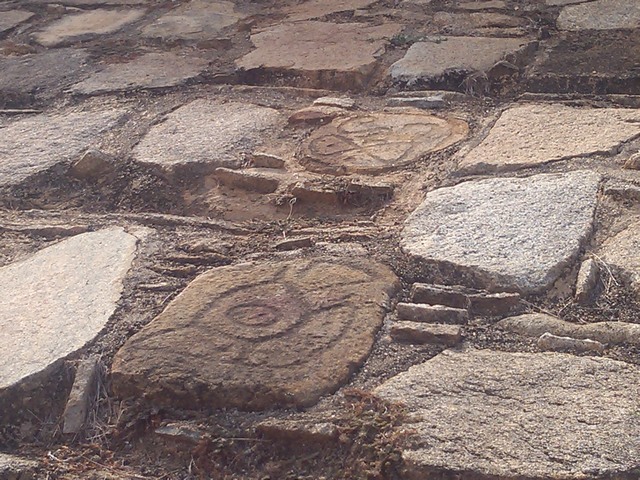 1) What I have always thought (and been told) was a decorative way of building rock walls using small stones between the larger rocks, turns out to have a practical reason (though lost to most Mexicans today.) The small stones allowed for more movement in the wall during seismic events (earthquakes) and thus the walls were less likely to come tumbling down.
2) The interpreter told us that the original pozole, a special soup traditionally eaten on Thursdays, Sundays, and holy days in this area, was made using the arms and legs of the sacrificial offering. Each bowl was topped with a small piece of the sacrificial victim’s meat, which was supposed to bring strength and protection for the coming year to those who ate it. As the guide said, some of our customs today, have their origins in these pagan peoples.
After a hot, sweltering, but very interesting afternoon we headed down the mountain to cool off in the river. But that is another story.
Hasta luego (until later),
In Mexico, you don’t just go to the supermarket and buy everything you need (well, you can sort of, if you like your fresh fruits and vegetables a week old and tasting like the rubber tires in the next aisle over.)
Most people shop the mercado (fresh market) where vendors sell everything from “fresh from their garden” fruits and vegetables, to meats, eggs, cheese, dairy products, herbs, dried fruits and nuts, masa (for making tortillas), housewares, hardware, clothing, and even handmade shoes. If you need it, someone will sell it.
In my house, the day to go to the mercado is Monday, that is because in addition to the main mercado downtown, there is a small mercado just around the corner. It is much easier to buy and transport heavy fruits and vegetables home from there than halfway across town. We load up on everything we think we will need for the week. On Mondays we eat like kings but sometimes by Sunday it is slim pickin’s.
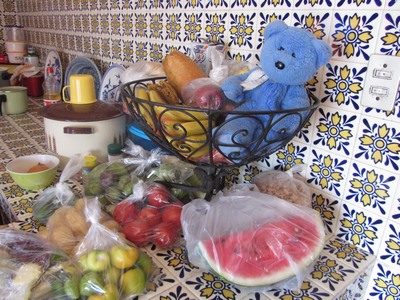
Shopping done
Here is a tour of a Mexican mercado.
 The Adventures of Blue Bear