Espanol or No Espanol? That is the question.

With my English group broken up and everyone going different directions, Vanessa to a little town to the East of Taxco, Sarah and Lili to a little town in a westerly direction, I have been immersed in Spanish “en todo.”

I don’t care what the language courses say about learning a language the way children do — by hearing it spoken; it does not work well for me that way. (Aren’t there studies that show that a child’s gift for learning language via the spoken word tends to disappear about age 5  when they begin to learn to read? ) I need to see the words, not just hear them.

BB learns Spanish

For me, learning a language is very difficult when there is no one to give me an explanation  of the word, even something as simple as “This is that.”  You can use visual clues for animate objects (table, chair, door, etc.) but what about things you can’t touch (feelings or ideas)?  How do you explain or understand the rules of the language (“I…” verbs end in o, or the difference between feminine and masculine articles  – an important concept in Spanish that makes no sense to an American who only uses a, an, or the.)

Adult language is filled with concepts and ideas, the untouchables of the world, and it can be very frustrating not being able to truly communicate. Do you think this is why 2-year-olds tend to throw temper tantrums?  I remember talking with Ezrah about that age, and having trouble understanding her pronunciation. She just kept saying the same thing louder and louder. Finally I said, “Saying it louder does not help me to understand, try saying it slower.” She did and I understood, and her frustration melted away.
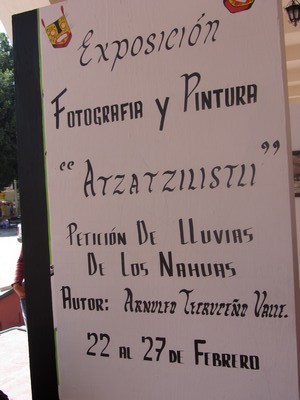
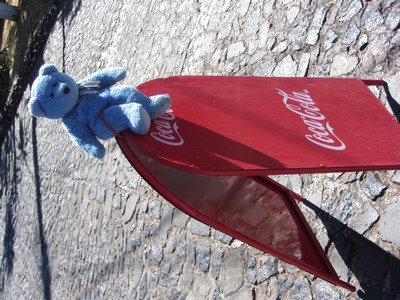
Exhibition sign

Can you read this?

I am learning more each day. Everyone tells me I know “much Spanish” and congratulates me. But what I know is words; what I do not know, at least not yet, is how to put them together to truly communicate. I am like a 3-year-old, “I want this” or “I go there.”  Or, I ask one word questions. Sometimes I manage to make myself understood, like when I asked for two sided copies at the copy shop, but any pride I might feel that I made myself understood disappears in a cloud of disappointment (and yes, frustration) when the next encounter I am not understood at all.

Perhaps I am doing OK speaking my “baby talk” however listening  and understanding is another thing altogether. I might get the gist of the conversation or it might just be a tangle of words, speeding by like a freight train, with no comprehension on my part. My brain hurts so I have decided I need a little English break. I am making plans to visit several different towns (Cuernavaca, San Miguel de Allende, and Puebla) in the next few weeks where, in each, I will enjoy not only a change of scenery but also an oasis of English speaking hosts that will benefit me spiritually as well as emotionally and intellectually.
img_3417-qpr

Stay tuned for the travelogue. Then it will be back to Spanish for the duration. Working on my power verbs!

Fuegos Artificiales

Fireworks, Taxco, MexicoYouth counts down until midnight to celebrate the arrival of a new year. Maturity counts down until midnight to celebrate the time that they can finally get to bed. –Andrew Peloquin

If you are one of the mature ones reading this you know how true those words are.  The traditions for welcoming in the new year are not that different in Mexico than in the States, except they are a little more random, unregulated, and engaged in by crazy drunks with firearms and no designated drivers.

Being in the center of town, I was treated to quite a sight at midnight as fireworks filled the night sky. And when I say filled, I mean filled.

From the Christo statue at the very tippy-top of town, to the Guadalupe church a little lower, to the small church near the center of Taxco, to the other side of the mountain at the Mission, to the top again at Hotel Montetaxco, fireworks exploded in a 360 degree arc from my balcony.   In addition, people in the streets shot off fireworks and bottle rockets of their own which whistled, popped, and lit up the sky with at least a few strayed dangerously toward neighbors houses into the wee hours of the morning.

Of course, all this activity had the dogs howling and at least one car alarm going off. It was quite a cacophony that has this “mature one” seeking a good night’s sleep!

Sweet dreams everyone.

Gatos y Perros (Cats and Dogs)

I have been told “It never rains in December,” or January or February, for that matter. And yet there I was with a family way up on the mountain and the tin roof started to ping, ping ping. The daughter rushed outside and brought clothes in from the line just as the ping, ping, pinging turned into a steady roar, so loud and furious that we could not hear each other speak. So after a few minutes of arranging a few buckets, they opened the window so I could see the rain coming down in sheets, shrouding the next mountain in a hazy aqua mist. It really was quite beautiful to watch even if we could not talk over the roar.  (Imagine what it might be like living under a waterfall.) I had been considering buying an umbrella for the sun, but after this downpour, I think there is no doubt that an umbrella is on my list of must-haves right up there with a sturdier pair of sandals for navigating the cobblestones.

I am in Mexico a full 6 weeks earlier than last year and I’ve noticed that it is cooler and cloudier; the latter greatly affecting the former, you see. In my previous visit, I marveled at how nearly every day was the same. The sun rose from behind the mountains with only a rosy glow, no clouds to reflect its glory. It traveled across a deep azure blue yet cloudless sky, until it set without much fanfare; only rarely a few clouds provided a canvass for the setting rays to wash with color. This year however, I have seen clouds over the mountains in the morning glowing in hues of pale pink to fuchsia to purple and at night deep tangy reds accenting steely blue cumulus puffs. Of course those clouds are where that sudden downpour came from. Ah the glory of creation!

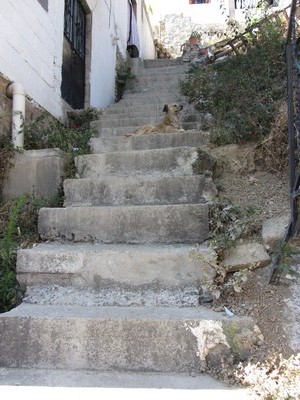
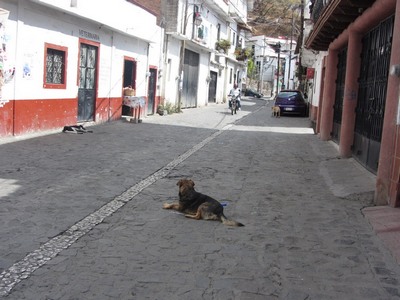
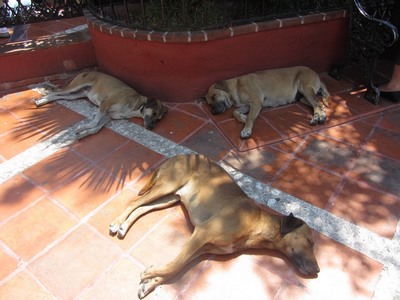
Dog on stairsThen there are the other kinds of cats and dogs. I am not sure why most Mexican’s buy dogs. Oh there are house dogs (usually Chihuahua or small poodle mix) as pampered as any US pet but most are just mutts that pace the rooftops barking at every noise, person, or vehicle that goes by (and there are many). There is one on a roof not far away that seems to bark incessantly — you’d think it’d grow hoarse, but no, “Bark, bark, bark, bark, breathe; bark, bark, bark, bark,” all day and late into the night.  Dog in street, Taxco, MexicoI am sure dogs deter would be thieves, and perhaps, along with the cats, keep any non-human creatures at bay, but they are not pets here, they are just dogs, not to be paid any mind. Many run wild and wander the streets, stealing garbage, and leaving messy reminders that they have traveled that way. When you walk the streets you definitely have to look up for low hanging building extensions (lights, plant shelves, window guards, even roof tops), ahead and to the sides for traffic (here it is pedestrians beware), and down to watch where you step. It can be exciting some days.

Dogs @ zocolo

Start doing things right

A Canadian I met in Florida sent this wish “for a brand new year to start doing things just right because this closing year has provided you with all the experience necessary to do so. Not?”

That really got me thinking. How often do we punish ourselves thinking about  when we made mistakes — “if only” we had done this differently or we “should have” done that instead? Why do we humans have the tendency to look backwards and beat ourselves up over all the little (and big) things we could have done differently? The past is past, and as Alwyn so astutely pointed out, it gives us the experience to make the future “just right.”

So be like Goldilocks, put the big mistakes behind you, forget about the shoulds that weren’t, and look forward, concentrating instead on what is best for you here and now that will make your life “just right.”

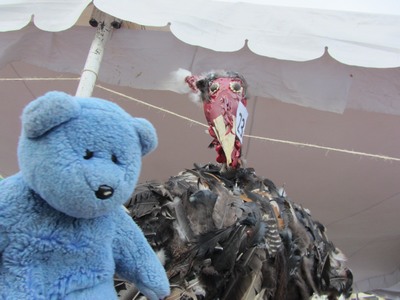
Oh, and don’t let the turkeys get you down!

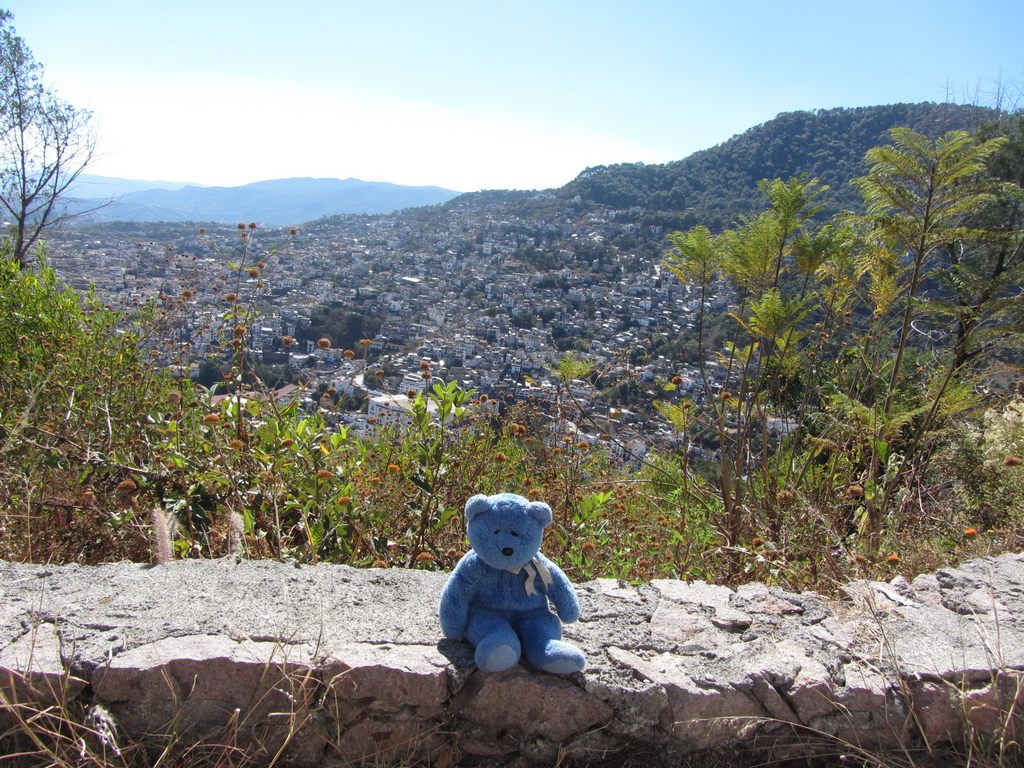
Blue Bear & Turkey pinata

Things We Take For Granted – Simple Living

Living in the United States, there are many things we take for granted. Things like a refrigerator and stove in the kitchen, electricity at the flip of a switch, garbage collection on the same day every week, hot water flowing from the tap, or even running water itself.  Those things may be common in a country like ours but in most of the world they are not.

Mexican bucket showerHere in Mexico, life is a little more like camping, even inside the house. Most places do not have hot water. If you need hot water for something, you heat it on the stove or grab a bucket and put an electric heating element in it until the water reaches the desired temperature. Then you take the bucket into the shower, and using a smaller container, mix it with cold water, slosh it over yourself, suds up, and slosh some more to rinse. (It is really pretty efficient — you can wash your hair, body, and underwear all in one fell swoop with one bucket.)

Of course, you could take an ice cold shower if you prefer; many people do.

You may have a refrigerator or you may not; if not, you go to the market more often and make foods that do not require refrigeration of leftovers (one reason I think salsa is a staple here.) You may have a stove with an oven even, or you may have the equivalent of a camping stove – 2 burners that run on propane. You buy drinking water in 5 gallon jugs at the local shop around the corner or from delivery trucks. Wash water is a hit or miss affair, however; it comes from the government, neighborhood by neighborhood on some schedule that only they know. To make sure they do not run out (at least hopefully) every house has a tank or two on the roof, so when “the water is falling” they can capture as much as possible to use until the next time their neighborhood is blessed. Many people also install a cistern in their house to store even more water. (I am not sure if, in true cistern fashion, they collect rainwater as well or if this is just an extra collection vat.) Trash collection is dependent upon when the truck goes by, and if you miss it….

Water delivery bike Everything here is delivered or hauled away by trucks, bicycle, or pushcart, and each has its own sound so the residents know who/what is coming down the street. It is quite a concert, though admittedly not particularly melodious. Water is announced with a loud, “Agua. Aqua.” The trash collector drives through the neighborhood ringing its bell and shouting “Basura!”on a recorded message over and over until it drives you crazy (but hey, you are not likely to miss them.) When you hear the bell, you take your trash out to the truck (or mule cart in some places) in whatever container you happen to have, and for 5 pesos (about 50 cents) they dump it in their truck and take it away somewhere. (A good deal considering that toilet paper cannot be flushed and there is a lot of human waste in those containers.) Propane is always delivered by truck (reasonable since even an empty tank is heavy). Crews drive around and around each block, filling the air with the scent of propane while honking the horn in 20-30 second increments, followed by the guy in back with the gas tanks yelling, “GAS!” If no takers, they continue up and down each street, repeating the honking/yelling routine, until they find buyers and the truck is empty. If someone hollers out that they want gas, the truck stops right in the middle of the street and traffic does not move until the full tank is off the truck, rolled into the receiving location, and the old tank rolled out and reloaded on the truck; impatient cars and combi drivers usually honking a not so subtle brass (horn) concert the whole while.

Close your eyes and imagine your morning wake up call — “Aqua! Aqua!,” “Clang! Clang! Clang! Basura!” “Honk! Honk! Honk! Gas!” along with the usual cars chugging, dogs barking, and people shouting. Quite a sound-acle, hey!

Now Irma is a classy lady, she has lived here for 50+ years and has all the vendors trained to come to her; water is delivered on Tuesday, trash is taken away on Thursday, and gas comes when she calls. All her needs are cared for like clockwork, well almost.  Though she has a cistern and a tank for water on her roof, even she is at the mercy of the city as to when the “water falls.” She lives in an area of more well-to-do residents, tourist shops, and hotels, where water for those tourists should be available but whether due to the holidays, the extra vacationers in town, or some other reason, water “hasn’t fallen in a month” and we are running out.

This being a large, four story house, my “penthouse in the sky” runs on a different water source (the tank)  than the rest of the house (the cistern.) The result is that Irma may have water in the kitchen but upstairs, where I stay, there may be none.. And that is exactly what happened on Christmas — the tank ran low so I did not have enough water to run the water heater (another rarity for Mexican households). “No problema,” I think, I can take a bucket shower using the cistern water, but no, the cistern is too low to provide water to the upstairs also.  So for 5 days now I have been going down to the ground floor, heating a pot of water to near boiling and carrying it up three flights of stairs (the last one, a wrought iron spiral staircase is the tricky one) in order to have hot water (or any water at all) to wash with.

This morning I awoke to the sound of water falling — and what a glorious sound that is. Ah, the little things we take for granted.

Mariachi

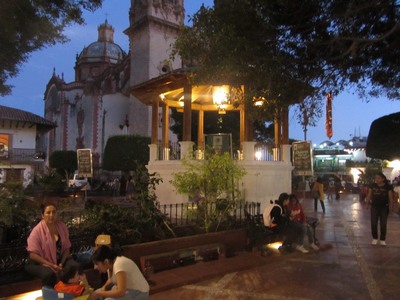
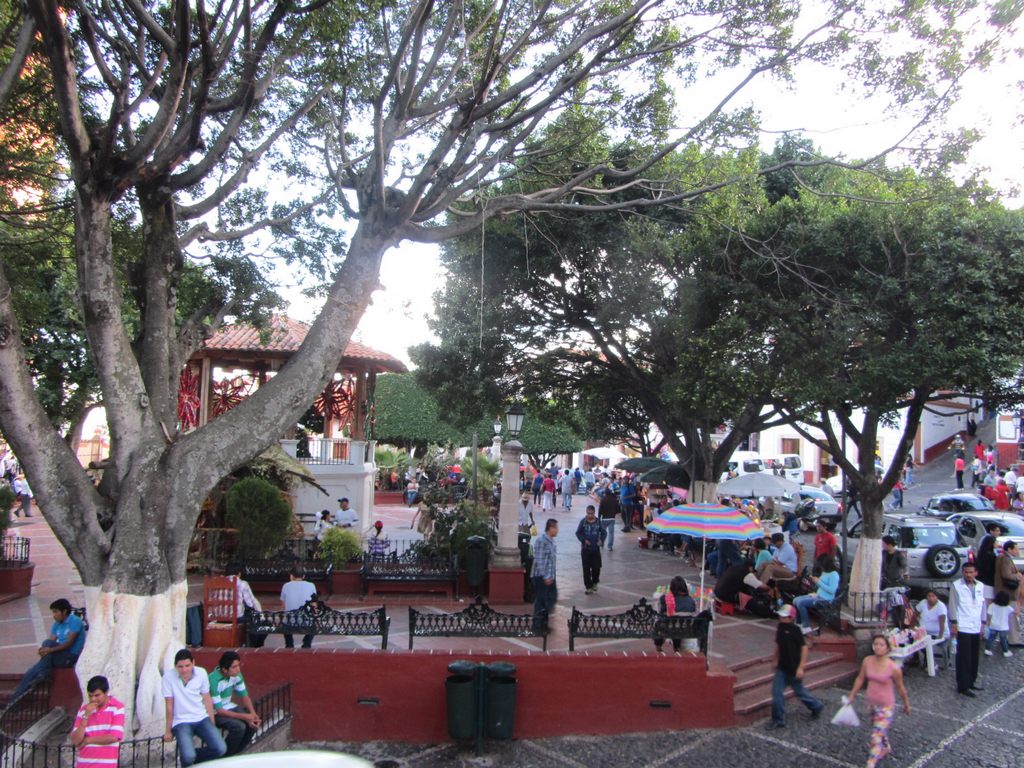
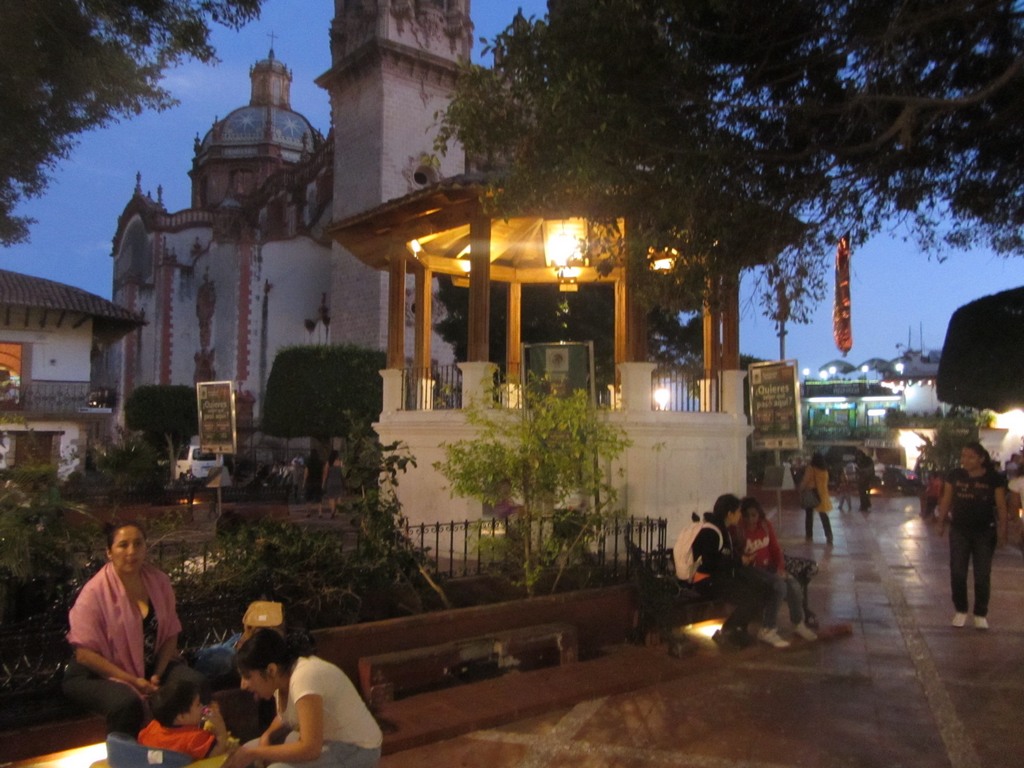
Zocolo at night, Taxco, MexicoThe Zocolo is the center of activity in most Mexican towns and Taxco is no different. There is usually a landscaped, park in the center, with flowers, trees, shrubbery, benches to sit upon, and a “kiosk” (bandstand) for musical and other presentations on special occasions. There is a casual, relaxed fiesta atmosphere about the place — vendors sell popcorn and candy, blow up toys and Mylar balloons; there are artisans selling watercolors, indigenous peoples selling sombreros (hats), colorful baskets, painted leather or pottery, embroidered clothing, and  the ever present street urchins with their packs of Chicklets. Of course, a Zocolo would not be complete without a shoeshine chair on every corner. They do a brisk business, too. Mexicans love shiny shoes.

You might find many of these things or their equivalent in almost any larger American city. Madison, Chicago, Austin, Boston, Manhatten, Brooklyn, all seem to have their version, whether in the city center or a central park of some sort. However, only in Mexico will  you find a true Mariachi band.

You can tell the Mariachi (the most distinguished of street musicians) from the rest of the bands by their black suits, red ties, and shiny silver buttons and chains adorning their jackets and pant legs. There are usually about 7 in the group — several violins, a viola, a couple guitars (one a bass), and a trumpet or two. They tend to gather at the Zocolo on weekends and in the early evening when people are strolling about, warming up, practicing riffs of new songs, and generally waiting for some lucky woman to come along whose escort treats her to a performance. After the negotiations over price, the band gets off their park bench, and with great aplomb seats the couple and gathers around to serenade her. One song turns into another and then another — like true musicians everywhere, they love to practice their craft.

I recorded video of one song, however I cannot seem to upload it to Youtube in a timely manner so you will have to be satisfied with pictures for now. If I do not figure it out and post it later, when you see me, ask to see the video. It is truly a treat.

Coming ‘Round the Mountain

Christo statue, Taxco, MexicoI spend most of my time in the central city, though I go up to the zocolo, at times quite steeply, and down to Las Jales where Vanessa lives, another long climb back up. But since this city is built on several mountains, at times I go up, up, up, and then up some more. Such was the case, today, when I accompanied Irma to visit Rosie and her daughters Denise and Rubi in Casahuates in the “nose-bleed” section of town, high above almost everything except the “Christo” (Christ) statue at the very tippy-top.

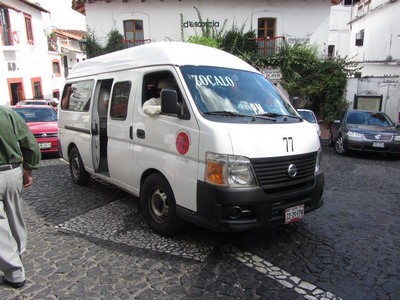
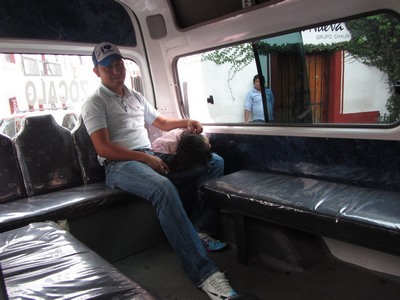
Combi, Taxco de Alarcon, MexicoTo get there we take a combi, a micro van fitted out as a taxi. Imagine a passenger van with all the seats removed and replaced by narrow benches, one on each side (behind the driver facing backwards, along the back, and lining both sides).

Combi, inside

Plenty of room today

They seat 12-16 comfortably (depending on the size of the people) but have hand rails attached to the ceiling for extra passengers to stand in the middle (if short enough to do so) raising the capacity to 20 or more (however many can or want to squeeze in.) Got the picture? Sort of a sardine can on wheels.

Now combi drivers are a wild lot, somewhat akin to kamikaze pilots but with their wheels on the ground (well, most of the time anyway.) You know this because the ceiling above the driver is filled with icons of Mary and other saints, presumably providing protection from anything bad happening. I think they get paid by the trip because they seem to fly through town, weaving and dodging, stopping just long enough to let passengers on or off, and off they go again, making change on the fly. Perhaps they even wish they had the wings of their kamikaze brethren so they could skip the traffic all together.

Combi rides  through town are exciting enough but when they start uphill it gets even more exhilarating —  twisting and turning along narrow cobblestone roads designed for donkey carts not cars, weaving around people, stray dogs, front steps, taxis, and other combis with mere inches to spare. There are houses built to the edge of the road on one side and a concrete wall on the other designed to keep you from falling off the edge of the mountain. Though the paint scrapes all along the length of it did not inspire much confidence in me, I have to admit the wall IS still there, and where it isn’t, the view is spectacular, though a loooooooong way down.  I digress though —

The truly exciting part is the ride down; it is as exhilarating as any roller coaster at Great America only remove the seat belts! It had me holding on for dear life as every twist, turn, or bump in the road meant sliding off the plastic covered seat, flying out into midair, and desperately scrambling to grab whatever was within reach (which was not, for some reason, the handrails) to keep from landing on the floor. I would, hand over hand, inch myself back to my seat only to fly around the next curve or over the next bump and repeat the process all over again.  I guess there was a reason that everyone on the combi had already claimed the undesirable  seats (behind the driver where you ride backwards or in the back where you jamb your knees against the wheel well.)  Wheeeeeeeeee!!!!
I think it is true, what Vanessa says, that “Mexicans must have special glue on their butts.” How else do you explain how they sit there nonchalantly as I fly?

Taxco de Alercon, Mexico

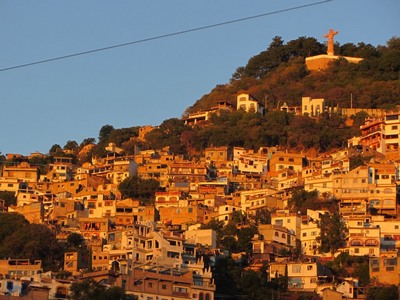
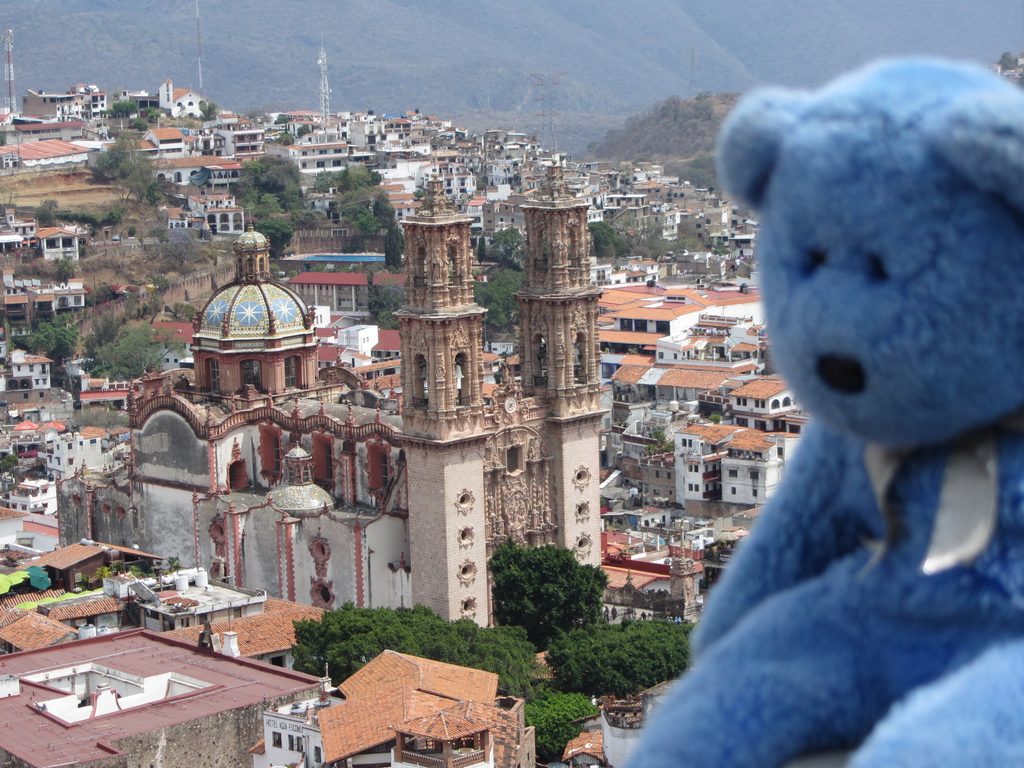
Taxco, MexicoI am currently in Taxco de Alercon (“The Silver Capital of the World”) a beautiful colonial Mexican town, all whitewashed walls and red tile roofs lining narrow cobblestone streets. Very picturesque.

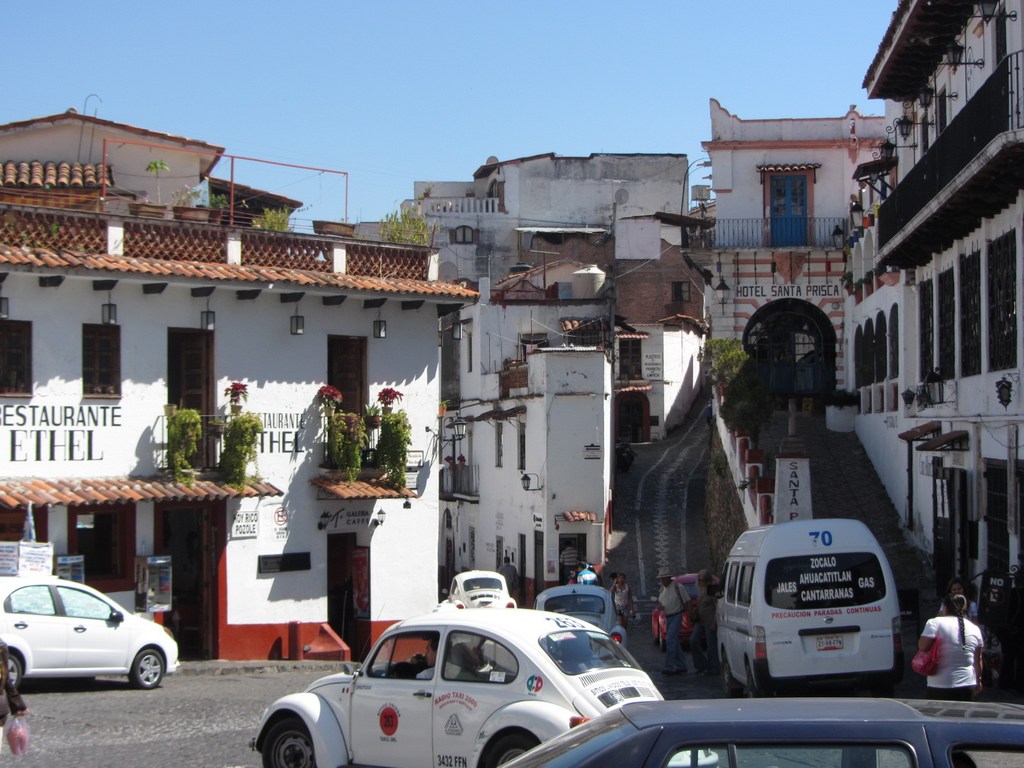
Typical Street - Taxco, MexicoThe government has designated it a heritage site. I’m not sure if that is the official name or not, but the result is that all the houses and business have to maintain that colonial appearance – circa 15-1600s. There are no neon or other lighted signs, only black lettering on the whitewashed walls  allowed, even at McDonald’s (though they managed to put golden arches graphics on the inside of the windows, how very out of place they look in this snapshot out of time.)

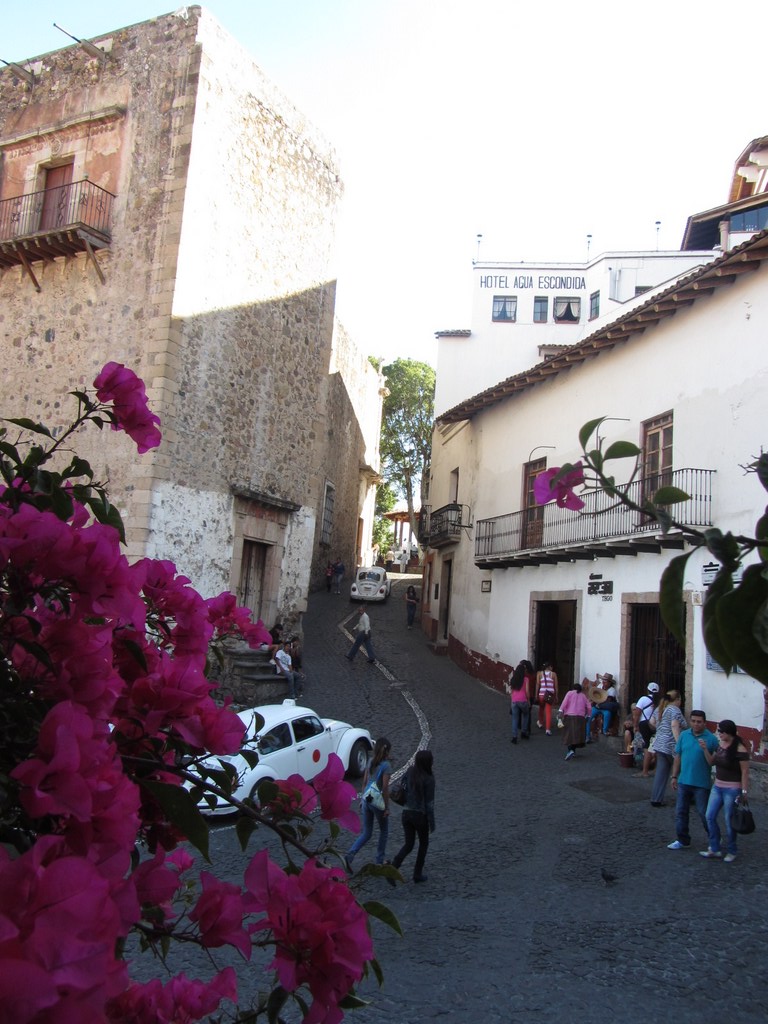
Plazuela - Taxco, MexicoBuilt on and surrounded by several mountains, where they mine silver, cobblestone roads zig, zag, and  wind steeply up and down the mountainside. Streets are narrow, the equivalent of an alleyway in the US, and accommodate moving cars, trucks, mini-van buses, people walking,  steps into houses and shops, and sometimes parked cars as well —  all at angles that would give you vertigo. It is an adventure to say the least to walk up or down the street trying to avoid rocks and potholes and have a delivery truck come along, causing you to brush along the wall of the houses with mere inches to spare, or a taxi swing far to your side of the street in order to make a tight  (280 degree) turn, then jam it into low gear and growl its way up the hill. When you see them do this, or you are riding in a combi (a shared ride van) shuddering up a steep hill, you wonder how it is possible. It is even more interesting watching the taxi dances, when one is coming down the hill and another wishes to go up — somehow they all manage though.

Winding streets - Taxco, MexicoAs with most of Mexico, the cars spew fumes. Thankfully my accommodations are on the 4th floor, above it all; I usually go out early, retreat to my room mid-day for siesta or work, and go out again in the early evening when the traffic dies down, or I just sit on my patio and enjoy the quiet, the breeze, and the beautiful view. I have a fabulous room in a private home with a private bath, hot and cold running water ( luxury in these parts), a balcony overlooking the alley on one side, a patio on the other side overlooking the valley between three mountains, and a big king sized bed in between (must have been a sight watching them get that bed in here; had to have been lifted in from the alley below through the balcony door, since the steps to this level are a wrought iron circular stair that I have enough trouble negotiating with a little something in my hands.)  There is even an automatic washing machine for my clothes though I use the cistern water to run it, so I won’t run out of clean water for my bath.)  It is as good or better than a room in a luxury hotel especially since meals are included. And the bonus —­­  every morning I awaken to a view of the sunrise over the mountains from my bed. Bueno!!!

My Hostess, Irma

My Hostess, Irma

My hostess, Irma,  a sprightly and beautiful (inside and out) 70-year-old Mexican woman (a sister, who looks 50) does not speak much English and my Spanish, though better (I know many more words but have difficulty putting them together) is still woefully adequate for conversation. I muddle my way through with a little help from my  offline English/Spanish dictionary and translation program (Jibbigo) on my phone.  It is not perfect, sometimes the word for word translation makes no sense, but I try another word or phrase and eventually we get close enough. Irma thinks my “talking phone” is a little brusque; she calls it the Sergeant because it barks orders. Yet if I do not have my phone on me, she sends me off  to get it.

Zocolo at night - Taxco, Mexico

Zocolo at night

The weather here is beautiful — warm sunny days and cool nights. I (as most people, there is no where to park a car) walk everywhere unless we have far to go, then we take an autobus/combi, a large van fitted out with extra seats as a taxi that whisk around from place to place on a specific circuit. If the seats wrap around the outside of the vehicle (most do) and they are covered in plastic, it can be a wild ride if you are sitting sideways. I love to  walk the winding streets to the Zocolo (central square of most Mexican towns) of Taxco where the locals come to gather in the evening and shop the local fresh market, where you can get just about everything if  you look hard enough, and probably get lost doing so. It always amazes me what the local commercial market, sort of a mini-super Walmart grocery selling everything from soup to nuts literally (and I do not mean the kind you eat), even tires, plaster and pots and pans, and what it doesn’t. Certain things are only sold in specialty stores.

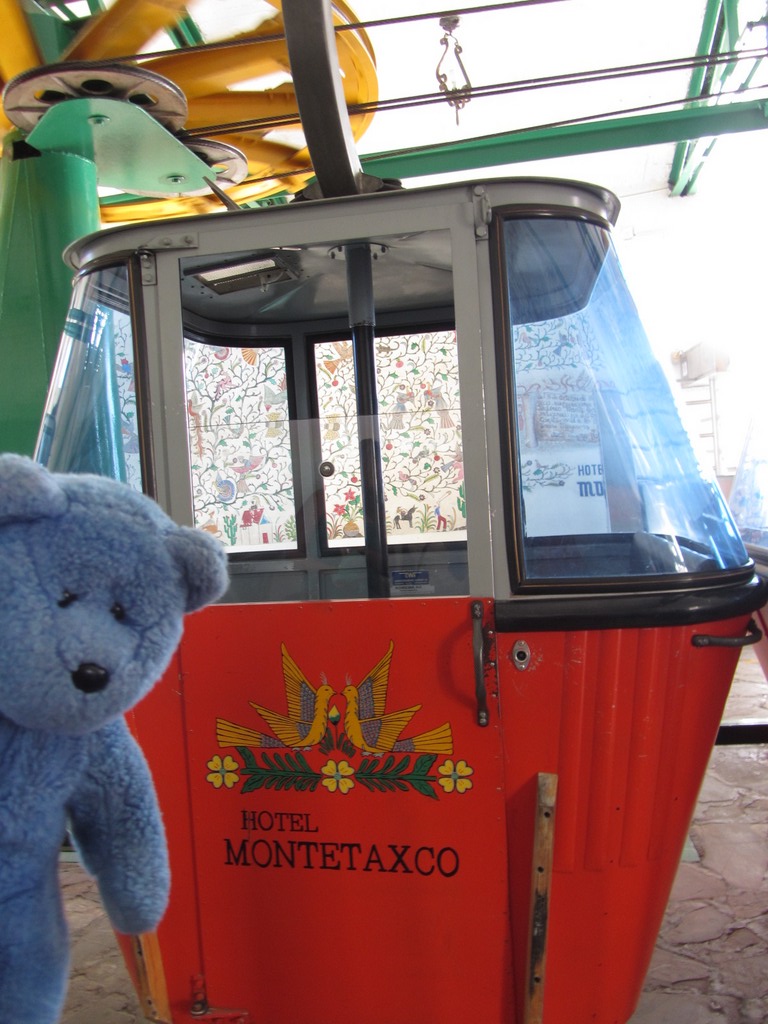
Teleferico - Taxco, MexicoIf you come here, you need to ride the teleferio (cable cars) to the fancy Hotel Montetaxco (resort and country club) on the mountain overlooking the city  where you will find spectacular views of the city and countryside. The ride up and down is pretty exciting too. Don’t come between Dec 12 and Jan 6  though or you may find “no room at the inn” as it is filled with “vacaciones.”

Overlooking Taxco

Mexican Traditions – Feliz Navidad

The holidays in Mexico are an interesting mix of indigenous, colonial, and modern somewhat international customs and traditions. I am told that the evening of December 24 is more important than the 25th here and that certainly seems to be the case.

Between December 12 (the Festival of Guadalupe, the Mexican virgin) and December 24, people are busy visiting neighbors delivering gifts of flowers and food, enacting las posadas, and feasting with family. There are solemn candlelight processions, raucous parades, wandering bands, pealing church bells, airworks (fireworks with just the boom), and, of course, children battering pinatas until treats shower down upon them.

Being a stranger to these traditions, I watch with curiosity.

I was puzzled by a group of people that gathered before the “la purisima virgen” (the purest virgin) shrine one night. Usually people gather before the shrines to pray to the virgin or ask blessings, but this group set up a TV for video and blasted American style country western music while a mass of human bodies, jumped , writhed, and shouted to the beat and the direction of a microphoned emcee. I wondered if the shrine was just a good landmark at which to meet because any religious significance escaped me.

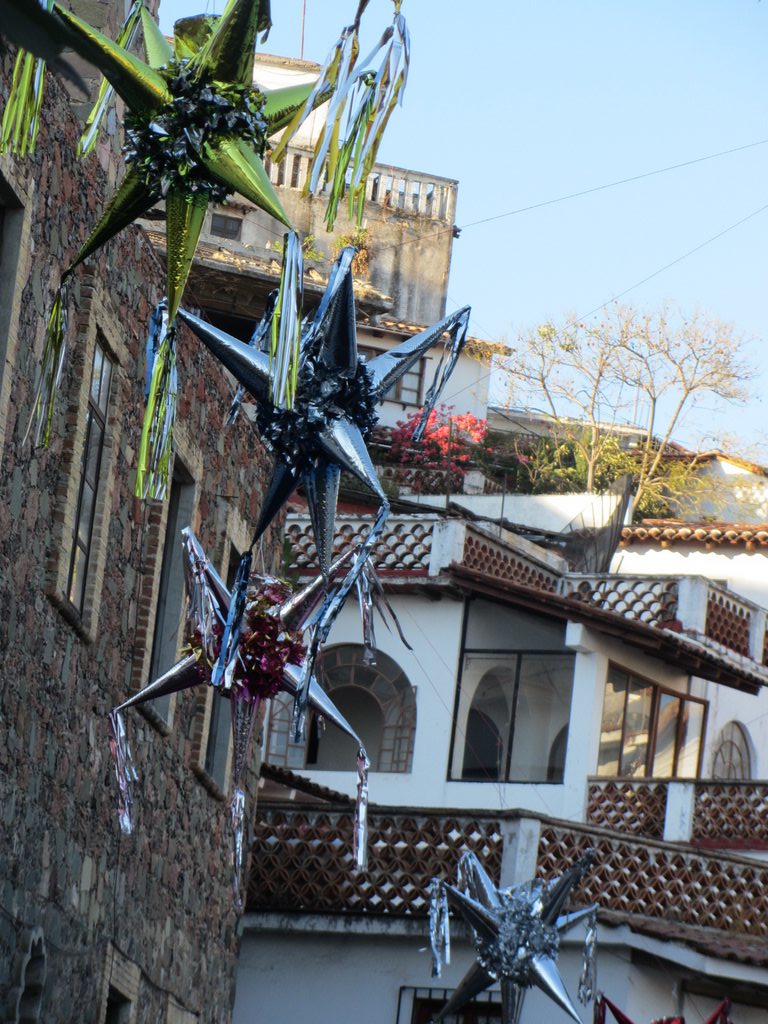
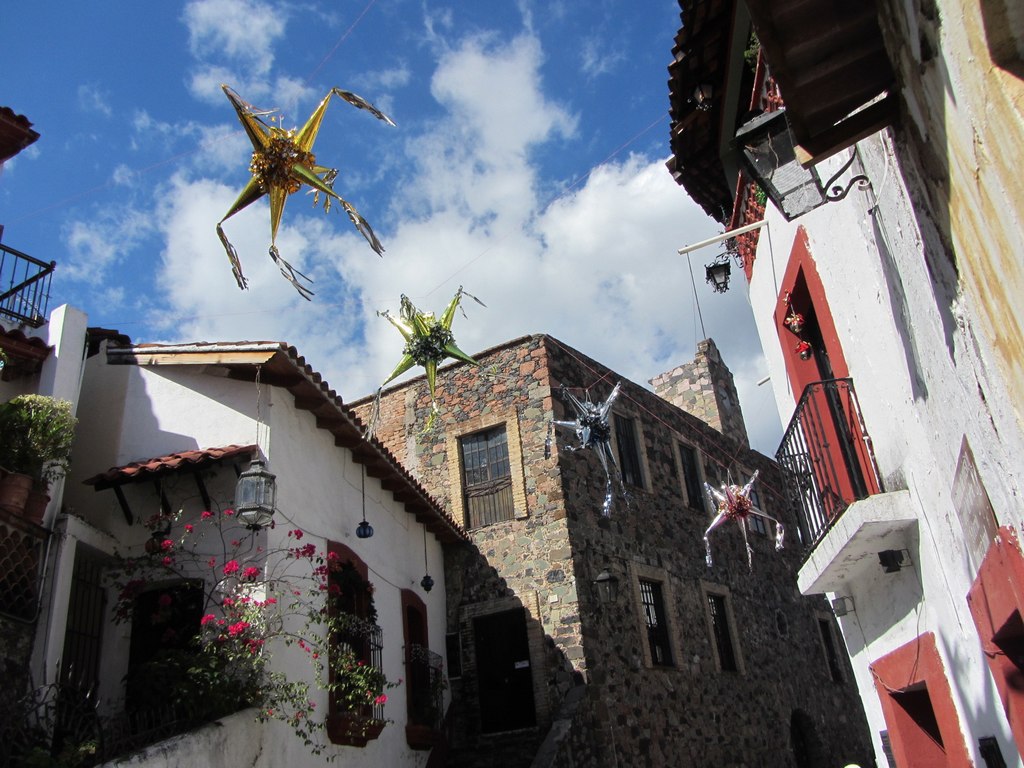
Pinatas- Taxco, MexicoThough there are signs of North American Christmas traditions, colored lights, Christmas carols (en espanol of course), and even decorated trees mostly in more well-to-do houses, the pinata is the traditional Mexican decoration and hangs everywhere.

Pinatas overhead- Taxco, MexicoThey are very different from the cartoon character type pinatas sold in the States. These have seven pointed cones that, in the Mexican Catholic tradition represent man’s struggle against the seven deadly sins; the beating with the stick represents the struggle against temptation and evil, and when it breaks the rewards of keeping the faith. As with many traditions, this one had its roots in the Mayan celebration of the birth of Huitzilopochtli, which was celebrated in mid-December, and was adapted into the Catholic traditions in this area by Augustinian monks in the late 1500s.

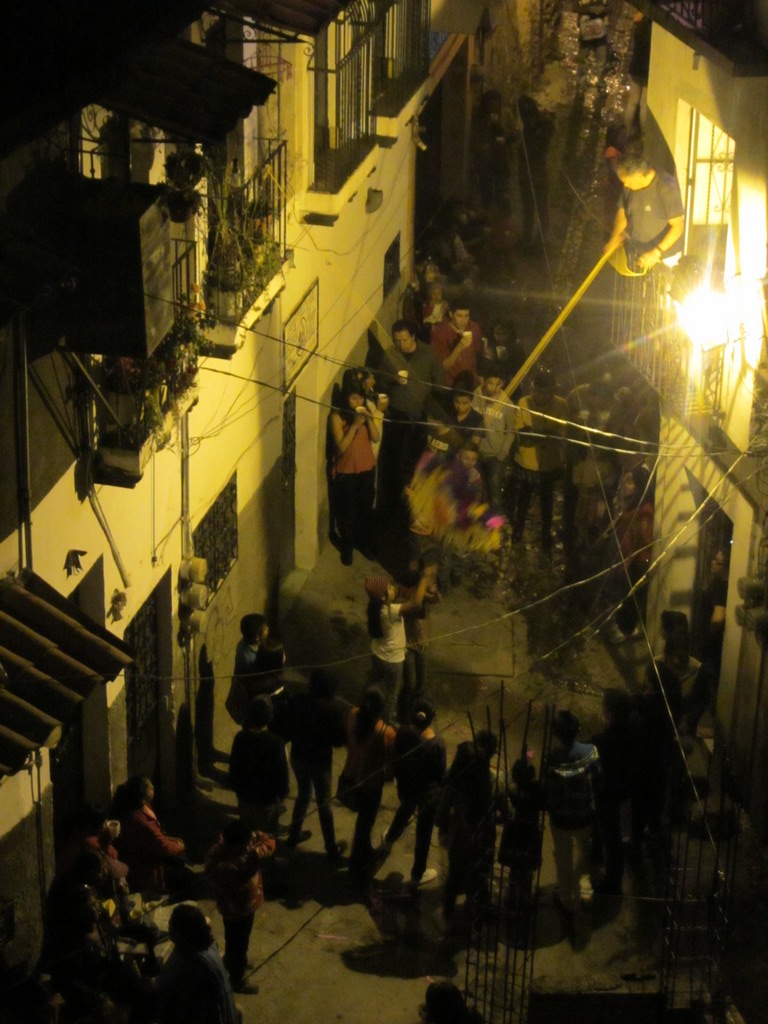
Breaking the pinata


Several nights, a group of children gathered in the alley behind my house to sing, shout, and take a whack at a pinata dangled above them by one of their parents. Their faith kept for another year.

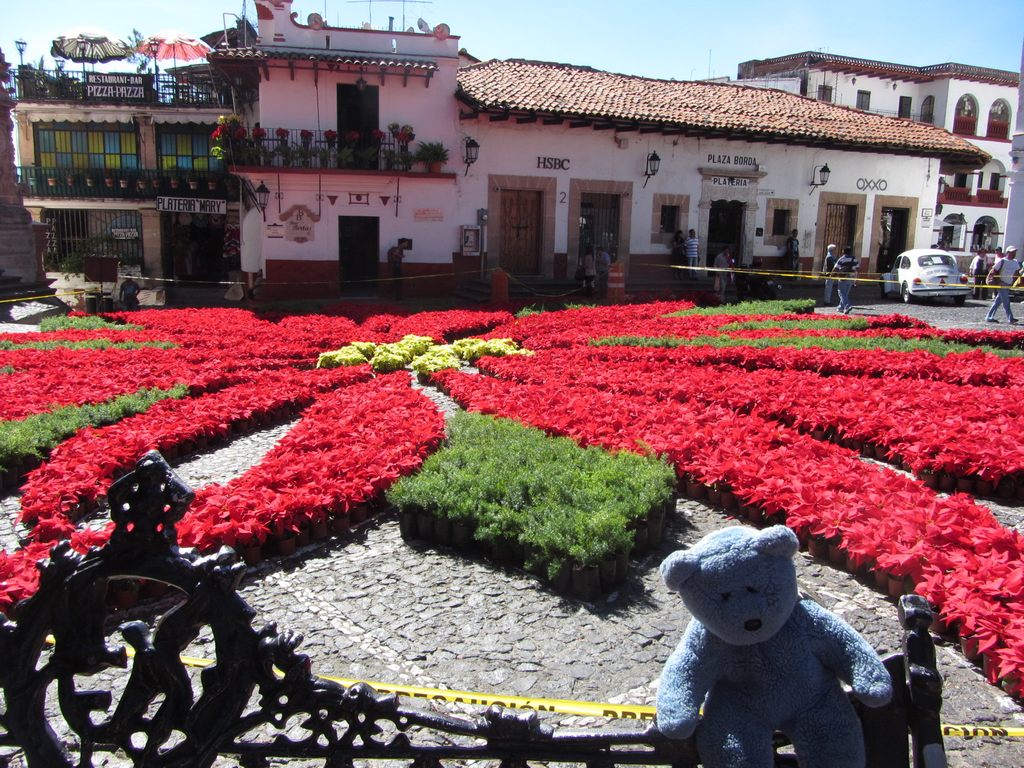
Zocolo_poinsettias - Taxco, MexicoPoinsettias are also prevalent. The Aztecs called them “Cuetlaxochitl;” the sap was used to control fevers (Mexican willow bark?) and the bracts were used to make a reddish dye. The first US ambassador to Mexico, Joel Roberts Poinsett, is credited with introducing the plant to America and since “Cuetlaxochitl” was so hard to say, as it became a popular Christmas decoration, the name was changed to honor him. Thousands of potted poinsettias, creating one giant poinsettia blossom, fills much of the street at the zocolo (the park/plaza at the center of town.) Though beautiful to look at, it hampers traffic (both foot and vehicle) even more than usual. With thousands of “vacaciones” in town, that is not necessarily a good thing; the narrow, winding, cobblestone streets are often filled, but the past couple weeks, the mob of bodies and cars often brings all movement to a standstill. Just the normal act of going to the market is nearly impossible due to the crowded conditions.

Zocolo - Taxco, MexicoThe zocolo is also the center of culture and entertainment. It is where everything important happens and where everyone gathers — to sit and feed the birds, play chess, see and greet friends, and watch the mariachi band serenade a special girl or teenagers posturing and giggling. This is also the center of entertainment both formal and informal — political presentations, musical performances, dancing troupes, and other activities.

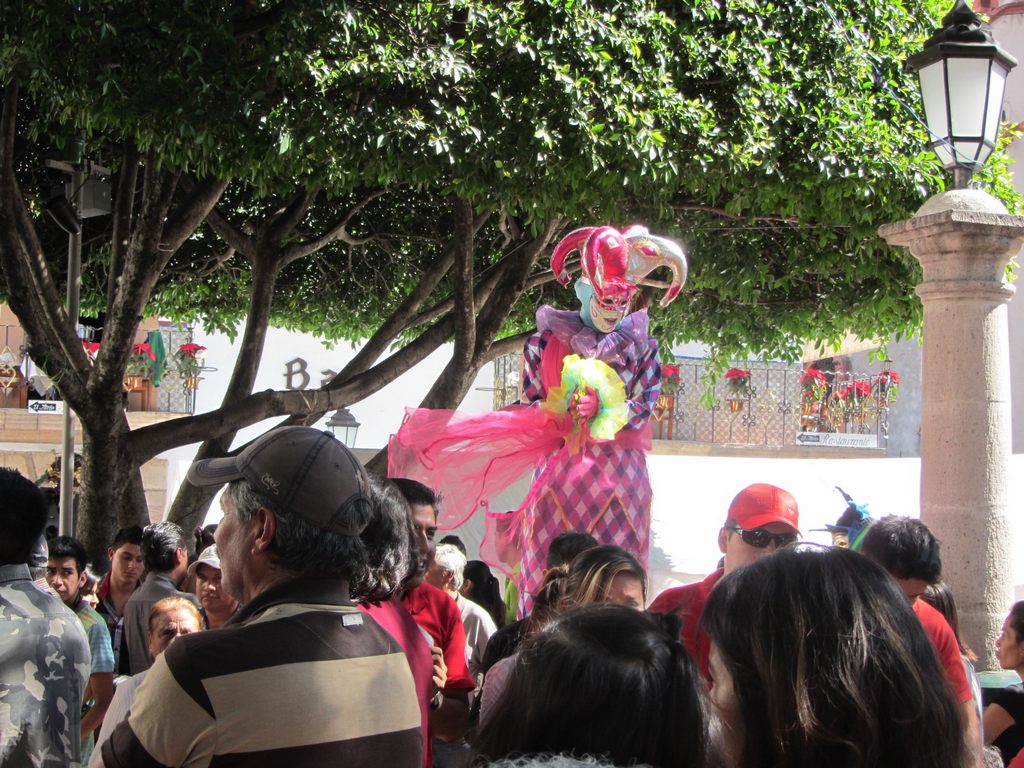
Harlequin on stilts, Taxco, MexicoSaturday afternoon, the local Rotary Club sponsored a fund-raising campaign that may or may not have been related to a pile of blankets, the Red Cross, and a shiny new car. There was a dance contest, some local kids performing traditional dances, minstrels, masked harlequins on 6 foot stilts, balloons, racing cars with nowhere to go so they just revved their engines, and more. I really felt for the clown, on stage in the direct and very hot sun, keeping up non-stop banter and dancing the gorilla song (whoot, whoot, whoot, whoot) with contestants, while readjusting his red nose every 30 seconds to keep it from sliding off. His partner was doing much better; she painted her red nose on.

As promised on December 12th, all the celebration came to a head last night, with many parties, much music, singing, and laughter floating through the air. There was also much shouting (pinatas?), cherry bombs, airworks, agitated dogs barking, church bells ringing, and generally noisy festivities into the wee hours of the morning. Today all is quiet. At least until Three Kings Day on January 6th.