Bricks and stones…

When I first arrived in Taxco, I watched in amazement as a one story building on the street side, which revealed a three story caved-in structure on the back began to be transformed into a beautiful multi-story edifice with covered balconies and beautiful views.

Quite the transformation right?

What is even more amazing is how the work is done — by hand! There are no cranes to lift bricks to the second, third, or higher floors, they are carried there a few bricks at a time. And if you need supplies delivered to an inaccessible location. Where there is a will there is a way.

Cement is mixed by hand, put into buckets, poured into the forms (which were also created by hand), and so it goes, day by day by day, little by little, one brick at a time until eventually walls, and doors, and balconies appear where there was only air.

This slideshow requires JavaScript.

It took three years, but now there are some mighty fine looking rooms (habitacions) at the Hotel de Mineral de la Taxco  ready for occupation.

Silence

Early morn, Taxco de Alarcon, Mexico

It felt like I was walking in a ghost town. Streets, that had been jam packed with food carts, street venders, and hordes of people, were suddenly empty. The whole city was silent except for the pealing of a single church bell.

After a week of processions, horns honking, drums beating, and hordes of people — penitents and their entourages and the thousands of onlookers that came for ” the show,” milling about, talking, shouting, and eating, the chaos of Seman Santa was suddenly all over.

It was very strange to hear no noise and to see no people, not even a taxi. It might have seemed that everyone was whisked off into some giant alien abduction until I realized that in addition to probably sleeping in or staying home for a quiet day with family, there was a time change.

It was the first Sunday in April and “Spring ahead” had come to Mexico.

The Silver Capitol of the World

Taxco is known as the “Silver Capitol of the World.” And for good reason, the area was rich in silver. The indigenous people mined it and created beautiful jewelry, decorations, and items for the home from this precious metal. Then the Spanish came and exploited the natives and the land to fill their own coffers. When the bulk of the silver was gone, the town went back to being a sleepy village (well sort of).

Then, in the 1930’s, an American named William Spratling came and reintroduced the lost art of silver jewelry making. Basing his designs on the original designs of the native peoples, he sold them to places like Tiffany and Cartier, and the silver industry in Taxco was reborn.

Now approximately 4 out of 5 adults are involved directly or indirectly with the silver trade. On weekends the streets teem with vendors offering their wares from nearly every nook and cranny and visitors looking for a bargain. It is chaos with a capitol C.

However I noticed a big change this year. Due to the high price of silver, the Silver Capitol of the World is fast becoming the brass and copper capitol instead. I wonder how much longer the artisans that I frequent can afford to produce pieces made from semi-precious stones and silver.

Here is a sampling of some of my finds this year.

This slideshow requires JavaScript.


In addition to the all silver jewelry, the mixed media pieces like in the slide show that I favor, there is the “costume” jewelry made mostly of beads but still strung together with handmade silver links, like these:

Tostadas

If you have ever eaten a tostada, you know that it can be a challenge.

You have a toasted tortilla, piled high with beans, meat, lettuce, tomato, crema, salsa, and cheese, possibly with a slice or two of avocado on top and you have to figure out how to bite into it without it cracking and crumbling into a heap. (Chips are so much easier.)

We had tostadas for lunch the other day. I was up for the challenge. I had neatly polished off one and started on my second when a couple of bites in, it suddenly cracked and fell out of my hand landing upside down on the placemat.

Alejandro, my hostess’ grandson, said, “No mas experiencia con tostadas?”

I heard that. Not only that, but I understood that.

Now what kind of thing is that to say?!!!!

We all had a good laugh, when he realized that I understood him.

Psst…the secret is to let the tostada sit a little while so the toppings have a chance to soften the tortilla a little before you try to bite into them.

Provecho!

And the band played on

…and on and on and on until the wee hours of the morning.

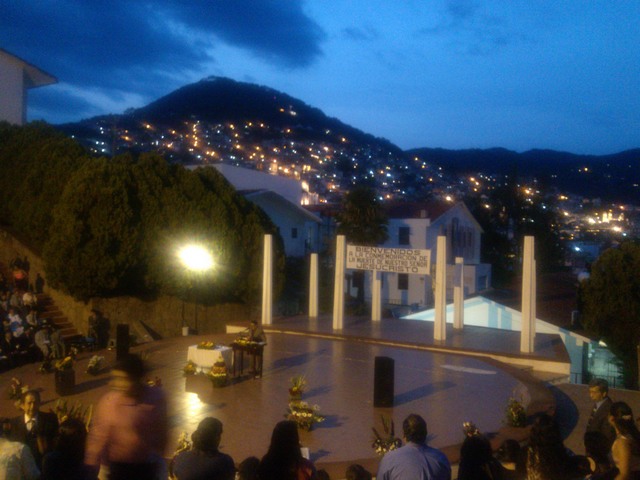
With all hoopla going on in Taxco last night and today, it might be easy to miss a quieter but much more important celebration happening down the street and in communities around the world.

Conmemmoracion, Taxco de Alarcon, Mexico

The night before he died, Jesus celebrated his last Passover meal with his disciples. He shared bread and wine with them as symbols of his body and blood to be poured out (with his death) on behalf of all those who put faith in him and the value of his offering his perfect human body as a ransom for our sins.  This act provides all with the hope of attaining life as God originally purposed, living forever in a Paradise earth. As he passed the bread and wine to his disciples, he said to them, “Keep doing this in remembrance of me.” (Luke 22:19)

Tonight, after sundown, is the anniversary of that momentous event. If you value the ransom Christ paid for our sins, I invite you to attend the commemoration nearest you. To learn more and for a full list of locations in communities near you, around the world, click here.

Millions around the world will attend. Will you be one of them?

Mexican Traditions — Semana Santa — Taxco Style

Boom, Boom, Boom       Boom, Boom, BoomBoomBoom                                             

That is the sound of Semana Santa, “holy week,” in Taxco de Alarcon, Guerrero, Mexico — a spectacle like no other. Probably one of the most revered of all celebrations in Mexico, Semana Santa, like many Mexican celebrations incorporates elements of pre-Hispanic cultures with Catholic traditions.

Starting on Palm Sunday, the Sunday before Easter, with the traditional blessing of the palms, most houses, shops, taxis, and combis are adorned with woven palm frond crosses and other designs. For days ahead of time, indigenous people sit  in the shade of church domes and on the side of the calles, weaving simple and intricate patterns in the stiff grass.

The streets, especially the main cobblestone calle that winds through town and past my house, are filled with the devout, proudly parading their church icons to the zocolo downtown. With its 1500s colonial period whitewashed walls, red tile roofs, and cobblestone streets, Taxco has the  atmosphere of a medieval fair, minus the castle walls, with makeshift silver shops, souvenir and food stands popping up everywhere there is an empty room or a few feet of space.

Every night there is a procession or more than one. Don’t even think of heading downtown unless you are willing to walk the miles jostled by the crowd — no  vehicles of any kind are allowed, not even taxis or combis.

On Monday, it is the procession of the virgins. Every church for miles, and there are a lot of them, bring their statutes to town and hand carry them on a bier, the mile or so from the edge of town to the center. The icon bearers are surrounded by candle holders, incense bearers, little children dressed as angels, girls dressed in white (think communion outfits), and a host of other helpers.  And let’s not forget those drummers and the occasional fiddler playing a tune that sounds oddly Celtic. The groups seem to be spaced out about every 30-40 minutes, so with my bedroom facing the action, just about the time I think it is safe to go to sleep, down the street another group comes with its boom, boom, boom cadence.

Tuesday, the observances that have been happening throughout the Lenten period, take on special significance. The street is quiet, but the churches are alive with people and their traditions of the season.

Wednesday, there is a special mass representing the disciples abandonment of Jesus and a procession of “lesser saints” — Cecelia, Joseph, and others are paraded through town.

Then, Maunday Thursday arrives and it is chaos everywhere, in preparation for the biggest procession of all.  Starting about 1 pm the contingents from out of town arrive. Cars, open pickup trucks, and huge dump trucks, filled with parishioners hooting and hollering, roll into town honking that same solemn cadence.  There was even a group on motorcycles and sometimes groups come on horseback or bicycle.

People line the streets and throw buckets of water on the people in the trucks. The opposite of an American parade where the people in the vehicles throw candy to the spectators.

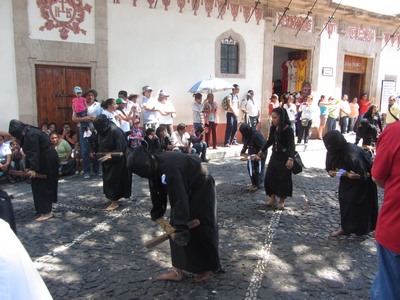
The night culminates with the most solemn procession of all — that of the penitents. Dressed in black robes, a horse hair belt, and their faces covered by a hood to conceal their identity, they gather along with their own entourage of young children dressed as angels, older girls barefoot and dressed in white dresses and veils, and an assortment of assistants. Of course, their patron saint is carried along for blessing.

Taxco appears to be one of the last remaining places where the three brotherhoods, the Animas (or Bent Ones), the Encruzados (the crossed), and the Flagelantes (Flagellants) reenact events from Jesus’ last day on earth in such a strict fashion.
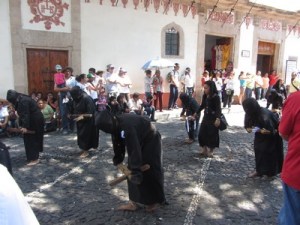
Animas (the Bent Ones), Taxco de Alarcon, Mexico

The Bent Ones, walk bent over with chains around their ankles and candles or small crosses in their hands. This being the only group that accepts women, you will often see a nunnery of penitents walking as a group.
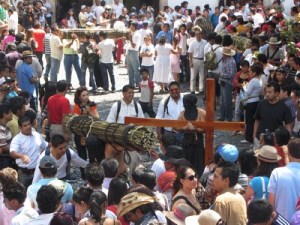
Flagelante, Taxco de Alarcon, Mexico

The Flagelantes carry a rosary and  a 6-7 foot wooden cross, representative of Jesus’ final walk to Gogotha. When the procession stops, they hand off their cross, kneel, and whip their bare backs causing blood to flow. Most gruesome.
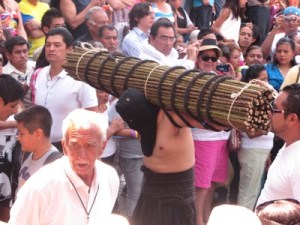
Encruzado, Taxco de Alarcon, Mexico

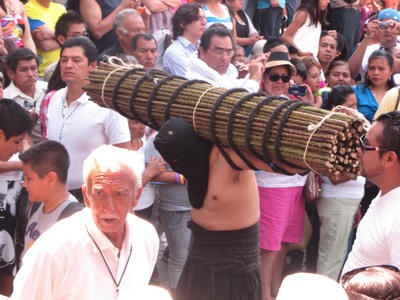
Then, there are the Encruzados who carry rolls of blackberry thorns, weighing up to 100 pounds, across their back and shoulders on outstretched arms (some sort of variation of the crown of thorns?) they might also carry a cross, rosary or candles in their hands.

On Good Friday,in the gold adorned Santa Prisca church, the praying statue of Jesus is mock captured, jailed, and crucified before the penitents. This is followed by another procession.

Saturday night they hold a candlelight vigil until midnight when it is announced that Christ has risen and then all is quiet.

A native told me, the first year I was here, that I had to “see the show” at least once. I have to say this much, it is an interesting show even if it keeps me awake all night most of the week.

Since I have a little computer issue I am going to link you to slide show from last year.

Crash Landing!

Sorry I have not been around the last few weeks. It is a long story but I will try to make it short.

I was happily adding pictures to my Blog post one day when all of a sudden my computer screen went black. No matter what I did, it would not let me reboot, restart, or anything. The modern version of the “blue screen of death.”

A friend, who works with computers and is trained as a tech, came over and could not get it to work either. Finally I had no option but to go without until I got back to the States 6 weeks or so later of  to take it to a computer repair person.

Now having a computer failure in the States where I speak the same language (well sort of) is difficult enough but trying to explain the situation in a language you barely speak is another thing altogether. Even my tech friend did not recommend I go anywhere in Taxco. Thank goodness for the father of my English students, a successful business man about town, who knew a skilled repair person and was willing to act as my translator.

To make a long story short, the hard drive failed. We were able to retrieve my data. Whew! I had just moved all my photos over to the computer to save space on my phone and make it faster and had run out of time to back it up. That could have been a disaster. Lesson learned, the hard way.

I now have a new hard drive but being in Mexico I have a Spanish version of my operating system (which is not the same) AND more challenging yet, an unfamiliar Web browser and Windows Office in Spanish.

Did I say, I don’t speak much Spanish?

The worst part of the situation is that I lost all my programs. So for the time being I am somewhat limited, especially in the adding photos to my Blog department. I am working on solutions that are accessible from here without the program CDs or proof of purchase documentation. Please bear with me.

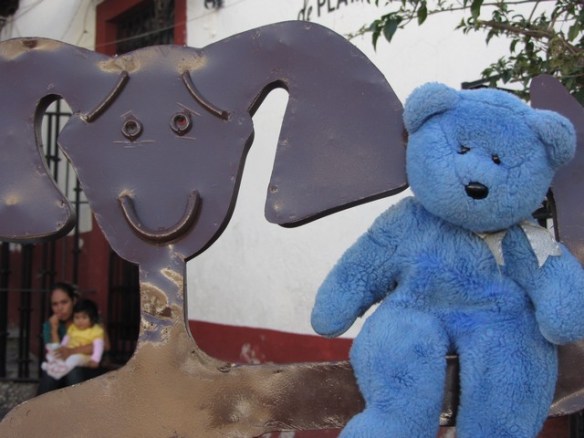
Blue Bear & Friend, Taxco, Mexico

You know, the concept of going paperless sounds great until something like this happens! And there is only so much you can do on/from a smart phone.

Do you have and electronic nightmare you wish to share?