Some days are diamonds, some days are stones

John Denver sang those words. He was not talking about sunrises but it is a good adage anyway.

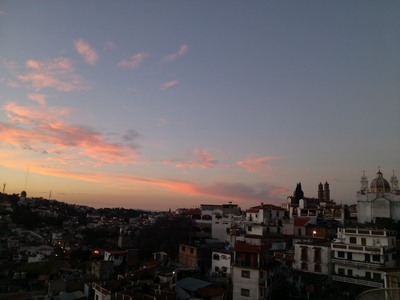
Each day awakens differently, some to sparkling brightness that illicit “oooohs” and “ahhs” as if watching fireworks. Others are more sedate in nature — cloudless days that offer a simple glow that grows from dark to light. This was one of those days.

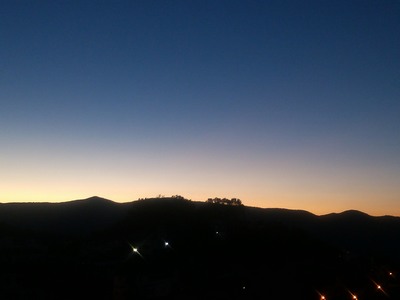
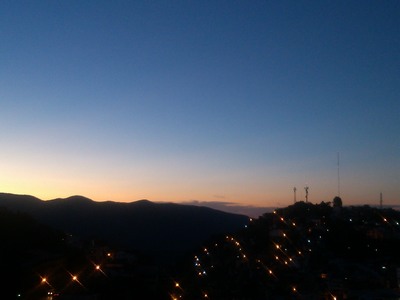
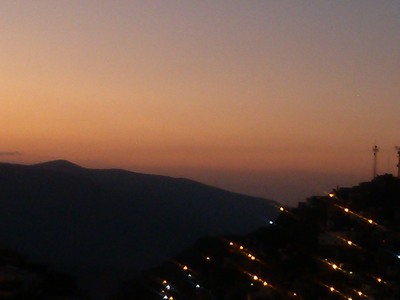
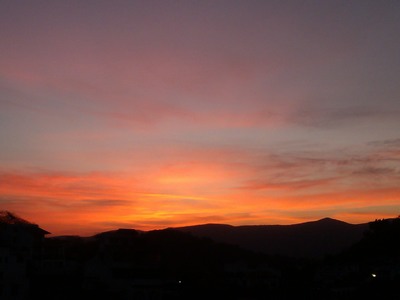
Sunrise, Taxco de Alarcon, Mexico Sunrise, Taxco de Alarcon, MexicoSunrise, Taxco de Alarcon, MexicoSunrise, Taxco de Alarcon, Mexico


Whether spectacularly colorful or a simple glow, each day’s beginning is still beautiful.

Sunrise: Taxco Style

I have been asked for sunrise pictures EVERY DAY! I am not sure I can grant that request but will give it my best shot! (OK you language junkies, noodle on that one — shoot who?)

Sunrise, Taxo de Alarcon, Mexico

I just love how the sky changes with each passing minute, growing in intensity before brightening. I am so thankful to have such a glorious way to start each day.

Watch this to see the whole show.

This slideshow requires JavaScript.

Just call me chicken

I stand corrected.

Recently I wrote about chicken feet in my soup.

I have heard from my readers and confirmed with my hostess that chicken feet are a delicacy to be savored not just here in Mexico but in other parts of the world as well. Chicken foot sculpture, market, Chilpancingo, Mexico

Now, I have eaten some strange things out of politeness but if offered chicken feet, I’m not sure I could eat one.

Reminds me of a scene in an Indiana Jones movie, where he was served monkey brain soup with eyeballs floating in it. Ewww!!!

Of course that is what they said when I told them that I had eaten alligator, raccoon, and rattlesnake.

And, no, they do NOT taste like chicken.

Curiouser and Curiouser

Isn’t that how Alice described the situation after falling down the rabbit hole?

The other night, it appeared that the sun was setting in the east, and this morning the sunrise was most visible over “el Centro” (downtown) to the west.

Have I somehow fallen down my own rabbit hole and awakened on another planet?

Sure is a pretty site though.

Sunrise, Taxco de Alarcon, Mexico

Taking Things for Granted – Agua

I admit it, I am guilty!

After being so careful about my water usage for months, when the pump was installed to send water to the roof, I was giddy with excitement. Water, was mine, whenever I needed it!

With the prospect of water at the turn of the handle, each and every day, I got a little extravagant. Not a lot, but I treated myself to a long, hot shower or two, or three — okay, a couple of weeks worth. It just feels so good to ease into the day under a stream of hot water.

Well, I paid for my extravagance (don’t we all eventually?) because I woke up this morning to a pitiful dribble which signaled the end to my showering, at least for now.

In investigating the situation, it seems that “la bomba esta defectivo y no esta trabajador.” (The pump is defective and it’s not working.) So it is back to carrying a pot of hot water up three flights of stairs. That will teach me.

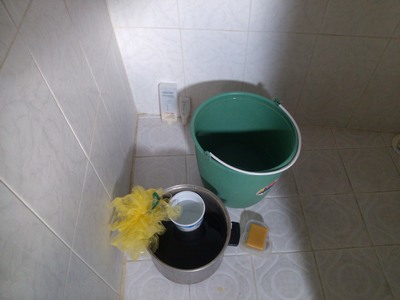
Bucket shower supplies

Showering essentials: hot water, cold water, and a calibrator….


Did you know that water weighs 8.34 pounds per gallon (at 62 degrees)?

Now that raises the question, does it weigh more at 200 degrees or less when it is frozen solid? After all ice floats.

Hmmmm, inquiring minds want to know.

Word Play

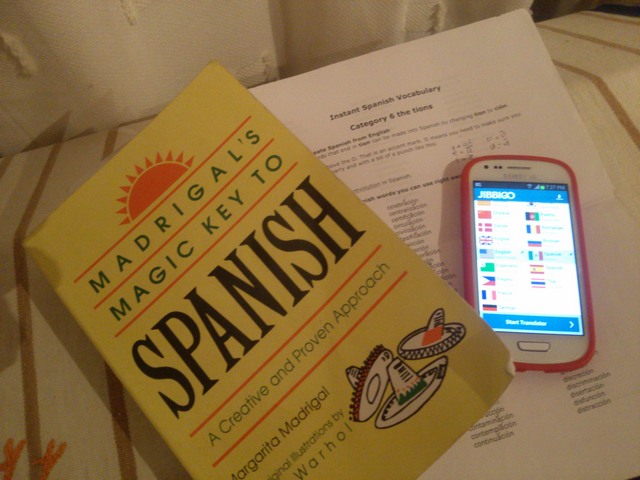
Tools for learning SpanishLast week I wrote about Spanish words that are confusing. I seemed to have struck a chord (Huh? Hope you didn’t hurt yourself.)

The responses are rolling in — with examples of words and funny expressions that we use to liven up our language but actually make no sense to someone from another county.

One friend wrote, ” Getting your head around a language is understanding the culture.” I agree. Only by understanding the background of the speaker can you truly understand what they are saying. For example, the adage attributed to Native Americans about walking a mile in another’s moccasins. To understand that, you first have to know what moccasins are.

My friend shared her frustration with learning Kayah, a tonal language native to Southeast Asia, spoken by a group of refugees where she lives in Texas. She wrote, “TOE is both yes and no. Yes is said high and no is said low. NGO is both tears or word. PREH can be person or again. If you use the wrong tones you can be telling them, “no again word,” which gets very confused looks, when you are trying to say, “Yes the person cried.”

Spanish has its share of tonal variations. Si‘, with an accent, means yes, but without means if. El with an accent on the e means he and el without the accent means the. Vino can mean come or wine.

Esta means this; accent the first syllable though (ESta) and it means this one (not that one), but place the accent on the “ta” and it is a form of the verb to be — esTA mal (it is bad.)

English has a fair share of tonal, or just plain confusing, words also. Read, for example — I read (reed) a book today, but I read (red) it yesterday. You, can mean one person or a group of people; with the exception of the deep South, we have no word for you all. And then there is here and hear.

And if you really want to have some fun, analyze the meaning of common idioms. What in one language is part of our cultural heritage and perfectly understood, makes another wonder “Que?”

Here are just a few:

Right now — How is now right? Can it be left (or wrong) too?
I’m under the weather — Do you need an umbrella?
He’s over the hill — Which hill?
See you — Well, of course, I am standing right here.
Time will tell — Time talks? Do you have a talking watch?
Hit the books — Why? What did they do wrong?
Feel free — At no cost? Great! But feel what?
Knock it off — What do you want me to knock off?
Go figure! — Figure what?
Get on the ball  — It keeps rolling out from under me.
Go fly a kite — But it’s storming!
Day in, day out — How is that?
Look up (something) — If the book is on the lower shelf do I look it down?
To each his own —Own what?
Polished off — Your plate needs polishing?
Stand corrected — And if not corrected do I sit?
Run over — Won’t that hurt?
Cut him off at the knees — That must really hurt!
Noodle on those for a while.

Played this classic Abbott and Costello skit for my English students this week. It is the perfect example of how confusing the English language can be.

Don’t die laughing!

Sunrise — Sunset

I saw my first sunset in Taxco today. Since the sun drops behind the mountains long before it sets, seeing any color at night is most unusual.

But wait, the sunset (r) was in the exact same place as the sunrise (l) this morning!

“How is that?” I asked my friend. And she responded with “January is crazy; February more” which may explain the ups and downs of the weather but not why the sun is setting in the east.

Having no logical explanation of this phenomenon, I will merely share the photos of this morning’s sunrise with you. Enjoy!

This slideshow requires JavaScript.


Candles for Groundhog Day

It is the middle of winter and we humans have to have a reason to mark that fact. Though back home, Super Bowl commercials and the predictions of Puxatawney Phil or Jimmy (the Wisconsin ground hog) for a long cold winter or an early spring  are the topic of the day (though if you figure it out, both seem to be about 6 weeks away).

Here in Mexico, the holiday season is finally coming to an end with Dia de la Candelaria (Day of the Candles.) I cannot really add anything new so I am reposting this article from last year. If you have not seen it, the information is all new to you; if you have, I hope you enjoy the review. Or, just rent the movie and have a good laugh or two.

Dia de la Candelaria

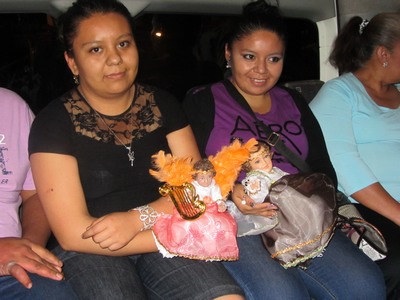
The brass bands are playing again and the airworks (those fireworks with only the boom) are going off again, and the combis are filled with people carrying around a doll wrapped up and cradled like it’s a real baby. What’s going on?

All this is in preparation for the last hurrah of the holiday season — Día de la Candelaria.

Officially known as the Feast of Our Lady of Candelaria or Candlemas, February 2nd marks 40 days after Christmas and thus Catholics celebrate in memory of the presentation of Jesus at the temple in Jerusalem (Luke 2; 22-39 ) and purification of his mother, Mary, after childbirth (a requirement of the Law of the Old Testament – Lev 12; 1-8).

Like many Mexican celebrations though, this feast day represents a fusion of pre-Hispanic traditions and Catholic beliefs. It appears to have originated in Tenerife (Canary Islands), southwest of Spain, in the early 15th century and spread from there.

The celebration may actually be a vestige of an old Pagan tradition, since this date coincides with the eleventh day of the first month of the ancient Aztec calendar and the beginning of the agricultural cycle when offerings to the gods of rain and clouds (tlaloques) would have been made to assure a plentiful harvest. In many rural villages the inhabitants wear corn cobs to church to be blessed.

Nino Dios, Taxco, MexicoIn Mexico, Dia de la Candelaria is an extension of the Christmas holiday season. (And I wondered why the Christmas decorations were still up in all their bedraggled splendor…)  On Christmas Eve a statue of the niño Dios (baby Jesus) is placed in the nativity scene; on January 6th, Three King’s Day, the child is brought presents from the magi or kings; and on February 2nd, the statue is dressed in fine clothes and presented and blessed in the church after which it is placed in a niche where it remains the rest of the year.
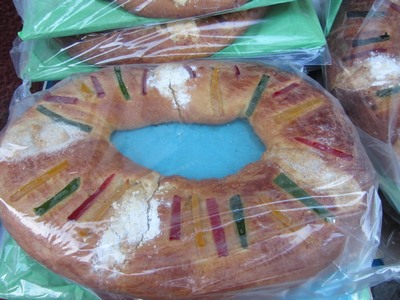
Rosca de Reyes

Rosca de Reyes

Mexican children receive gifts on Christmas Eve (the babe’s birth day) and on January 6th (the big day), when it is thought that the kings or wise men would have visited the Christ child. Then on February 2, the doll is taken to church and whomever found a toy baby in their Rosca de Reyes (wreath of the kings) bread on January 6th, hosts a Candlemas feast consisting of tamales and atole (a thick gruel drink).
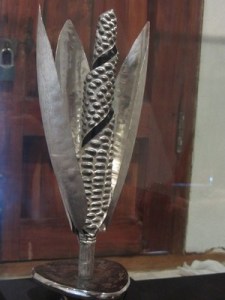
Silver corn statue, Mexico Both are predominantly made with corn; another link to Aztec ceremonies.

I find it interesting that February 2 also marks the mid-way point between the winter solstice and spring equinox which has long been thought to be a marker or predictor of the weather to come. In the US we call it Groundhog Day and according to tradition, if the ground hog sees his shadow, he goes back in his hole, representing 6 more weeks of winter; if not, spring is supposedly on its way.  Often Punxsutawney Phil (Pennsylvania) and our own Wisconsin groundhog, Jimmy, will compare predictions and hopefully agree that the long, cold winter will soon end.

Here are a couple of poems that show the connection between Candlemas and Groundhog Day.

From Scotland:

If Candle-mas Day is bright and clear,
There’ll be two winters in the year.

From England::

If Candle mas be fair and bright,
Winter has another flight.
If Candlemas brings clouds and rain,
Winter will not come again.

Groundhog Day Video cvrFor a few laughs, watch your local channel (library or Netflix) for the Bill Murray movie Groundhog Day.

What is your favorite scene?