Launderia

After nearly two months of being very careful about my water usage, washing shirts, skirts, pants, and undies, every day in the bucket of cold water that precedes the hot through the shower pipes, and airing out my sheets in the sunshine and breeze, I decided with more water at my disposal, it was time to do the laundry –  the sheets, comforter, my towel, all those big or heavy things that don’t easily fit into a bucket — although I have managed from time to time.

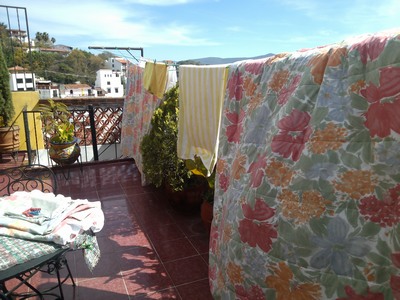
Laundry on the lineThough there is an automatic washer, it is not like in the States where you put in the dirty clothes, add soap, turn the machine on, and walk away, returning later to clean clothes. No, here you have to watch the machine.

First, you grab a hose and fill the tub of dirty clothes with water from the cistern, then you turn the washer on and let it wash. When you hear it start to spin the clothing, you intercept it before it starts to refill with rinse water and repeat the water from the hose procedure once more. Then you let it go through the rinse and spin cycle, and when it is all done, you hang the clothing on the roof top lines.

Even when I wash my clothes in the bucket, I have it easy, I can use the machine to spin the clothes, so I do not have to wring them by hand. It also happens that my roof top lines are attached to regular t-shaped clothes poles on the room sized balcony outside my room, so I have easy access.

At other houses, they wash and rinse the clothes by hand in a concrete “tub,” wring them out, and carry them to the roof, where they pin or string them from cords tied to the re-bar, sticking up from the floor below, and maybe the TV antenna. And, sometimes they just “hang” the clothes from whatever is handy including a railing, fence post, or even a shrub or tree.

No matter how you hang ’em, there is not much that smells sweeter than laundry dried in the sun and breeze.

Doing laundry in MexicoDo you hang your clothing outside and breathe deeply the scent of sunshine and fresh air when you bring them in?


Ya, no!

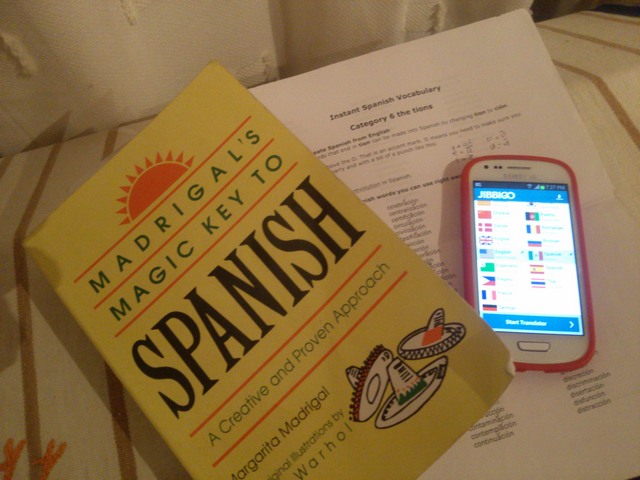
Tools for learning Spanish“Ya, no” is an everyday Spanish expression that is a bit of a conundrum to me.

Where I come from, “ya” is slang for yes and “no” is no, so to me, what the speaker is saying is “yes, no.” Yes, no, what? Which is it? Yes or no?

Even though I now know that “ya, no” means not anymore or no longer (literally “already, no” or “no already”), I still hear “yes, no.”

This is just one of a number of confusing expressions such as:

  • La manana de la manana – the first manana means the morning, and the second manana means tomorrow. I don’t know how many times I have tried to say I was going to do something in the morning and we ended up in a whole conversation about tomorrow? No, I meant today. Esta manana.Now really, you’d think they could come up with a different word for one of the two!
  • And why is it you say, “Buenas dias,” instead of Buenas Manana Heaven forbid you should say, Buenas dias (literally “Good day”) past noon. Are Mexicans so fanatical about their greetings because the listener would not know if you were wishing them “Good morning” or “Good tomorrow?”
  • There are similar words like caro and carro. The first means expensive, and the second is actually a cart but is used to say car. The difference is the two rrs are rolled or trilled, which I cannot do (yet anyway). So I could be talking about a car or something expensive, unless I am talking about a caro carro.
  • Words that look exactly like an English word but are pronounced totally differently really throw me. Try getting your mind around the word idea pronounced “e DAY ah” starting with a long E. Same word different pronunciation.Or sea – that is not sea as in  “sea to shining sea,” it is “SA ah” a form of  ser (to be.)
  • Perhaps my favorite word of all is pronounced “au REE ta;” don’t ask me how to spell it though, because I could not find it in any dictionary. I was hearing it all the time in conversation and asked what it meant and the answer I received was that it could mean: now, right this second, in a moment, wait a minute, in a short while, after a while, sometime, and even, perhaps, maybe, but not likely anytime soon. Or something like that.

Ya no?

What is an example of your favorite language conundrum?

Water Woes

In Mexico, you cannot just turn on the faucet and expect that water will flow out. The city sends water, on a schedule that only they know, to different neighborhoods at different times, when they feel like sending it. And sometimes, during dry spells or when workers are off during holiday periods, maybe not at all.

To make sure that they have water when they need it, everyone here has a cistern or a water tank or two or more, or both a cistern and water tank(s), so when the water “falls,” they can capture it for use later. Some in poorer, less serviced areas even fill their yards with various containers to capture rain water, lest they run out. And when the water “falls,” you capture as much as you can.

In this house, the city water fills the cistern for the rest of the house first, before it fills the tank on the roof. This is adequate most of the year, since my room is vacant, but can be a bit problematic when I am here. If the city does not send enough water to fill the cistern, the water never makes it to the water tank on the roof, and I have no water! I have to resort to carrying buckets up the spiral staircase for washing and flushing the toilet. A might inconvenient.

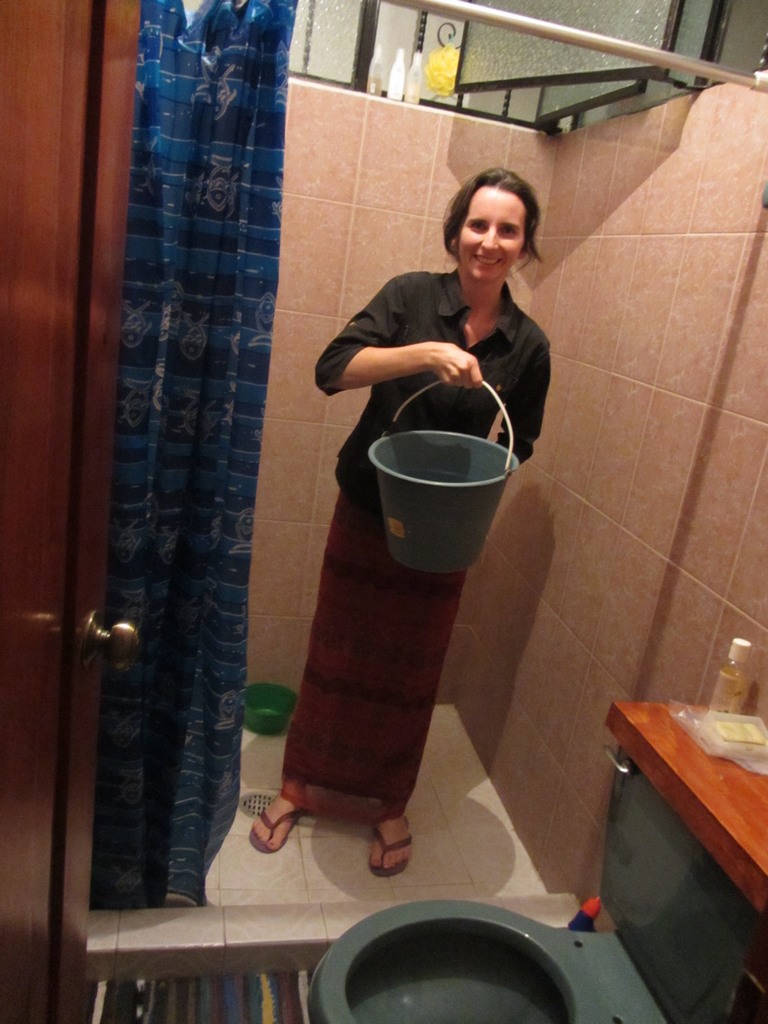
Ready to take a bucket shower, MexicoAs happens at least once every year, I ran out of water recently. No problem. I heated water on the stove, carried it upstairs, and took a bucket shower. Sounds a bit primitive, but actually a bucket shower is a very efficient and water saving way to bathe.  All you need is a bucket of warm water, a bowl, and your soap. You simply pour a bowlful of water over your body, soap up, and use the bowl again to rinse off.  You can even wash yesterday’s clothes or your underwear, all in a gallon or two of water. The average American runs more than that down the drain just brushing their teeth.

When I came back at noon the next day, I found the front door wide open (very unusual), pvc  pipe and tools all over the front room, and a burly plumero and several younger ones (most likely his sons) pounding, drilling, and running in and out.   Irma said something about water and Rotoplas (the water tank on my roof) but I didn’t fully understand her flurry of Spanish.

Shortly thereafter someone was pounding on my roof and I heard water running into the tank. Appears there will be more water and fewer dry spells in my future.

What is your “water sense?” Check here for 100 ways to conserve water useage.

How do your conserve water where you are?

Sunrise in the Mountains

If you have followed my adventures for any amount of time, you know that I love sunrise. To me, there is no better way to start the day than in the peacefulness of the early morn, as the birds awaken and begin to sing, hearing  the breeze rather than the rush of traffic, feeling the lingering coolness of the night as the day slowly brightens.

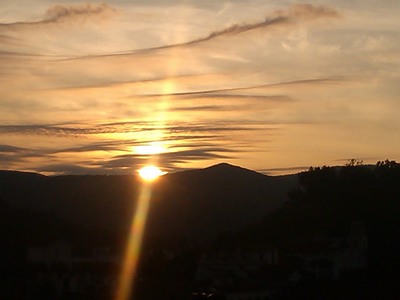
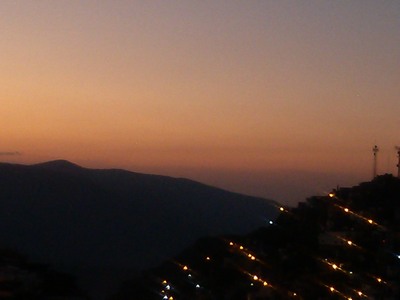
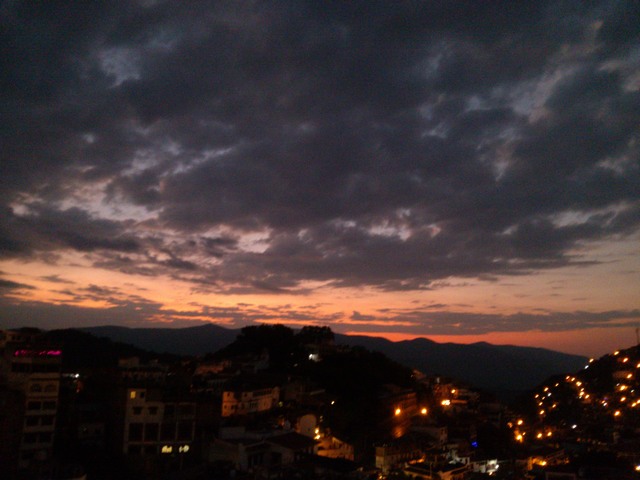
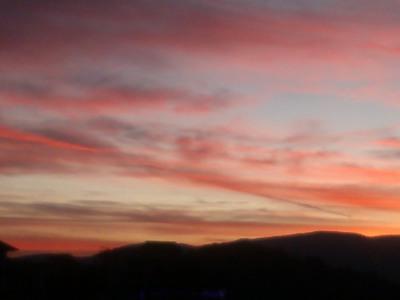
Sunrise over Taxco de Alarcon, MexicoThe variety of that early morning palette never ceases to amaze me. Vivid or pastel, cloud filled or mostly clear, the changes that occur between darkness and sun up are always a wonder to ponder.

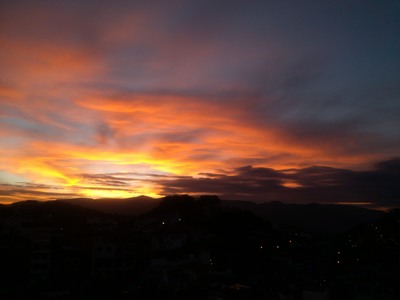
Sunrise, Taxco de Alarcon, MexcioSunrise, Taxco de Alarcon, Mexcio Sunrise over Taxco de Alarcon, MexicoSunrise over Taxco de Alarcon, MexicoSunrise, Taxco de Alarcon, MexcioSunrise, Taxco, MexicoLiving at the top of a four story house on a hill overlooking the city gives me a great vantage point for watching the sun come up. Being in the mountains though is a different experience than being at the seashore.

At the shore, the sun rises over the horizon culminating in that glorious golden globe painting the sky and turning the sea to a golden rivulet surrounded by diamonds.

Sunrise, Cocoa Beach, FloridaIt comes up right on time, when the almanac says it should.That is not true of sunrise in the mountains.

In the mountains sunrise is slower. By the time the sun actually breaks the horizon, the actual sunrise is long past — maximum beauty occurs a good 10-15 minutes before that golden orb lifts above the mountain tops. When it finally crests, all that usually happens is a mighty brilliance that just makes an already bright and beautiful day complete.

Occasionally though the clouds and the light work out just right, like this day:

Which do you prefer? The slow awakening of a mountain sunrise or the instant gratification of the seashore?

How do you greet the sunrise where you are?

Agua Verde

If you want a refreshing, and cleansing, good for you drink, try this traditional Mexican “agua de fruta” (fruit water.)

Green Water (juice drink)

A big bunch of parsley, washed and chopped, discarding any long thick stems (about 2 cups)*
A large cucumber, peeled and cut into bite size chunks (about 2 cups)*
1\3 of a pineapple, peeled and cut into bite size chunks (about 2 cups)*
2 Tbsp lime juice (1 large or several small)
1 1\2 quarts cold water In a 1/2 gallon pitcher

In a blender blend the parsley with 1\2 quart water and add it to the rest of the water in a 1/2 gallon pitcher. Blend the cucumber with some of the parsley water in the pitcher, strain through a colander into the pitcher. Do the same with the pineapple. Squeeze the lime(s) and add to green water. Stir well and serve. If you prefer a little sweeter, add a little sugar or mix with lemonade instead of water.

Best fresh, but drink within 24 hours.

Actually you can follow this procedure for most any juice drink. Just blend the fruit down to pulp, strain, and add to water. Sweeten to taste. Good combinations are papaya, orange and lime, guava and lime, watermelon, cantaloupe and lime or your favorite combination. The idea is to add to water to make the juice go farther and make it more refreshing by reducing the sugar content (and calories.)

* Ingredients are not exact, start with approximately equal parts of parsley, cucumber and pineapple, then adjust to your taste.

Cheese, please

The word of the day is “queso.” Cheese in English.

In Mexico they only have a few kinds of cheese and except for queso Oaxaca (Mexican string cheese) they are all pretty much the same, only varying in ripeness (aging) and, thus, firmness and stronger flavor. The way I, a gringo, see it is that they have the kind that crumbles, the hard kind either grated or whole, and Oaxaca. Little do I know!

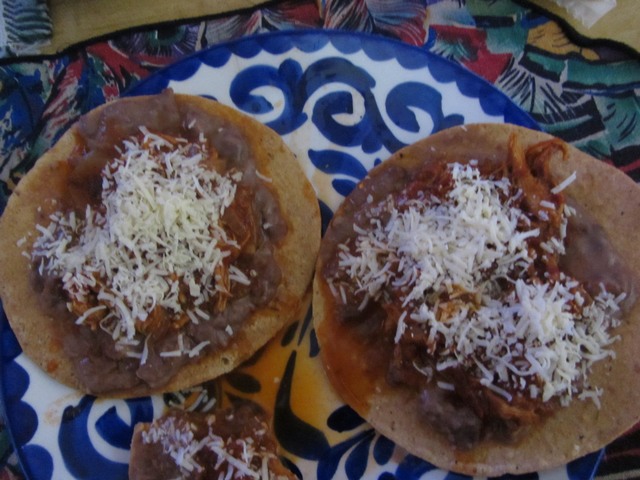
Once a week, a friend of mine who lives in Buena Vista, a small town near Taxco, comes to town bearing handmade cheese that everyone says is “the best.” I decided to get some for the house and was asked what kind I wanted. I knew I wanted Oaxaca (for quesadillas or just eating) and I wanted the kind that crumbles to put on tacos, tostadas, etc. so that is what I asked for.

My friend was apparently confused by my using the word crumbles (and I found out later, that he asked another American what I meant by that) and by text he replied, “Sorry I’m not sure which is the second one. What do you want to do with it? I know you want to eat it but how??”

I, thinking this is a simple request (after all, they only have 4 kinds of cheese), answered, “For tacos and such.”

Still confused about “what kind” of cheese I wanted, he told me he would send a message in Spanish and would I please show it to Irma and have her respond. But Irma, not having her “lentes” (glasses), could not read the message, so I handed my phone to her grandson to read and reply in Spanish.

Cheese stall at the mercado, Chilpancingo, MexicoA very lively conversation discussing cheese names ensued between them. I imagine, she just buys it, like I do, hard, soft or crumbly, from the cheese stalls in the “mercado” (market.) Finally, they settled on a couple kinds by name (manchego or criollo), then changed their minds and asked for cotija or criollo.

Thinking we had settled on the quantity and kind of cheese, I headed up to my room on the fourth floor. About the time I was taking off my shoes, I received another message. My friend wanted to know if they wanted “suave” (soft) or “seko” (hard) and told me that one kind came both ways and the other only came “seko.” So down the stairs I went to ask an “otro pregunta” (another question.)

Criollo seko being decided upon, my friend acknowledged the choice with a “Sorry now.”

This sent me into peals of laughter. He was not the one to take 20 minutes to figure out what kind of cheese we wanted, nor was it his confusion to be sorry for. After saying so, I replied facetiously, “You only have a few kinds of cheese, how hard can it be?”

To which he replied, “Just a little hard. Don’t worry,” which had me laughing even harder.

I explained that, “In Wisconsin, we have hundreds of kinds of cheese to choose from. This is too funny!”

“jaja” (ha ha),he replied.

To be fair, the Mexican food guru at Epicurious says there are seven kinds of Mexican cheese. The kinds I know are:

Queso Fresco (Fresh cheese): Aged only a few days, it is soft and crumbly and can be used like feta. (I think this may be the kind I was thinking of.) I have since learned that cheese here is made from raw milk and because this cheese is not aged very long, it can possibly carry a bacteria that can make you sick. You should definitely cook it.

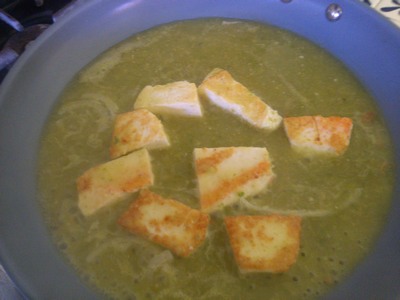
Chili con QuesoQueso Cotija: A hard cheese that is sold in rounds or grated from large blocks. The unique thing about this cheese is that it does not melt, it only softens, making it perfect for Chile con Queso – where you brown the cheese on a griddle, then serve it in chile verde sauce like soup. Yummy. The browned cheese is delicious all by itself too.
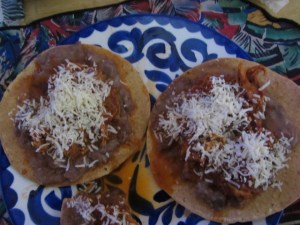
Tinga tosadas, Taxco, Mexico


Queso Criollo: Is a local cheese made only here in the state of Guerrero. It appears, by its use, to be similar in nature to Cotija. Better to crumble this kind than Fresco.
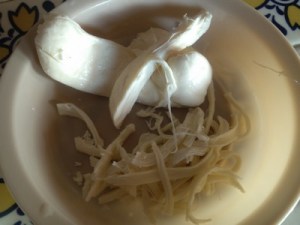
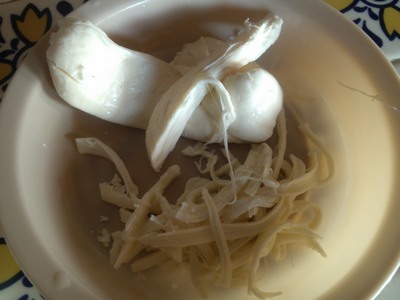
Queso Oaxaca, Mexico


Queso de Oaxaca:
My favorite, because we have nothing like it in the States, comes in broad strands that resemble string cheese, only softer. It’s unique texture comes from stretching the cheese as it is made. Pull it apart and put it on beans, tostadas, or soups, or because it melts wonderfully, in quesadillas. I will often buy a few pesos worth for an easy snack on the go.

Tostadas with crema, Taxco, MexicoAnd then of course there is that other dairy product — crema, a thick fresh or slightly sour cream (like the French creme fraiche) that is dolloped on tacos, tostadas, and in soups.


For a description of other Mexican cheeses and some delicious sounding recipes, see the Mexican cheese article in Epicurious.

Securidad

If you have been watching the news, you know that Guerrero state has been in a state of chaos recently. Some students, protesting the inequalities of the government’s placement of teachers (urban students favored over rural) were rounded up by police and disappeared. It is assumed that the then mayor of Iguala and his wife, who has connections to a drug cartel, ordered the police to transfer the students to the cartel inferring that some of the students had rival gang connections.

Well you can just imagine what happened.

The students are missing and presumed dead.

All over Mexico, and the world, people have protested these barbaric actions. Unrest is high and tempers are short.

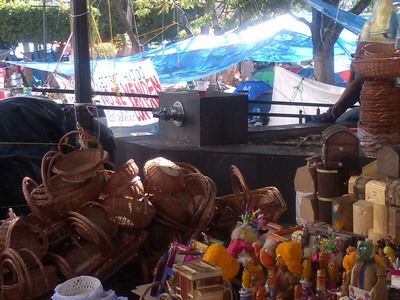
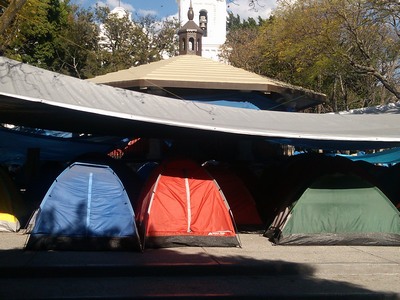
Protesters, tent city, Chilpancingo, MexicoProtesters have built a tent city, on the zocolo, in the middle of the market in Chilpancingo, the state capital. The government is on full military alert, which means there is a heavy Federal Police presence in Chilpancingo, Iguala, and other cities with universities (including Taxco), especially so during holiday periods when the students do not have classes.

Tent City, Chilpancingo, MexicoAlthough all is quiet here, the heavy military presence feels a little like Madison during the height of the Vietnam War protests.

With this unrest comes insecurity and people are more aware than usual of their vulnerabilities. It is not uncommon for people known to be successful or have wealth to build a “fortress” of protection around themselves. Now even the average Juan is doing the same.

Wall with broken glass on top, Taxco, Mexico

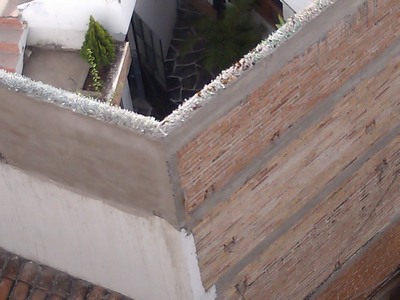
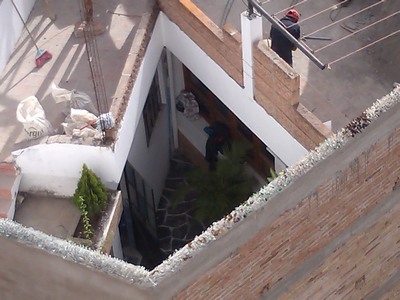
Houses already secured by solid metal doors, walled courtyards, and decorative ironwork over windows, are raising walls higher to make access to their homes impossible.


Wall with broken glass on top, Taxco, Mexico


Broken bottles are set into the cement on top not so much to deter birds landing and dropping gifts into the patio below as to keep possible intruders out.

(This used to be one of my favorite houses too. A lovely courtyard behind a one story wall, provided privacy yet was bright and airy. Now with its three story wall, it is more like a dungeon.)

Houses, Taxco, MexicoEven the little guy, between these two much larger, taller buildings has added onto his house, though his found materials construction and corrugated metal roof pale in comparison.

Yet, if anyone were to consider his humble abode worthy of breaking into, the resident turkey would give a gobble.

The Singing Rocks of Teloloapan

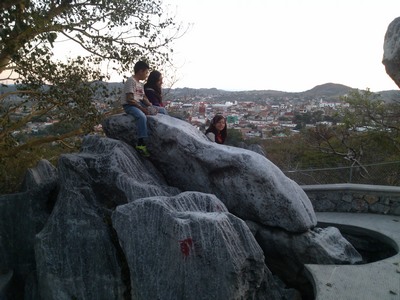
As the sun lay low on the horizon, we took a little side trip to a massive uplifting of gigantic stones that tower above the city. Some of the rocks in this area are known to “sing,” emitting a deep, resonant musical tone, like a large bell, when struck with another rock.

Singing Rocks, Parque de Campana, Teloloapan, MexicoThe locals have been coming here for centuries to make the rocks sing, and as with many such places of uniqueness, a legend has grown up to explain the phenomenon. Like Romeo and Juliette and so many other legends, this too has an element of unrequited love.

According to one version of the Aztec legend, on the death of King Azteca Ahuitzol, in order for his son, Tecampa , to succeed him, he had to conquer more land and bring more people into the empire. Tecampa conquered many peoples but when he came to Mexicapan, the chief, Texol, and his people battled with Tecampa for nearly a month.

Though Tecampa did not capture the city, he did succeed in capturing the springs that were the only water source, thus the people of Mexicapan were dying of thirst. Texol’s daughter, princess Na, who was always at his side, even in battle, feeling that the life of the warriors was more important than her own, volunteered to go and get water for the people, even at the cost her life.

With her maidens to accompany her, she set off for the pile of rocks where the  springs were located. When she arrived, she found a strong, young warrior, the king of the Aztecs, “contemplating the infinite.” He fell instantly in love with the beautiful princess, and granted her request for water for her people under the condition that she return the next day at sunrise where he would give her not water, but his heart.

She returned the next day and Tecampa asked her to go with him to the center of his empire near the mountain of Toluca, where together they would make his people happy.

But King Texol followed his daughter that day, and upon seeing her in the arms of his mortal enemy, his heart was broken and he angrily uttered a curse that the two young lovers be turned to stone. Immediately the two bodies were merged into one large stone, one seemingly holding the other, forever. Now when a stone is touched to the rock, the young lovers sing with tenderness.

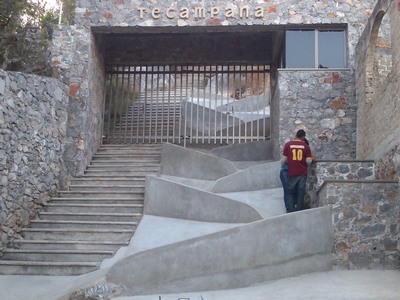
Now named Parque de Tecampana, what used to be just a local attraction, where you scrambled up the mountainside on a dirt path to climb the rocks and make your own music, the city has decided to create a real tourist attraction, with gates, paved paths, a playground, an amphitheater, bathrooms, and even exercise area at the top (though really, just climbing the hill is exercise enough!)


Main Entrance, Parque de Tecampana, Teloloapan, MexicoLove this accessible entrance, don’t you? There is no way you could push a wheelchair up this ramp, nor the pathway above; I don’t think even my friend Shelley’s electric scooter would make it. But if you ask, the locals, they will direct you to a back entrance that is a fright to drive but takes you to a much more level path to the singing rocks.

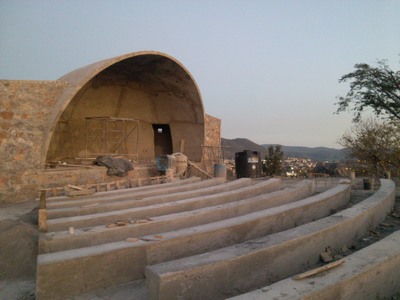
Amphitheater, Parque de Campana, Teloloapan, MexicoAmidst all this “beautiful,” new construction, is an old shack. It seems that the land is owned by a young man whose family has lived there for generations. The city wanted to buy the land to make it into an official park, but he refused — it was his ancestral home. Finally they made him an offer he could not refuse. Let them improve the area into a park and they will build him a better home and let him be the caretaker. A win-win — he and his ancestors, who may just be related to Tecampa and Princess Na, can continue to make the rocks sing, at least for his lifetime.

FYI — I did some research on what might make the rocks sing and came across an article by someone with some scientific background that determined that it is a combination of the type of rock, crystalline diabase, and the fact that the ringing rocks are supported on points of other rocks thus allowing them to ring rather than thud. If you want more information on ringing rocks, which occur in various places around the world, see this article about Ringing Rocks Park, in Pennsylvania. Or follow this link to hear them ring. (They kind of sound like the bell the trash collectors ring in Mexico.)