St. Augustine

St Augustine bannerI could not be in NE Florida without at least stopping at our oldest city, St. Augustine. This city dates back to the 1500s when folks like Christopher Columbus and Ponce de Leon (of fountain of youth fame) claimed this land for Spain. They were not the only ones, the French and English were here too, before the good ole USA either bought or fought their way to claiming all east coast lands from Maine to Florida.
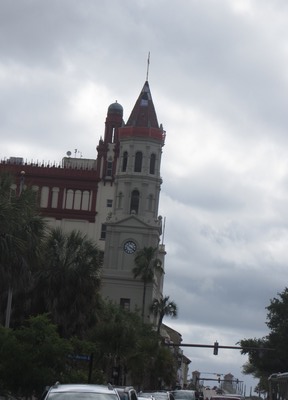
Castle-like turret, St Augustine, Florida

Back to the Spanish —

Pedro Menendez, the founder of the first European colony in what is now the US, landed here in 1565 (40 years before Plymouth Rock), met up with the Timucua people, indigenous to the area, and set about creating a thriving society that at once enriched the coffers of Spain and inadvertently decimated the native peoples (by giving them European diseases to which they had no immunity.) The city’s architecture still maintains a very Old World, Spanish feel, with tabby (a cement made with oyster shells) walls and tile roofs, at least in the historic downtown area. If you like history, you will find it in St. Augustine, in all its fascinating and commercialized glory.

Dominating the downtown is the old Hotel Ponce de Leon (now the home of Flagler College). Built in the Spanish Renaissance style and covering an entire city block, it was one of America’s most impressive resorts when it opened in 1888, and is no less impressive today with its beautiful courtyard and stained glass designed by Tiffany.

Across the street is another Flagler hotel, the Alcazar (now the city hall and home of the Lightner Museum), also in the Spanish Renaissance style, and a few steps away is Villa Zoyada, a 1/10th scale of a section of the Alhambra Palace in Spain.

If you tire of opulence and Spanish Renaissance architecture, the parklike square offers glimpses of life in the old city — the old market and well, along with tall ships in the harbor, the historic bridge of lions, not one but two historic forts, the city’s lighthouse, and numerous “attractions” that interpret the city’s history.

I was going to take a picture of the fountain of youth for y’all but since everything came with a price, this is as close as you get unless you come yourself.

Fountain of Youth, St Augustine, Florida


Holy Week – Mexican Traditions (a flashback)

Palm Sunday is past and Easter is coming up, that means bunnies and egg hunts here in the US but in Taxco it is Holy Week, something that a young man who lives there calls “a show you just have to see — at least once.” This one week of the year, people descend upon Taxco who take their Lenten penitence very seriously.

Hundreds of penitents come to town bearing the virgin statue from their parish, accompanied by an entourage of family, friends, townspeople, and all the confirmation girls of the village in their white dresses. The penitent’s intent is to show their devotion by “walking in the footsteps” of Christ (never mind that he never set foot in Mexico.)

With masks over their faces (to disguise their identity) and what I can only describe as a black sarong (I am sure they have a different name for it) tied around their waists, each chooses one of three ways to show their devotion — walk bent over with chains around their ankles holding candles or a small cross in their hands (usually women), carry a giant cross (usually adolescent boys), or carry a tree trunk sized roll of thorn stems over their shoulders forming a sort of human cross.

On the evening of Maunday (or Holy)Thursday, there is a procession of the shrines, when the main street winding through town is filled with these masked guys in black,bowing to their particular virgin, and self flagellating themselves with a fabric whip. Each penitent along with their entourages wind all the way through the main street of town from the la Garita statue to the church at the Zocolo (the park square in the center of town.) Don’t even think of trying to get anywhere downtown on that night, or the rest of the weekend for that matter, as thousands upon thousands fill the streets (the hotels, and restaurants – some of which rent and open a second seating area just for this week) to gawk and “see the show.”

Statues of penitents, Ex-convent, Taxco, Mexico

Statues of Holy Week penitents, Ex-convent, Taxco, Mexico

Saturday morning is the solemn procession. I am not sure how far these people walk (a mile or 2) all bent over or carrying their burden, but they do it barefoot on hot cobblestones, and if you are carrying the thorns bleeding. Each penitent is watched to be sure they carry their own burden, though they have assistants to guide them along (since those with the thorns cannot see where they are going, and, if the procession stops to lift the thorn rolls off the guys shoulders, while the bent can straighten up.

Around the Zocolo people throng to watch the procession, creating an avenue between rows of live bodies snapping photos, making videos, and cheering as each penitent reaches the church and receives communion. It is pure chaos but fascinating.

This slideshow requires JavaScript.

As my friend, said, if you are in Taxco during Holy Week, you must “see the show.”

Fat Tuesday — Mexican Traditions

Today is  Fat Tuesday. They are partying in Rio  (Carnival), New Orleans (Mardi Gras) and other places around the world — celebrating a night of excessive eating, drinking, and revelry before Ash Wednesday and the Lenten period of fasting leading up to Easter.

I have never been to Rio or New Orleans on Fat Tuesday, but having been on Ludwig Strasse in Partenkirchen (Bavaria), Germany, where it’s called fausching and involves cow bells, yodeling, and an excess of sauerkraut and beer, the processions and celebrations in Taxco are a tame in comparison. But what they lack in revelry and drunken debauchery, they make up for in duration filling the streets today, tonight, and every Friday leading up to the Thursday before Easter, when the really big procession begins (more on that in another post though).

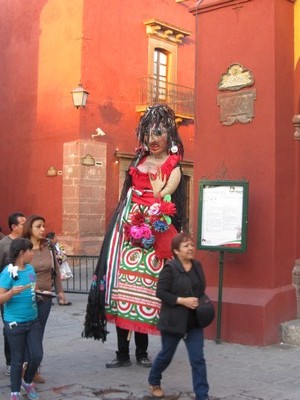
There are stilt walkers, costumed dancers representing indigenous traditions, and revelers of all ages — from school children who get off school early to dress in costume and parade the winding cobblestoned streets to adults forming informal street bands wandering through the city serenading the neighbors.

I am told that the processions — both solemn and fanciful, the parties at the churches, the fireworks, and the bands playing are all to remind people of the sacredness of the season, which is really ironic when a ragtag band comes over the hill playing “Roll Out the Barrel.”


Hoofin’ it

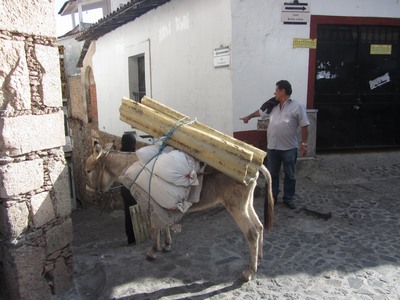
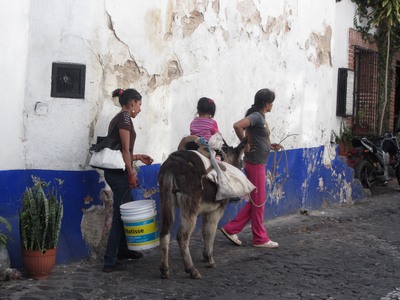
I went to the copy shop around the corner to make some copies. A few minutes later when I turned around to leave, I almost ran into a burro  “parked” right outside the door.  Oh my!

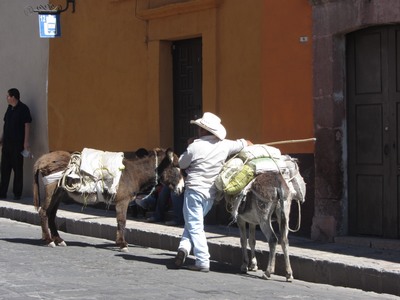
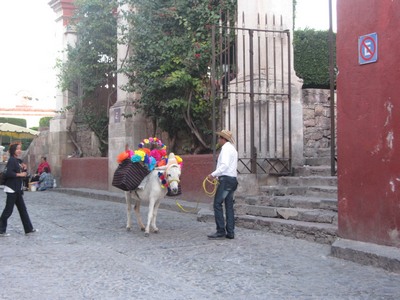
Delivery by mule., Taxco, Mexico It is not uncommon in some places to see burros on the street. When the streets are narrow and steep (they were originally designed for carts pulled by four-footed creatures, you see) sometimes the best way to get around  is four footed.

mule with child, Taxco, Mexicomules, Mexicomule, San Miguel de Allende

img_5591-qpr