Curiouser and Curiouser

Isn’t that how Alice described the situation after falling down the rabbit hole?

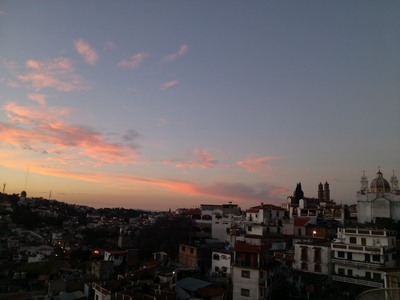
The other night, it appeared that the sun was setting in the east, and this morning the sunrise was most visible over “el Centro” (downtown) to the west.

Have I somehow fallen down my own rabbit hole and awakened on another planet?

Sure is a pretty site though.

Sunrise, Taxco de Alarcon, Mexico

Taking Things for Granted – Agua

I admit it, I am guilty!

After being so careful about my water usage for months, when the pump was installed to send water to the roof, I was giddy with excitement. Water, was mine, whenever I needed it!

With the prospect of water at the turn of the handle, each and every day, I got a little extravagant. Not a lot, but I treated myself to a long, hot shower or two, or three — okay, a couple of weeks worth. It just feels so good to ease into the day under a stream of hot water.

Well, I paid for my extravagance (don’t we all eventually?) because I woke up this morning to a pitiful dribble which signaled the end to my showering, at least for now.

In investigating the situation, it seems that “la bomba esta defectivo y no esta trabajador.” (The pump is defective and it’s not working.) So it is back to carrying a pot of hot water up three flights of stairs. That will teach me.

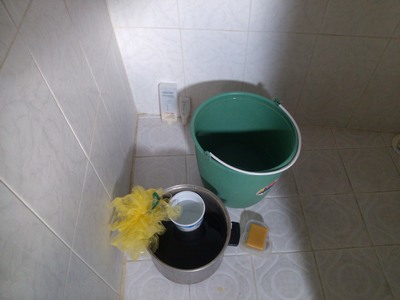
Bucket shower supplies

Showering essentials: hot water, cold water, and a calibrator….


Did you know that water weighs 8.34 pounds per gallon (at 62 degrees)?

Now that raises the question, does it weigh more at 200 degrees or less when it is frozen solid? After all ice floats.

Hmmmm, inquiring minds want to know.

Word Play

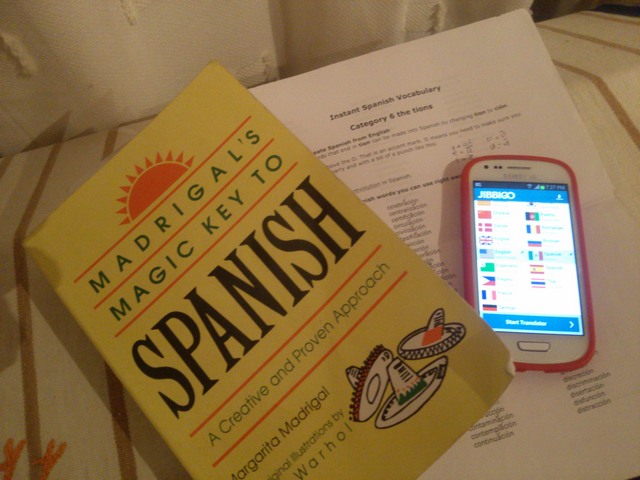
Tools for learning SpanishLast week I wrote about Spanish words that are confusing. I seemed to have struck a chord (Huh? Hope you didn’t hurt yourself.)

The responses are rolling in — with examples of words and funny expressions that we use to liven up our language but actually make no sense to someone from another county.

One friend wrote, ” Getting your head around a language is understanding the culture.” I agree. Only by understanding the background of the speaker can you truly understand what they are saying. For example, the adage attributed to Native Americans about walking a mile in another’s moccasins. To understand that, you first have to know what moccasins are.

My friend shared her frustration with learning Kayah, a tonal language native to Southeast Asia, spoken by a group of refugees where she lives in Texas. She wrote, “TOE is both yes and no. Yes is said high and no is said low. NGO is both tears or word. PREH can be person or again. If you use the wrong tones you can be telling them, “no again word,” which gets very confused looks, when you are trying to say, “Yes the person cried.”

Spanish has its share of tonal variations. Si‘, with an accent, means yes, but without means if. El with an accent on the e means he and el without the accent means the. Vino can mean come or wine.

Esta means this; accent the first syllable though (ESta) and it means this one (not that one), but place the accent on the “ta” and it is a form of the verb to be — esTA mal (it is bad.)

English has a fair share of tonal, or just plain confusing, words also. Read, for example — I read (reed) a book today, but I read (red) it yesterday. You, can mean one person or a group of people; with the exception of the deep South, we have no word for you all. And then there is here and hear.

And if you really want to have some fun, analyze the meaning of common idioms. What in one language is part of our cultural heritage and perfectly understood, makes another wonder “Que?”

Here are just a few:

Right now — How is now right? Can it be left (or wrong) too?
I’m under the weather — Do you need an umbrella?
He’s over the hill — Which hill?
See you — Well, of course, I am standing right here.
Time will tell — Time talks? Do you have a talking watch?
Hit the books — Why? What did they do wrong?
Feel free — At no cost? Great! But feel what?
Knock it off — What do you want me to knock off?
Go figure! — Figure what?
Get on the ball  — It keeps rolling out from under me.
Go fly a kite — But it’s storming!
Day in, day out — How is that?
Look up (something) — If the book is on the lower shelf do I look it down?
To each his own —Own what?
Polished off — Your plate needs polishing?
Stand corrected — And if not corrected do I sit?
Run over — Won’t that hurt?
Cut him off at the knees — That must really hurt!
Noodle on those for a while.

Played this classic Abbott and Costello skit for my English students this week. It is the perfect example of how confusing the English language can be.

Don’t die laughing!

Candles for Groundhog Day

It is the middle of winter and we humans have to have a reason to mark that fact. Though back home, Super Bowl commercials and the predictions of Puxatawney Phil or Jimmy (the Wisconsin ground hog) for a long cold winter or an early spring  are the topic of the day (though if you figure it out, both seem to be about 6 weeks away).

Here in Mexico, the holiday season is finally coming to an end with Dia de la Candelaria (Day of the Candles.) I cannot really add anything new so I am reposting this article from last year. If you have not seen it, the information is all new to you; if you have, I hope you enjoy the review. Or, just rent the movie and have a good laugh or two.

Dia de la Candelaria

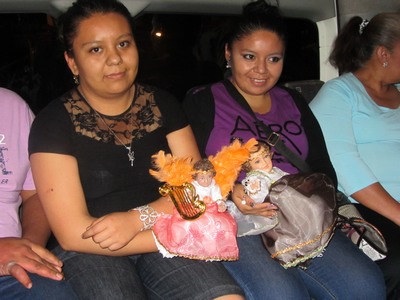
The brass bands are playing again and the airworks (those fireworks with only the boom) are going off again, and the combis are filled with people carrying around a doll wrapped up and cradled like it’s a real baby. What’s going on?

All this is in preparation for the last hurrah of the holiday season — Día de la Candelaria.

Officially known as the Feast of Our Lady of Candelaria or Candlemas, February 2nd marks 40 days after Christmas and thus Catholics celebrate in memory of the presentation of Jesus at the temple in Jerusalem (Luke 2; 22-39 ) and purification of his mother, Mary, after childbirth (a requirement of the Law of the Old Testament – Lev 12; 1-8).

Like many Mexican celebrations though, this feast day represents a fusion of pre-Hispanic traditions and Catholic beliefs. It appears to have originated in Tenerife (Canary Islands), southwest of Spain, in the early 15th century and spread from there.

The celebration may actually be a vestige of an old Pagan tradition, since this date coincides with the eleventh day of the first month of the ancient Aztec calendar and the beginning of the agricultural cycle when offerings to the gods of rain and clouds (tlaloques) would have been made to assure a plentiful harvest. In many rural villages the inhabitants wear corn cobs to church to be blessed.

Nino Dios, Taxco, MexicoIn Mexico, Dia de la Candelaria is an extension of the Christmas holiday season. (And I wondered why the Christmas decorations were still up in all their bedraggled splendor…)  On Christmas Eve a statue of the niño Dios (baby Jesus) is placed in the nativity scene; on January 6th, Three King’s Day, the child is brought presents from the magi or kings; and on February 2nd, the statue is dressed in fine clothes and presented and blessed in the church after which it is placed in a niche where it remains the rest of the year.
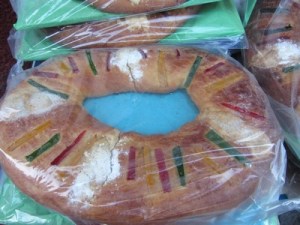
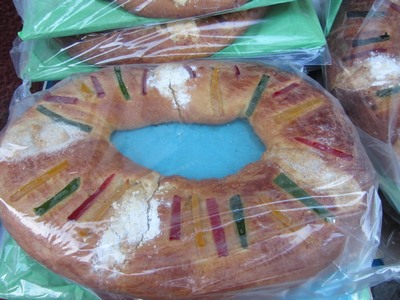
Rosca de Reyes

Rosca de Reyes

Mexican children receive gifts on Christmas Eve (the babe’s birth day) and on January 6th (the big day), when it is thought that the kings or wise men would have visited the Christ child. Then on February 2, the doll is taken to church and whomever found a toy baby in their Rosca de Reyes (wreath of the kings) bread on January 6th, hosts a Candlemas feast consisting of tamales and atole (a thick gruel drink).
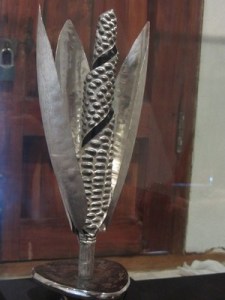
Silver corn statue, Mexico Both are predominantly made with corn; another link to Aztec ceremonies.

I find it interesting that February 2 also marks the mid-way point between the winter solstice and spring equinox which has long been thought to be a marker or predictor of the weather to come. In the US we call it Groundhog Day and according to tradition, if the ground hog sees his shadow, he goes back in his hole, representing 6 more weeks of winter; if not, spring is supposedly on its way.  Often Punxsutawney Phil (Pennsylvania) and our own Wisconsin groundhog, Jimmy, will compare predictions and hopefully agree that the long, cold winter will soon end.

Here are a couple of poems that show the connection between Candlemas and Groundhog Day.

From Scotland:

If Candle-mas Day is bright and clear,
There’ll be two winters in the year.

From England::

If Candle mas be fair and bright,
Winter has another flight.
If Candlemas brings clouds and rain,
Winter will not come again.

Groundhog Day Video cvrFor a few laughs, watch your local channel (library or Netflix) for the Bill Murray movie Groundhog Day.

What is your favorite scene?

Mexican Chicken Soup

The word of the day is “la gripa,” cold or flu.

Even though it is sunny and warm, it is cold season in Mexico, just as it is in the States. And just like everywhere, when one person brings home a cold or the flu, they generously share it with other family members.

When Irma was under the weather recently (now there is one of those “what does that mean?” expressions), I thought I would make chicken soup to help her feel better faster.

I was busily chopping onion and garlic while the chicken was starting to simmer in the pot when she appeared to fulfill her duty to make lunch. When she insisted on handing me the alphabet macaroni (something I was never fond of except for spelling practice), I had to explain that I was making “sopa Americana por la enferma” (American soup for the sick) or she would have nothing of it. Later when the hot, fragrant broth was set before her, she gingerly tasted it and declared it “muy bueno” very good.

Here, the treatment for what ails you — whether la gripa, a broken bone, anxiety, depression, or anything in between — is sopa made with alphabets in a tomato broth. Apparently, they believe in the healing capacity of alphabet soup as we do in chicken broth.  Science just might disagree though, as this article from Web MD points out.

It is not like Mexicans do not make chicken soup, as this photo of a recent lunch will attest to.

Mexican chicken soup

“Look mom, there’s a foot in my soup!”

I always wondered what they did with these.

Chicken foot sculpture, market, Chilpancingo, MexicoAs an amusing anecdote. An American friend of mine once told me about when he and his wife first moved to a small town in Mexico. Chicken feet were highly valued, and chicken breasts were almost given away. They said they never ate better.

To each his own.

My grandmother always preferred what she called the “Shteets,” those two tiny specks of meat “that jump over the fence last” (the tail bone). I was never really sure if she liked that part best or she was making sure that everyone else ate high off the bird while she was satisfied with a bite or two.

By the way, they do not eat the chicken feet, they just flavor the broth with them. (I stand corrected, many do eat them. Eeeeew!)

What is your favorite remedy for a cold?

Escaleras

The word of the day is escalera — stairs, in English.

Stairs, MexicoAs you might remember, I live on the 4th floor. To get from my room to the main level, I must descend one spiral staircase and two long sets of regular stone or tile steps. And, of course, for every trip down, I must also climb back up.

For some reason today was an especially rigorous stair climbing day. I went down for breakfast, up to get dressed, down to meet someone, who was late, so back up again, and down to meet them later…

And on and on it went — 22 trips altogether. And that does not count the set of stairs outside the house to reach the calle (street.)

Here is a sampling of some of my “favorite” Mexican escaleras. Some old, some new, some fancy, some not, and some when you come to them you just say, “Whoa!”

This slideshow requires JavaScript.

Who needs a Stairmaster when you have the real thing?!!!

Launderia

After nearly two months of being very careful about my water usage, washing shirts, skirts, pants, and undies, every day in the bucket of cold water that precedes the hot through the shower pipes, and airing out my sheets in the sunshine and breeze, I decided with more water at my disposal, it was time to do the laundry –  the sheets, comforter, my towel, all those big or heavy things that don’t easily fit into a bucket — although I have managed from time to time.

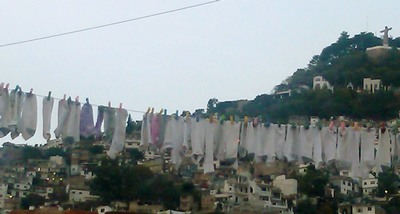
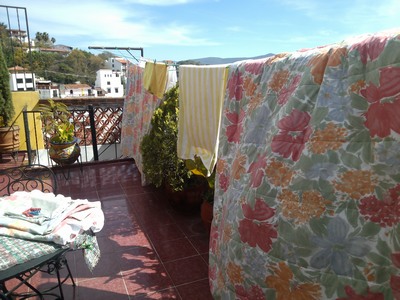
Laundry on the lineThough there is an automatic washer, it is not like in the States where you put in the dirty clothes, add soap, turn the machine on, and walk away, returning later to clean clothes. No, here you have to watch the machine.

First, you grab a hose and fill the tub of dirty clothes with water from the cistern, then you turn the washer on and let it wash. When you hear it start to spin the clothing, you intercept it before it starts to refill with rinse water and repeat the water from the hose procedure once more. Then you let it go through the rinse and spin cycle, and when it is all done, you hang the clothing on the roof top lines.

Even when I wash my clothes in the bucket, I have it easy, I can use the machine to spin the clothes, so I do not have to wring them by hand. It also happens that my roof top lines are attached to regular t-shaped clothes poles on the room sized balcony outside my room, so I have easy access.

At other houses, they wash and rinse the clothes by hand in a concrete “tub,” wring them out, and carry them to the roof, where they pin or string them from cords tied to the re-bar, sticking up from the floor below, and maybe the TV antenna. And, sometimes they just “hang” the clothes from whatever is handy including a railing, fence post, or even a shrub or tree.

No matter how you hang ’em, there is not much that smells sweeter than laundry dried in the sun and breeze.

Doing laundry in MexicoDo you hang your clothing outside and breathe deeply the scent of sunshine and fresh air when you bring them in?


Ya, no!

Tools for learning Spanish“Ya, no” is an everyday Spanish expression that is a bit of a conundrum to me.

Where I come from, “ya” is slang for yes and “no” is no, so to me, what the speaker is saying is “yes, no.” Yes, no, what? Which is it? Yes or no?

Even though I now know that “ya, no” means not anymore or no longer (literally “already, no” or “no already”), I still hear “yes, no.”

This is just one of a number of confusing expressions such as:

  • La manana de la manana – the first manana means the morning, and the second manana means tomorrow. I don’t know how many times I have tried to say I was going to do something in the morning and we ended up in a whole conversation about tomorrow? No, I meant today. Esta manana.Now really, you’d think they could come up with a different word for one of the two!
  • And why is it you say, “Buenas dias,” instead of Buenas Manana Heaven forbid you should say, Buenas dias (literally “Good day”) past noon. Are Mexicans so fanatical about their greetings because the listener would not know if you were wishing them “Good morning” or “Good tomorrow?”
  • There are similar words like caro and carro. The first means expensive, and the second is actually a cart but is used to say car. The difference is the two rrs are rolled or trilled, which I cannot do (yet anyway). So I could be talking about a car or something expensive, unless I am talking about a caro carro.
  • Words that look exactly like an English word but are pronounced totally differently really throw me. Try getting your mind around the word idea pronounced “e DAY ah” starting with a long E. Same word different pronunciation.Or sea – that is not sea as in  “sea to shining sea,” it is “SA ah” a form of  ser (to be.)
  • Perhaps my favorite word of all is pronounced “au REE ta;” don’t ask me how to spell it though, because I could not find it in any dictionary. I was hearing it all the time in conversation and asked what it meant and the answer I received was that it could mean: now, right this second, in a moment, wait a minute, in a short while, after a while, sometime, and even, perhaps, maybe, but not likely anytime soon. Or something like that.

Ya no?

What is an example of your favorite language conundrum?

Water Woes

In Mexico, you cannot just turn on the faucet and expect that water will flow out. The city sends water, on a schedule that only they know, to different neighborhoods at different times, when they feel like sending it. And sometimes, during dry spells or when workers are off during holiday periods, maybe not at all.

To make sure that they have water when they need it, everyone here has a cistern or a water tank or two or more, or both a cistern and water tank(s), so when the water “falls,” they can capture it for use later. Some in poorer, less serviced areas even fill their yards with various containers to capture rain water, lest they run out. And when the water “falls,” you capture as much as you can.

In this house, the city water fills the cistern for the rest of the house first, before it fills the tank on the roof. This is adequate most of the year, since my room is vacant, but can be a bit problematic when I am here. If the city does not send enough water to fill the cistern, the water never makes it to the water tank on the roof, and I have no water! I have to resort to carrying buckets up the spiral staircase for washing and flushing the toilet. A might inconvenient.

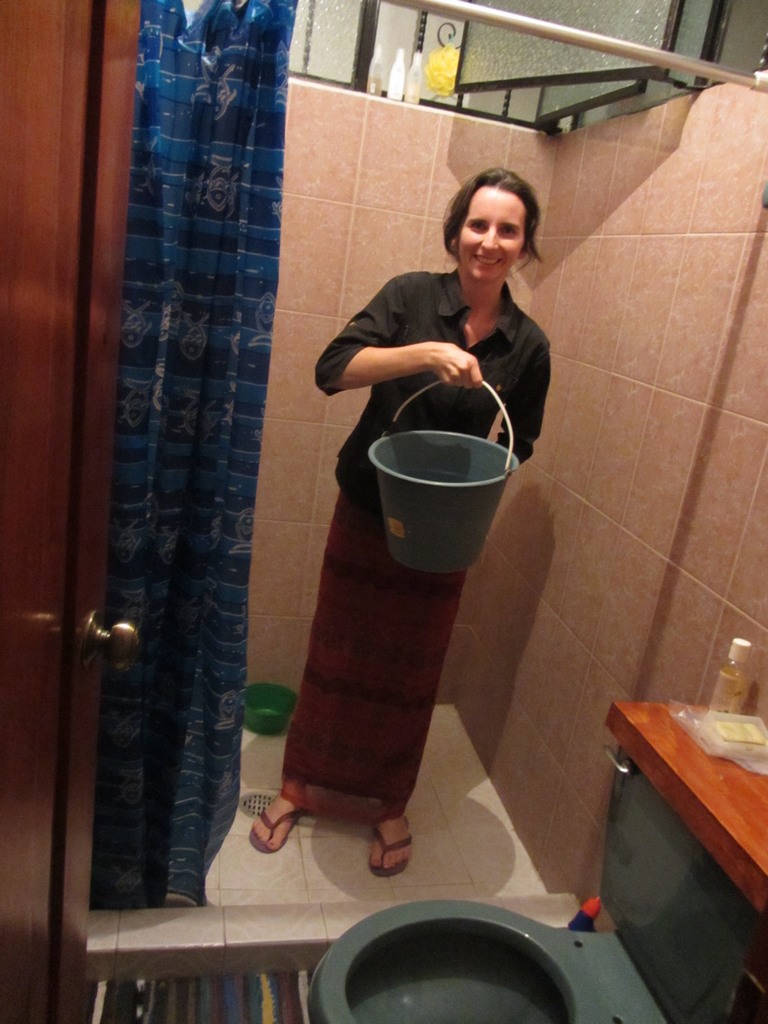
Ready to take a bucket shower, MexicoAs happens at least once every year, I ran out of water recently. No problem. I heated water on the stove, carried it upstairs, and took a bucket shower. Sounds a bit primitive, but actually a bucket shower is a very efficient and water saving way to bathe.  All you need is a bucket of warm water, a bowl, and your soap. You simply pour a bowlful of water over your body, soap up, and use the bowl again to rinse off.  You can even wash yesterday’s clothes or your underwear, all in a gallon or two of water. The average American runs more than that down the drain just brushing their teeth.

When I came back at noon the next day, I found the front door wide open (very unusual), pvc  pipe and tools all over the front room, and a burly plumero and several younger ones (most likely his sons) pounding, drilling, and running in and out.   Irma said something about water and Rotoplas (the water tank on my roof) but I didn’t fully understand her flurry of Spanish.

Shortly thereafter someone was pounding on my roof and I heard water running into the tank. Appears there will be more water and fewer dry spells in my future.

What is your “water sense?” Check here for 100 ways to conserve water useage.

How do your conserve water where you are?